Get Full Government Meeting Transcripts, Videos, & Alerts Forever!
Get email alerts on the State Of District topic
No spam. Unsubscribe anytime.
Superintendent delivers annual State of the District, highlights enrollment, achievement and student needs
Summary
At a regular meeting, the Carson City School District superintendent presented a data-rich State of the District overview covering enrollment trends, demographics, student achievement measures, attendance and behavior, staffing and capital needs, and rising family instability measured by McKinney‑Vento enrollments.
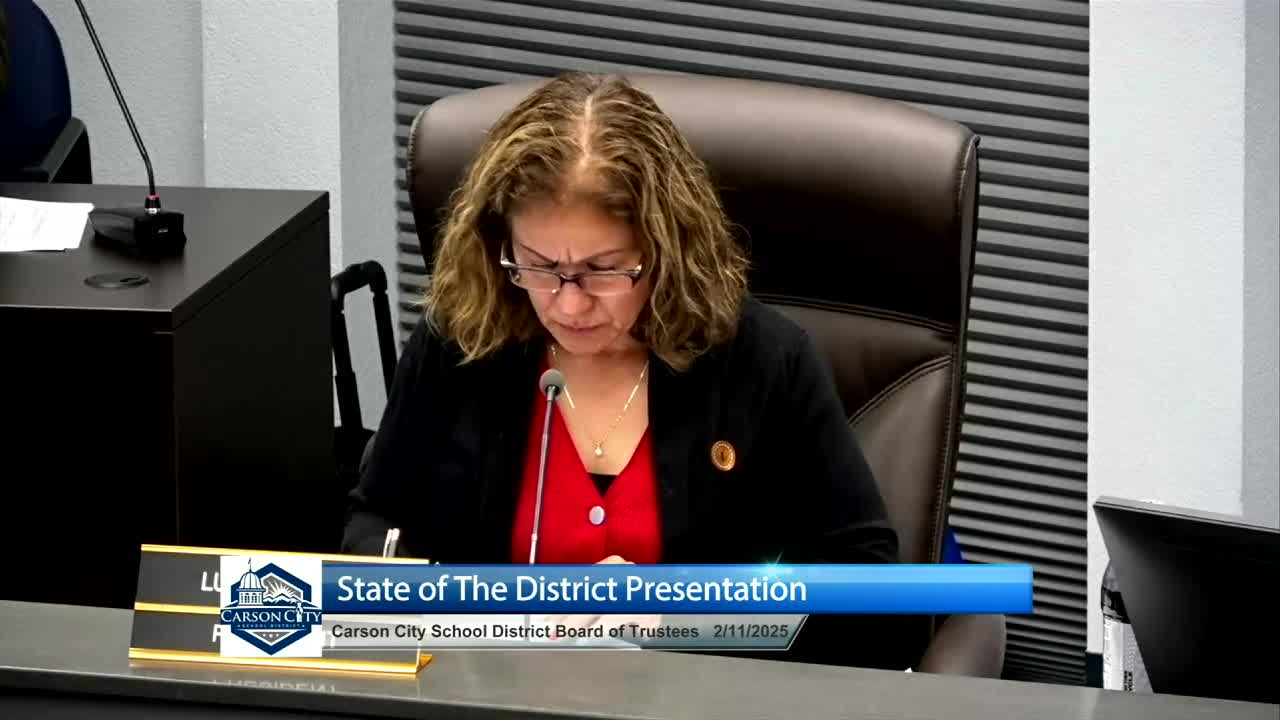
Superintendent Fielding delivered the district's annual State of the District presentation and reviewed student data, staff numbers, program activity and facilities needs for the 2024'25 school year and beyond.
The presentation opened with enrollment and demographic data drawn from the Nevada Report Card and district records. District enrollment has trended downward since about the 2012'13 school year, with a small projected uptick in the current year's funded average daily enrollment compared with last year. The superintendent said the district's student population is racially and ethnically diverse: 48.8% Hispanic, 42.1% White, with smaller percentages of American Indian, Asian, Black and multiracial students. He reported that 12.8% of students had an IEP last year, 13.2% were identified as English learners, and 67.2% qualified for free or reduced-price meals (the superintendent cautioned that pandemic-era changes in meal program enrollment complicate direct comparisons across years). He also noted that "direct certification" of students whose families receive federal assistance rose to about 44% from roughly the low-20s a decade earlier, reflecting increases in economic need.
Student mobility (transiency) and attendance were central themes. The superintendent cited Nevada'wide transiency reporting and stated Carson City's transiency rate was about 15.2% (compared with a statewide figure of 25.7% for states that track the metric). Chronic absenteeism increased after COVID and remains above pre-pandemic levels, though the district reported improvement on key measures this year. Graduation rates dipped after COVID but rose to about 83.1% in the most recent year; for students enrolling at the University of Nevada, Reno the district reported about 117 enrollees, the highest on record. Remediation rates for graduates attending Nevada public higher education were about 19.2%.
On academic programs and assessment, the superintendent described district work on MTSS (multi-tiered systems of support), the rollout of proficiency scales, new middle- and high-school curriculum alignment, and winter MAP assessment results that showed recent gains in math growth and more modest movement in reading. He described school-level interventions (including Exact Path and additional interventionist positions) and the plan to add regular in‑day intervention time in next year's schedules.
Behavior and school climate changes were discussed. Secondary schools have adopted an electronic hall-pass monitoring system and phone pouches; leaders reported reductions in incidents tied to those changes (the superintendent cited ranges reported by school administrators, for example 20'60% reductions on certain aggression or disrespect metrics). Carson Middle School staff survey results after the phone-pouch rollout were described as showing perceived improvements in hallway behavior, classroom engagement and school climate.
Student supports and family instability: the superintendent emphasized rising use of the McKinney‑Vento program for students experiencing housing instability. He reported 256 students enrolled at the end of the 2023'24 school year and, as of January 2025, 288 enrolled with 326 students having cycled through services so far during that school year, numbers greater than the prior year totals.
Staffing, finances and facilities: the district reported roughly 939 total employees (about 503 certified, 380 classified), and that general-fund staffing represents about 87% of spending. The district described relatively low leadership-cost ratios vs. statewide peers (leadership personnel about 6.1% of budget) and said increasing that to a comparable peer level would cost roughly $2 million. The district said it expects major HVAC and boiler work at Carson High this summer (about half the campus project estimated near $8 million). The superintendent also noted a clean audit and ongoing legislative advocacy (including school capital and federal IDEA funding shortfalls).
The presentation closed with updates on professional development, the end of most COVID-era federal grants (with legacy funding issues to manage), and continuing work on a district comprehensive needs assessment. Trustees and board members asked questions about multilingual learners and ELAD/TESOL endorsements, reasons for within-district student moves, the definition and tracking of family engagement, and whether facilities or rural-status changes would affect staffing rules. The superintendent said some data items are available publicly on the Nevada Report Card and described follow-ups to provide more detail to trustees.
Why it matters: the presentation aggregated academic, social and fiscal indicators the board and community use to set priorities, shape budgeting and target interventions for students facing the greatest barriers to learning.