Get Full Government Meeting Transcripts, Videos, & Alerts Forever!
Get email alerts on the Public Safety topic
No spam. Unsubscribe anytime.
Sheriff and juvenile services report fewer referrals, describe SRO program and outreach partnerships
Summary
Sheriff Ken Furlong, juvenile services and SRO leaders briefed trustees on the School Resource Officer program, reporting outreach activity, a near 10% drop in referrals and an SRO staffing model of five officers covering the district's ten schools.
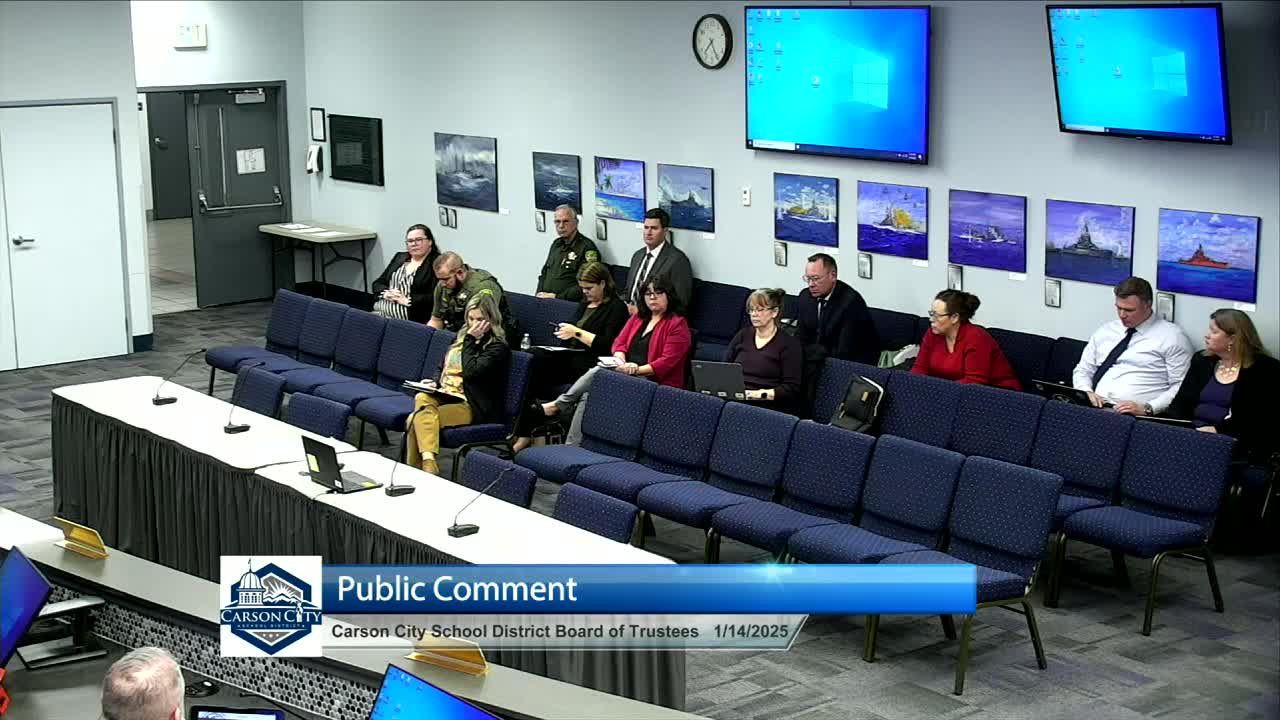
CARSON CITY, Nev. — Sheriff Ken Furlong, juvenile services leaders and Sergeant Taylor Maris briefed the Carson City School District Board of Trustees on the district's School Resource Officer (SRO) program, describing a multi-agency partnership, outreach activity in schools and a modest decline in juvenile referrals.
"In Carson City, the Sheriff's Office is in collaboration or partnership with the school board," Sheriff Furlong said as he opened the briefing. He introduced representatives from juvenile services and praised Sergeant Maris' leadership of the SRO and MOST (mental outreach) teams.
Chief of Juvenile Services Ali Bannister and Deputy Chief Linda Lawler described two outreach specialist positions placed in schools and said the outreach work is focused on evidence-based programs including anger management, in-school suspension interventions and a curriculum similar to DARE for elementary students. Lawler reported that in 2024 the outreach specialists delivered 94 classes to 375 students and that referrals to juvenile services declined by 9.9 percent since the positions were implemented.
Sergeant Taylor Maris summarized the SRO staffing and roles: "Our SRO group, made up of 5 people, we have 2 at the high school..." He said deputies are present at athletic and school events, conduct counseling and mentorship work, and partner daily with school counselors, social workers and probation officers. Maris highlighted the department's canine, Camper, who frequently visits elementary schools.
On funding and coverage, trustees asked whether five officers adequately serve the district's 10 schools. Sheriff Furlong said prior federal COPS grant support had lapsed years earlier and that current funding is drawn from a mix of the city and department general funds; "about half of the program comes out of our general fund, about half from the city," a staff member said during the discussion. Furlong added that while five SROs meet normal operations, the department can and does surge patrol resources when incidents require additional staffing.
Trustees and staff described the program as highly collaborative. Trustee Mike Walker called for clarity on funding sources and sustainability; Lawler and the sheriff's office described the current mix of local funding and earlier grant support. No action was required of the board; the item was listed as informational.
Ending: Board members praised the visibility and community relationships established by SROs and juvenile outreach staff and requested future updates on program impacts and funding.