
Tribal leaders tell House committee Medicaid and third-party revenue are critical to tribal health systems
Get AI-powered insights, summaries, and transcripts
Sign Up Free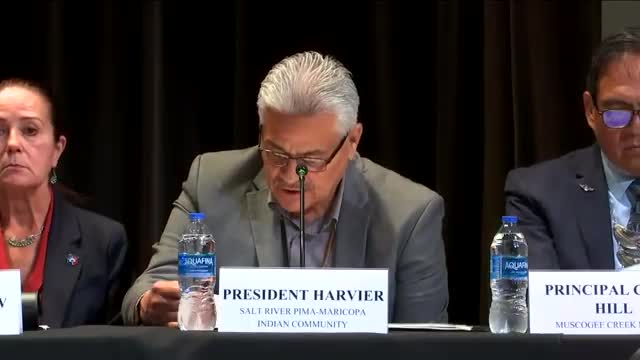
Summary
Multiple tribal leaders warned that tribal health systems depend on Medicaid and other third-party revenue and said proposed Medicaid reductions would significantly curtail services, hiring and planned facilities.
Tribal officials told the House Natural Resources Committee at an April 2 field hearing in Oklahoma City that tribal health systems rely heavily on Medicaid and other third-party revenues to supplement Indian Health Service funding, and that cuts to Medicaid would put services and planned projects at risk.
Marion Harvey, president of the Salt River Pima-Maricopa Indian Community, told the committee that "IHS only funds about 65% of our operational budget," adding that recent expansions of services would be difficult to sustain if Medicaid funding were reduced. Harvey described a residential treatment center the community plans to open later this year and said the facility could be jeopardized by reductions in third-party revenues.
Other witnesses echoed that concern. Bill Anoatubby, governor of the Chickasaw Nation, said third-party revenue is integrated into tribal health operations and that "any reduction in Medicaid would, in fact, cause us to have a reduced budget." Chuck Hoskin Jr., principal chief of the Cherokee Nation, said the Cherokee system leans on Medicaid while building a larger health-care enterprise and called cuts "not only damaging ... it's a double injury." Gary Batton, chief of the Choctaw Nation, said the impact would be "devastating" for his system and noted an existing multi-million-dollar shortfall in the current fiscal year.
Why this matters: Witnesses described health systems that have expanded under ISDEAA compacts and compacts with IHS but stressed that IHS funding does not cover full operating costs. Many tribes use Medicaid reimbursement to expand services, staff specialist positions, and invest in facilities; a reduction in Medicaid funding, witnesses said, would force program cuts, hiring freezes or deferred capital projects.
Committee members asked witnesses to provide written details about how proposed federal changes to Medicaid would affect specific service lines and capital projects. Witnesses said the impacts would include reduced behavioral-health capacity, fewer substance-use treatment beds, deferred facility expansions and reduced third-party revenue used to support contract support costs and other non-IHS funding gaps.
Speakers who addressed Medicaid and third-party billing at the hearing included Marion Harvey (Salt River Pima-Maricopa Indian Community), Bill Anoatubby (Chickasaw Nation), Chuck Hoskin Jr. (Cherokee Nation), Gary Batton (Choctaw Nation), Marlene Supernaw (Quapaw Nation) and Martin Harvier (Salt River testimony attributed in transcript). The committee indicated it will seek written follow-ups on exact budget impacts and plans for mitigation.