Citizen Portal
Sign In

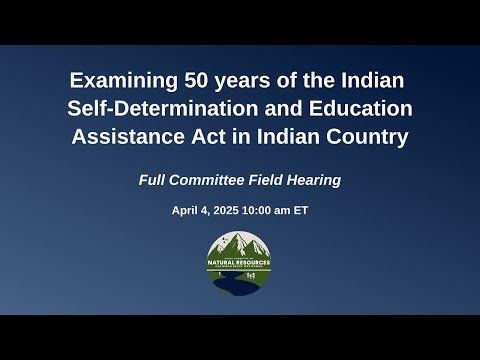
House Natural Resources holds field hearing in Oklahoma to mark 50 years of Indian Self-Determination law

2879959 · March 24, 2025

Loading...

AI-Generated Content: All content on this page was generated by AI to highlight key points from the meeting. For complete details and context, we recommend watching the full video. so we can fix them.

Summary

Members of the House Natural Resources Committee convened a field hearing at the First Americans Museum in Oklahoma City to review five decades of the Indian Self-Determination and Education Assistance Act, hear tribal leaders describe program successes and remaining barriers, and discuss recommendations for expansion and administrative fixes.

The House Committee on Natural Resources met at the First Americans Museum in Oklahoma City on April 2, 2025, for a field hearing marking the 50th anniversary of the Indian Self-Determination and Education Assistance Act (ISDEAA). Chairman Bruce Westerman (R-Ark.) convened the hearing and framed the session around the law’s purpose and accomplishments. "We must make it clear that Indians can become independent of federal control without being cut off from federal concerns and federal support," Westerman quoted President Richard Nixon, echoing the policy origins he outlined at the start of the hearing.

Why this matters: Tribal leaders told the committee that ISDEAA has enabled tribes to assume program responsibility, spur economic development and deliver culturally appropriate services. Witnesses described measurable growth in tribal health systems, education and business activity, while also warning of persistent funding shortfalls, administrative barriers in federal agencies and operational strains for public safety and social services.

Committee members and witnesses highlighted three recurring themes: (1) the practical benefits of self-determination in health care, education and natural-resource management; (2) gaps in funding and federal administrative systems that limit tribal capacity; and (3) proposals to expand ISDEAA authorities into additional federal programs.

Witnesses from multiple tribal nations described program-level results and asked Congress to consider statutory or appropriations changes to make contract support costs and leasing payments more predictable, to extend ISDEAA-style authority into other federal agencies, and to modernize Interior and Indian Affairs systems that tribes rely on to run programs. Jay Spann, executive director of the Self Governance Communication and Education Tribal Consortium, summarized the policy pitch: "When tribal nations control the programs that serve our communities, outcomes improve." That line framed much of the discussion that followed.

Several witnesses gave concrete examples of services and local innovations: tribes described operating hospitals and clinics, launching meat-processing facilities and food-distribution programs, managing title and lease recording more quickly than the Bureau of Indian Affairs previously did, and creating emergency operations capacity that serves entire counties. Committee members pressed witnesses about the potential impacts of proposed federal Medicaid changes and about capacity building for tribes that have not yet compacted or contracted for programs.

The hearing record will remain open for written member questions and responses. Chairman Westerman closed by urging continued bipartisan work to refine the law and to address obstacles identified by witnesses.

The session included testimony from tribal leaders representing the Chickasaw Nation, Cherokee Nation, Choctaw Nation, Quapaw Nation, Muscogee (Creek) Nation, Salt River Pima-Maricopa Indian Community, Osage Nation Health System and the Self Governance Tribal Consortium.

Looking ahead: Committee members asked witnesses to provide written follow-ups on specific administrative fixes (Interior/Indian Affairs technology, USDA pilot expansion, contract support cost implementation and health-system workforce incentives), and set a deadline for written responses from witnesses and staff.