Get email alerts on the Property Law topic
No spam. Unsubscribe anytime.
House panel hears bill to create uniform process for relocating private easements
Summary
House Bill 144 would allow judicial relocation of many private easements under a standardized process intended to help landlocked parcels and clarify who pays relocation costs; the bill exempts public utility, railroad and conservation easements from its scope, sponsors and witnesses said.
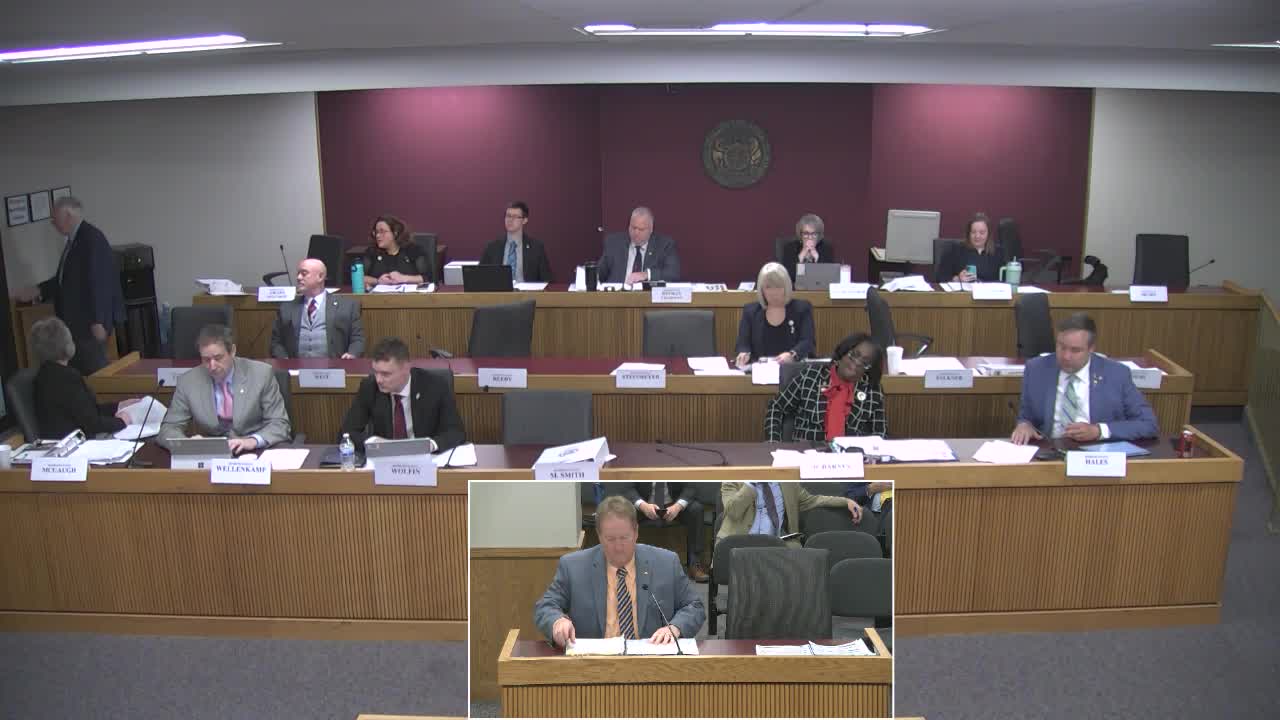
Representative Bill Faulkner presented House Bill 144, the Uniform Easement Relocation Act, to the House Committee on Local Government, describing it as a modernization of easement-relocation law intended to provide a clearer, judicially supervised process for relocating many private easements while preserving the functional benefit to the easement holder.
"It aims to modernize easement relocation laws and provide a more streamlined process ... to relocate easements when necessary to maximize the utility of the servient property and foster development without diminishing the functional benefit of the easement holder," Faulkner said.
Faulkner said the act applies to most private easements but explicitly excludes public-utility easements, conservation easements and railroad easements; he also noted neighboring states such as Arkansas and Nebraska have similar statutes.
Committee members asked practical questions. Representative Walsh Moore asked for a plain-language explanation; Faulkner said the bill chiefly helps landlocked parcels that need access and establishes that the party seeking relocation typically bears the relocation cost, subject to court oversight.
Representative Wellenkamp sought to confirm the exemptions, and Faulkner and witnesses agreed that creating a new conservation easement would not be impeded by the bill because it addresses relocation of existing easements rather than creation of new ones.
Arnie C. Deanoff, the state public advocate, testified in favor after reviewing the draft and discussing clarifications with the sponsor. He emphasized the bill is voluntary, requires circuit-court approval of relocation agreements, and provides a non-adversarial option for owners in difficult access situations.
Witnesses and the sponsor said an amendment to exclude railroads had been discussed and would be added if necessary; Faulkner said he expected to offer that as a technical amendment.
The committee closed the public hearing on HB 144 without recorded committee action during the same meeting.
AI generated
The text on this page is AI generated. Summaries, highlights, analysis, and video transcripts are all produced from the original source material.
AI can make mistakes, so if you spot one, and we will fix it for everyone.
Note: the source content is unaltered by us. Any content source we link to, be it a video, an audio recording, or a document, is presented exactly as its publisher released it. That publisher is usually a government body, sometimes an individual official or another organisation.