Get Full Government Meeting Transcripts, Videos, & Alerts Forever!
Get email alerts on the Emergency Services Funding topic
No spam. Unsubscribe anytime.
Missouri committee hears bill to let ambulance districts seek 1% sales tax cap
Summary
Representatives and industry groups told the House Committee on Local Government that rising ambulance costs justify allowing ambulance and fire protection districts to seek a local sales tax increase from 0.5% to 1%, while a state public advocate urged offsets to avoid shifting the tax burden.
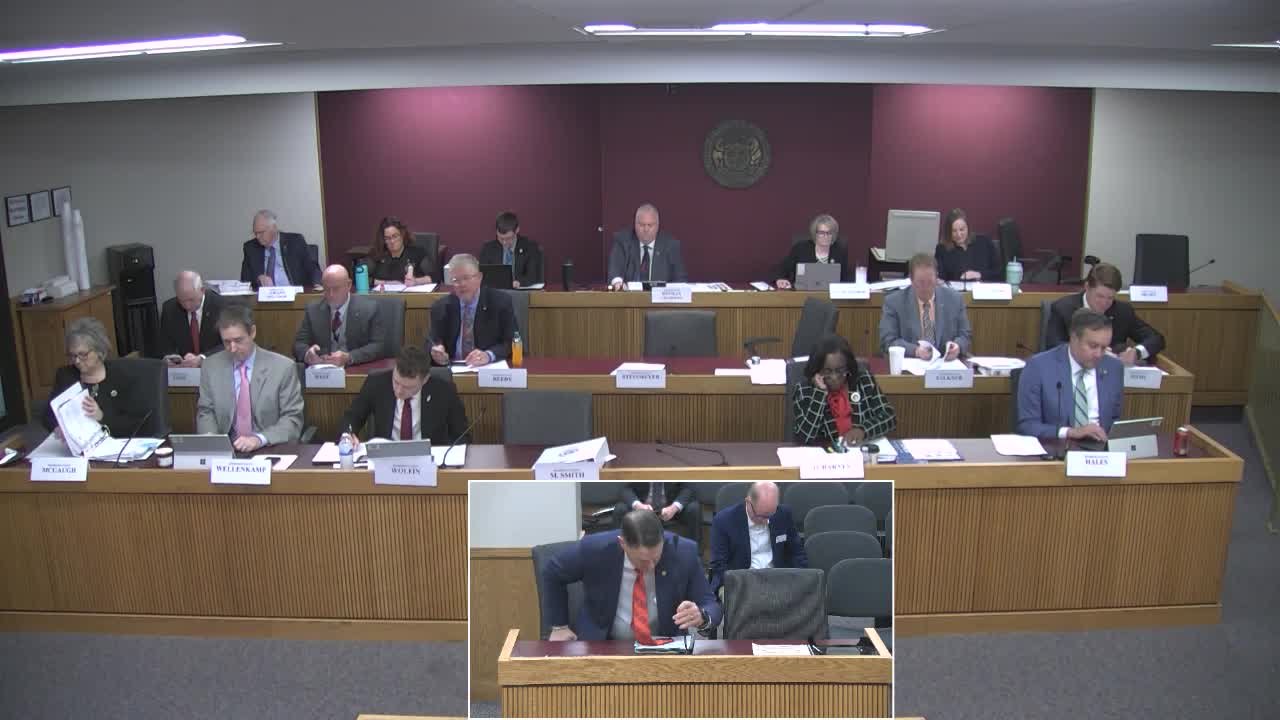
Representative Jeff Knight introduced House Bill 895 to the House Committee on Local Government, saying the measure would allow ambulance districts to raise their local sales-tax rate from one-half of 1% to 1% if approved by local voters.
"This would allow ambulance districts to raise their sales tax portion from 1 half of 1% to 1%, and it has to be voted on by the people, approved by the people locally," Representative Jeff Knight said.
The bill drew support from ambulance and fire district representatives at the public hearing. Brent Hemphill, representing the Missouri Ambulance Association, told the committee the existing half-cent cap in many counties no longer covers modern ambulance costs and that practice had been to use statute under chapter 3.21 for sales-tax authority even when ambulance districts are in chapter 190.
"Half cent sales tax in third class counties just isn't sufficient to create a successful environment for ambulance districts to provide the services that you demand," Hemphill said.
Trent Ford, a registered lobbyist for the Ambulance District Association of Missouri, and Tom Dempsey, a lobbyist for the Missouri Association of Career Fire Protection Districts, also went on record in support.
Arnie C. Deanoff, the state public advocate, testified in opposition, urging a dollar-for-dollar offset between any new sales tax authority and reductions in property taxes. "There needs to be a definite offset ... between real estate and personal property tax versus sales tax," he said, warning that increasing reliance on sales tax could shift the overall tax mix.
The committee took public testimony and closed the hearing without taking final action on HB 895 during the same meeting.
The bill text amends statutory references for sales-tax authority related to ambulance and fire-protection districts; it would set the local voter-approved ceiling at 1% but would not require districts to levy that maximum.
No formal committee vote on HB 895 was recorded in the transcript for this meeting. The public hearing record included supporters from district associations and at least one formal opposition centered on tax-shift concerns.
Local control: the sponsor repeatedly noted that any increase would require voter approval at the local level. That procedural point was reiterated in testimony from association representatives.
Funding and scope: witnesses described the change as a ceiling (a maximum available by local vote), not a mandatory rate. Hemphill said ambulance districts commonly use chapter 3.21 sales-tax authority, even where ambulance districts are organized under chapter 190.
Questions from committee members touched on whether the bill would interact with separate legislation to allow more counties to adopt sales taxes; the sponsor said that expansion was not in this bill but that other measures may address it.
Looking ahead: the bill remains in committee following the hearing. If it is scheduled for a committee vote in a future meeting, the committee will need to consider Deanoff's requested offset language or other fiscal clarifications.