
Pacific Grove Unified unveils yearlong ethnic studies course aligned with state model curriculum
Get AI-powered insights, summaries, and transcripts
Subscribe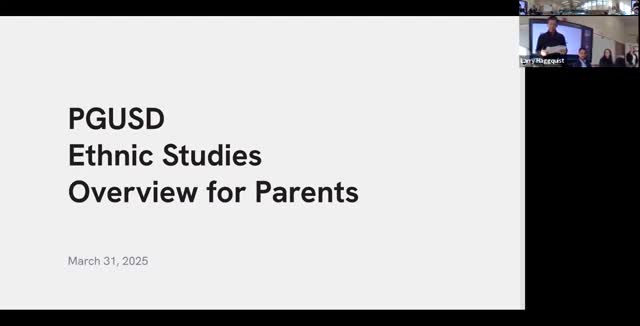
Summary
Pacific Grove Unified staff and community partners described a proposed yearlong ethnic studies course for Pacific Grove High School at a community engagement meeting, emphasizing alignment with the state model curriculum and the district—s Local Control and Accountability Plan.
Pacific Grove Unified staff and community partners described a proposed yearlong ethnic studies course for Pacific Grove High School at a community engagement meeting, emphasizing alignment with the state model curriculum and the district—s Local Control and Accountability Plan.
Dr. Lawrence Hedquist, executive director of educational services for Pacific Grove Unified, told attendees the state requires schools to offer a one-semester ethnic studies course beginning in the 2025–26 school year and that the course "by 2029–30 this course will be a graduation requirement." He said the district—s proposed offering differs from the state minimum: "we are offering a one year course," to allow more time for project-based work and community engagement.
The course proposal centers on four units: Native American studies, Asian American studies, African American studies and Chicano/Latinx studies. Brandy Lopez, the district—s current world geography teacher and the planned instructor for next year—s ethnic studies class, described course goals and planned signature assignments. "The course aims to foster this idea of critical thinking, cultural awareness, social responsibility by exploring the themes of identity justice and community engagement," Lopez said. She said units will include primary documents, project-based learning and peer feedback, and that students will be able to choose topics for deeper study.
Lopez outlined example readings and signature assignments: for Native American studies she listed An Indigenous Peoples— History of the United States (selected excerpts) and a unit assignment focused on Native American sovereignty and land rights; for Asian American studies she cited The Making of Asian America by Erika Lee and Minor Feelings by Cathy Park Hong and proposed research-based historical case studies; for African American studies she said she would begin with precolonial African kingdoms and move through slavery, Reconstruction and civil-rights-era material, assigning persuasive essays on structural racism; for Chicano/Latinx studies she named La Raza C——asmica and Harvest of Shame among source excerpts and proposed advocacy projects on immigration policy.
Community partners and guest contributors described their planned classroom roles and resources. Robert Kikuchi Yubgojo and Nancy Wong of EthnoTech said they provide storytelling materials and a teacher—s guide tied to local histories, and Nancy Wong summarized EthnoTech—s mission: "Our mission is to build cultural bridges that celebrate diversity and create compassionate communities through the art of storytelling." Dr. Joshua Orozco, a philosophy professor who has worked in equity and belonging, spoke about using primary sources to expand whose stories students study. Mika Okamura, introduced as a queer Japanese American instructor collaborating on Native American content, described a recent local convening with tribal leaders and referenced "a mandate for educators to be teaching true histories," citing the transcript reference to "assembly bill 18 21" as part of that broader regional work.
Presenters said the course development has included multiple planning meetings with community partners and district staff and that Lopez is receiving paid planning time over the summer to finish curriculum materials. The district emphasized that community feedback is part of course development and that the meeting was expressly described as an engagement session: "Suggestions are welcome. We will be taking notes on any suggestions that you have," Hedquist said.
Audience commenters urged explicit facilitation training and structured classroom practices to support difficult conversations. One parent, identified in the transcript as Jessica, urged the district to incorporate dialogue-across-difference training and strong facilitation to "set this up for success" in light of national debates. A commenter identified as Dallas, a UCLA faculty member, suggested adding material on the social construction of whiteness and recounted experience that well-intentioned discussions can backfire without trained facilitators. Lopez said she plans to attend an ethnic studies workshop in Berkeley and named Socratic seminar techniques as one approach she is considering.
District staff said field trips and live guest visits from partners are under consideration but not finalized. Presenters also said supplementary films and excerpts provided by partners would be incorporated; specific funding sources for field trips or outside speakers were not specified during the meeting. The presentation concluded with organizers thanking partners and noting the session would be posted online for broader viewing.
The district did not take formal action or a vote at the meeting; the session was presented as development and community engagement for a course the district intends to offer in the next school year.