
Planning commission approves Portman Holdings Brookside mixed-use plan, OKs variances and 42 conditions
Get AI-powered insights, summaries, and transcripts
Subscribe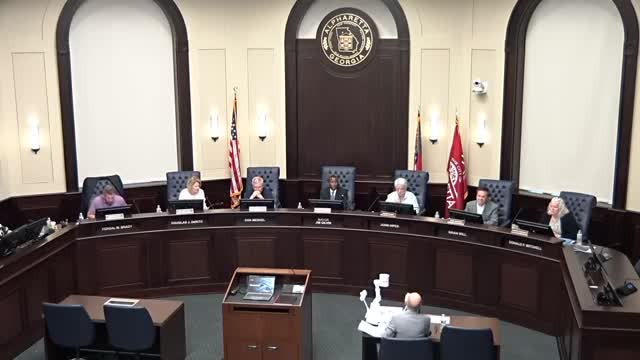
Summary
Alpharetta planning commissioners voted to forward Portman Holdings’ Brookside Master Plan amendment and rezoning request to city council with 42 conditions, approving variances for lot size, shared parking and driveway separation while directing staff to finalize parking-management language.
Alpharetta Planning Commission members voted on April 3 to forward a Portman Holdings proposal to city council to rezone and redevelop roughly 19.7 acres in the Brookside master plan (pod A) into a mixed-use project that would include office, retail, for-rent apartments and for-sale townhomes.
Michael Woodman, planning staff, summarized the application as a request for a master plan amendment and comprehensive land use plan change from corporate office to mixed use, rezoning from O&I (office institutional) to MU (mixed use), conditional uses for dwelling units for rent and for sale, and three variances. The applicant proposes retaining one existing office building (approximately 130,000 square feet total office across the site, with 30,000 sq ft retained in the existing building), constructing a five-story, ~335-unit for-rent building wrapped around a six-level parking deck, creating about 60,000 square feet of retail and restaurant space, and delivering 75 for-sale townhomes at the south end of the site.
Why it matters: the site sits adjacent to the city’s 30-acre Brookside Park and Georgia State University’s Alpharetta campus, and is within the Brookside Small Area Plan area identified for retrofit and mixed-use redevelopment in the city’s 2040 Comprehensive Plan. Staff and the applicant say the proposal aims to convert an underused suburban office park into a walkable activity node and to provide an off-site trail connection to the Big Creek Greenway.
Key approvals and variances
Staff recommended approval subject to 42 conditions. The three variances requested are: (1) reduce the MU minimum lot size from 25 acres to 19.68 acres (the property is part of a larger 84-acre pod A); (2) increase the shared-parking reduction the city’s Unified Development Code (UDC) allows staff to approve from 25% up to 27% (the applicant asked for the extra 2%); and (3) reduce the required driveway separation for curb cuts on Brookside Parkway, which are already legal nonconforming and being adjusted slightly. An additional variance for a reduced landscape strip along Old Milton Parkway was withdrawn after the applicant agreed to meet the 20-foot planting strip requirement.
Project design, open space and infrastructure
Portman’s plan calls for demolition of the northern office building, conversion of ground-floor space in the southern office building to commercial use, a retail village with a central roundabout, a five-story rental building with amenities and a parking deck, and a row of 22-foot-wide, four-story rear-loaded townhomes. The applicant’s submission identifies roughly 13.72 acres of open space (the code minimum was described by staff as about 12 acres). The application also proposes a conceptual road-diet along Brookside Parkway and a trail connection through Brookside Park to the Big Creek Greenway; the applicant proposed to construct the connection in exchange for impact-fee credits, although the trail-bridge design is conceptual at this time.
Stormwater and site utilities
Because parts of the site are adjacent to Big Creek and an existing floodplain, staff said the applicant proposed using a timing analysis and other stormwater measures rather than traditional on-site detention. The applicant is working with the adjacent Northpointe Community Church regarding a detention pond the church owns that sits on the property and may transfer or modify that facility as part of the redevelopment.
Parking and shared-parking debate
The applicant proposes a multi-level parking deck (about 803 structured spaces) and additional on-street and surface parking; townhome parking is separate (each townhome would have two garage spaces and two driveway spaces). The submitted shared-parking study projects a weekday peak demand of roughly 922 shared spaces and a weekend peak of 909—figures the city staff said they had reviewed and generally concurred with. The UDC parking requirement calculation would yield a larger number but allows a 25% shared-parking reduction; Portman asked for a 27% reduction to reflect shared use across office, retail and multifamily. At the hearing commissioners and staff pressed the applicant’s consultants on operational details (nesting of spaces in the garage, enforcement, license-plate registration/management, valet options and how the easement with a nearby bank might be used). Commission members said the shared-parking approach can work but requires explicit, enforceable operational controls and ongoing management; staff agreed to work with the applicant to add parking-management requirements to the conditions.
Housing policy, phasing and occupancy timing
The application requests 335 rental units that the city tied to its housing analysis and rental policy. Staff explained that the city’s rental-housing study (updated in 2022) and the comprehensive-plan policy informing owner-occupancy goals were used to recommend a condition requiring a certificate of occupancy (CO) for the 335 rental units no sooner than Jan. 1, 2027; staff said that projection accounts for other entitled rental projects expected to come online. The conditions also include a reversion clause: if a building permit is not issued by April 28, 2028 (three years after potential approval), the residential units would revert to for-sale product, a clause Portman asked staff to revisit for additional flexibility; staff said it would work with the applicant but did not support wholesale deletion of that safeguard.
Public outreach, traffic and regional review
Staff said the applicant held a virtual meeting on Jan. 9 and mailed notices to property owners within 500 feet; staff also posted material on the city website and advertised in the newspaper. The city reported no attendees at the virtual meeting and no written correspondence submitted as part of the application packet; staff additionally said they and the applicant had reached out directly to nearby homeowners associations (the Glen Abbey HOA had discussed trail connectivity). Because the proposed development met the threshold for a Development of Regional Impact (DRI) review, the state solicited comment from regional partners; staff said the regional review focused on transportation, and the state review (identified in the transcript as GRETA) agreed with the applicant’s traffic-study recommendations and required improvements to the three site driveways.
Commission discussion and conditions
Commissioners questioned the applicant and staff about parking operations, potential traffic impacts on Old Milton Parkway during GDOT’s planned widening project, stormwater timing analyses, loading and service access for retail, the proposed architecture and massing, and the townhome mix and builder-selection process. Staff walked through 42 recommended conditions addressing the site plan tie, land-use designation, allowed uses and maximum sizes, building heights, limits on amounts of retail and restaurant space (staff flagged a 32,000-square-foot cap within the 60,000 square-foot retail envelope), restrictions on the percentage of townhome units that could be rented, the 335-rental-unit CO timing, landscaping and tree-save expectations, frontage and sidewalk easements, requirements for pedestrian and bicycle connections, requirements for screening and aesthetic treatment of parking decks and retaining walls, and triggers for when features must be in place with certain COs. Several conditions (notably the condition that requires a parking-management plan and the reversion language for rental units) drew extended discussion; staff agreed to continue negotiating firm operational language for parking management with the applicant and to retain the CO/reversion safeguards unless the commission and later council approve a change.
Formal action
A commissioner moved to approve the master-plan amendment, comprehensive land use plan change, rezoning, conditional uses and variances as presented, incorporating staff’s 42 conditions and noting that staff would finalize parking-management language with the applicant. Another commissioner seconded. The commission voted to forward the item to city council; the chair announced the motion carried and that council would hear the item on April 28. The transcript did not record a roll-call vote count in the public record provided at the hearing, and the formal tally was not specified in the transcript; staff and applicant indicated they will continue to refine the conditions before council.
What’s next
The Planning Commission’s approval sends the rezoning and related applications to Alpharetta City Council for final action with staff- and applicant-agreed conditions to be finalized prior to council consideration. Staff and the applicant indicated they expect to refine operational language around parking management and to continue discussion on timing language for rental-to-for-sale reversion in case permitting or market conditions delay unit conversions.