Get Full Government Meeting Transcripts, Videos, & Alerts Forever!
Get email alerts on the Economic Development Tourism Committee Briefings topic
No spam. Unsubscribe anytime.
House economic-development committee advances HR 883 and hears regional tourism, industry briefings
Summary
The Georgia House Economic Development and Tourism Committee voted to advance House Resolution 883 to the Rules Committee and then heard a series of briefings from economic‑development and tourism officials representing Columbus, Metro Atlanta, Augusta, Bulloch/Statesboro, Cartersville‑Bartow and Macon‑Bibb.
The Georgia House Economic Development and Tourism Committee voted to advance House Resolution 883 to the Rules Committee and then spent the meeting hearing presentations from local and regional economic-development and tourism leaders across the state.
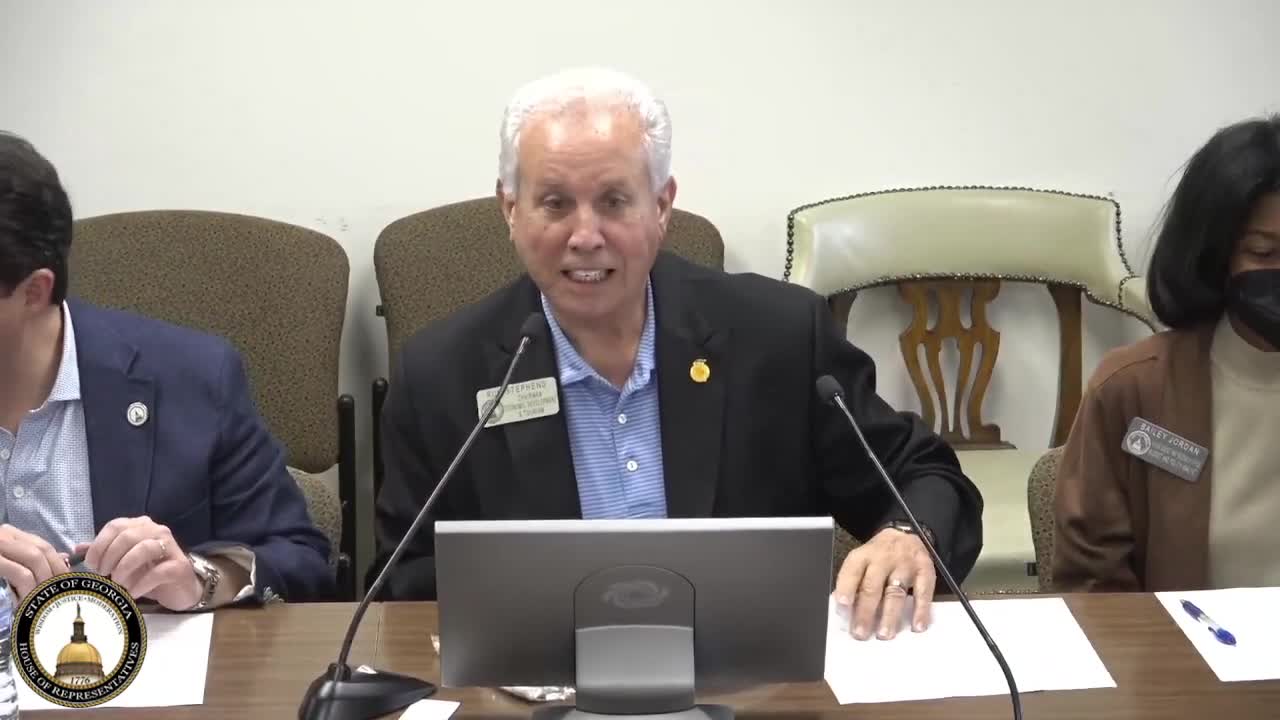
Committee Chair Speaker Stevens opened the meeting by moving consideration of House Resolution 883 toward the Rules Committee; the chair announced the motion carried on a committee voice vote. The committee then heard presentations from the Columbus Chamber of Commerce and Visit Columbus GA, the Metro Atlanta Chamber, the Greater Augusta Black Chamber of Commerce, representatives of Bulloch/Statesboro, Cartersville-Bartow County and the Macon-Bibb Industrial Authority.
Why it matters: lawmakers said the speakers demonstrated how tourism and targeted economic-development tools—stadium and downtown projects, major events, site development and workforce credentialing—are being used locally to attract private investment and visitor spending, and how those projects interact with state programs and infrastructure needs.
Brian Solito, vice president of the Columbus Chamber of Commerce, told the committee Columbus has invested in a $50 million revitalization of the city’s baseball facility and related public amenities and is pursuing mixed-use redevelopment of a downtown area he called South Commons. "We have successfully transformed Columbus' image downtown," Solito said, and he urged continued state support for programs such as the OneGeorgia Authority. Solito also described a new Minor League team (the Columbus Clingstones) and the renovated Synovus Park as anchors for surrounding redevelopment.
Ashley Wotena, president and CEO of Visit Columbus GA, described tourism as a driver of local economic activity. She said Columbus received roughly 2 million visitors in fiscal 2024, employs more than 4,400 people in tourism and hospitality, and is home to attractions that include the National Infantry Museum and an urban whitewater course used for international kayak events. "Tourism isn't simply adjacent to economic development. It is economic development in its most dynamic form," Wotena said, adding Fort Benning is a major regional employer with an estimated economic impact she cited as about $4.75 billion to the state.
Dylan Horn of the Metro Atlanta Chamber summarized the chamber’s project-recruitment and marketing work for the 29-county Atlanta metropolitan area. Horn credited a “business friendly environment” created by state policy for helping the region land major sporting events and corporate investments; he described recent work to secure events spanning national championships to international soccer matches and noted the chamber’s role in providing labor and market data to prospects.
Ronique West, president and cofounder of the Greater Augusta Black Chamber of Commerce, gave a regional overview for Augusta and the Central Savannah River Area. West said Augusta welcomed more than 5 million visitors in 2023, highlighted the economic contribution of the Masters tournament, and listed key local concerns raised to the committee: an estimated housing shortfall (she cited a local figure of about 8,600 units), rising rental and housing costs, gaps in public transportation, child-care affordability and limited nontraditional access to capital for small businesses. She also described ongoing recovery needs from Hurricane Helene and urged stronger participation by lenders in state small-business capital programs.
Representatives from Bulloch/Statesboro and Cartersville-Bartow described how higher education institutions, industrial-site readiness and recent large private investments are changing local economies. The Cartersville-Bartow presentation listed several major projects and manufacturers, and said a cluster of recent announcements (including a joint venture between Hyundai and SK On and a large solar-panel manufacturer) together represent several thousand new jobs and multi‑billion-dollar capital commitments; the presenter said the county has invested years building utility and site capacity to win those projects.
Steven Adams, executive director of the Macon-Bibb Industrial Authority, told the committee Macon-Bibb has worked with the Macon Water Authority and other partners to provide ready sites and capacity and has seen nearly $3 billion in new private investment since 2017. He cited investments by long-term manufacturers and new projects as a key recruitment selling point and highlighted recent downtown cultural and tourism activity.
Committee members asked presenters about workforce credentialing and short-term training programs, public‑safety and search‑and‑rescue work on rivers, infrastructure challenges (notably water and wastewater capacity), and coordination across local governments. Presenters repeatedly said site development—cleared, serviced industrial or mixed‑use parcels—is critical to winning or keeping large private investments, and they asked for continued coordination with state economic-development tools.
Votes at a glance: - House Resolution 883 — Motion to refer the study to the Rules Committee. Motion moved by Representative Reese; second not recorded on the transcript. Committee voice vote: chair announced the motion carried and said it would move on to the Rules Committee.
What the meeting did not decide: the committee received information and advocacy requests but did not adopt new state policy, alter funding formulas or award state grants during the session summarized in the transcript. Several presenters requested follow-up engagement with lawmakers and staff on topics including site development funding, small‑business capital access and regional infrastructure planning.
Looking ahead: presenters urged follow‑up on infrastructure capacity (water and wastewater), housing availability, workforce training and lender participation in state small‑business programs; several requested technical follow‑ups and meetings with relevant state agencies and local partners.