Get Full Government Meeting Transcripts, Videos, & Alerts Forever!
Baltimore finance director transmits $4.6 billion preliminary FY26 budget; officials flag targeted fee increases to close $85 million gap
Summary
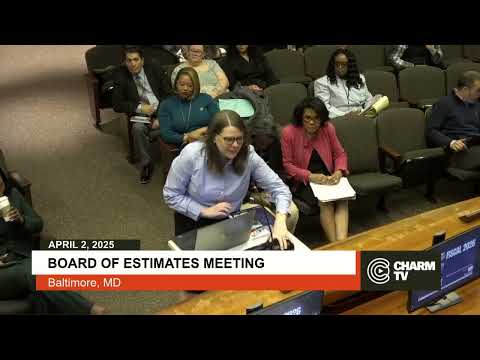
Baltimore’s finance director formally transmitted a $4.6 billion preliminary spending plan for fiscal 2026 to the Board of Estimates on April 2, saying the proposal balances an $85 million shortfall through a mix of expense savings and targeted new revenue measures including fee and fine updates.
Finance Director Laura Larson formally transmitted Baltimore’s preliminary fiscal 2026 spending plan to the Board of Estimates on April 2, a $4.6 billion budget that she said will be balanced through a mix of expense reductions and targeted revenue changes.
The budget “represents a $4,600,000,000 spending plan that’s comprised of a $3,600,000,000 operating budget,” Laura Larson said as she opened the Board’s nonroutine session, and she told members the proposed plan reflects an $85,000,000 shortfall created by expenditures outpacing revenue growth.
Larson said the proposed general fund is about $2.6 billion — roughly $256 million more than the current year — and that the plan funds 9,921 city positions, 66 more than in FY25. She told the Board the shortfall was driven by rising personnel and benefit costs, expected higher debt service tied to planned borrowing, and inflationary increases across agency budgets.
Why it matters: Baltimore’s preliminary plan sets the size and priorities that the Board of Estimates will review and the City Council will consider this spring. If enacted with changes, it will set tax-supported spending levels and staffing for the coming fiscal year and influence how the city responds to state and federal budget actions that Larson said remain uncertain.
Larson outlined how the plan proposes to close the $85 million gap: roughly $26.6 million in new revenue initiatives paired with deeper expense savings. On revenue, she said the city is pursuing a targeted package of fee and fine updates rather than broad-based tax increases. “We’re assuming about $26,600,000 worth of new revenue initiatives and that includes … $6,500,000 that would be generated from updating different fee structures and fine structures,” Larson told the Board.
Larson and other speakers repeatedly emphasized that recommendations will be targeted and phased. She said staff will complete a comprehensive city fee study this summer and return specific fee recommendations to the Board, with a goal of bringing proposals back early in the fall.
Selected fee proposals discussed in the hearing include: a proposal to move landfill tipping fees to a “full cost recovery model” and raise the fee to $135 per ton, which Larson said the administration expects would generate about $8.9 million and would primarily affect large private haulers; and a proposed 20% increase to the city’s EMS transport fee, targeted mainly at non-Medicaid and non-Medicare payers. Larson said the city is not proposing changes to the small-hauler program that serves household or small-contractor customers.
Larson said grant-funded spending is also a significant budget component: the preliminary plan reflects about $344.4 million in state and federal awards in FY26, a decline of about $16.7 million from FY25 driven in part by more cautious, award-based grant budgeting. She listed the five largest federal grant programs included in the forecast: Community Development Block Grant, Ryan White, Head Start, Continuum of Care, and Workforce Innovation and Opportunity Act funding, and told the Board some discretionary EPA awards have already been canceled.
Budget priorities: Larson walked the Board through the administration’s five pillars for FY26 spending and highlighted major investments: $624.8 million for youth initiatives (including funding from the Children & Youth Fund to create about 8,500 summer youth work slots and $850,000 to continue a healthy-babies program that can leverage Medicaid match); roughly $1.1 billion for public safety (with civilianization of additional police teams and $5.2 million from the opioid restitution fund for EMS enhancements); $1 billion for cleaner and healthier communities (including $5.2 million for temporary solid waste crews and plans to reduce route sizes); $346.4 million for equitable neighborhood development (including permitting reforms and zoning office changes); and $219.2 million for stewardship of city resources (with moves to convert some contract positions to permanent staff and a $300,000 allocation to complete a citywide equity assessment).
Mayor Brandon Scott pushed back on the notion of broad-based tax increases and defended targeted enforcement fees. “I have no sympathy for someone who’s illegally dumping,” the mayor said. “If they don’t wanna pay a higher fine in the city, don’t illegally dump.” He also emphasized the administration’s intent to protect core services while making targeted revenue changes.
Compt…
Already have an account? Log in
Subscribe to keep reading
Unlock the rest of this article — and every article on Citizen Portal.
- Unlimited articles
- AI-powered breakdowns of topics, speakers, decisions, and budgets
- Instant alerts when your location has a new meeting
- Follow topics and more locations
- 1,000 AI Insights / month, plus AI Chat