Get Full Government Meeting Transcripts, Videos, & Alerts Forever!
Get email alerts on the Housing And Nitrate Management topic
No spam. Unsubscribe anytime.
Charlestown reviews MTAP housing and nitrate-management study; councilors say it falls short on affordable-housing guidance
Summary
Consultant Jim Reardon of Weston & Sampson presented the Town of Charlestown’s MTAP needs-analysis report on housing and nitrate management at a March 17 special meeting, recommending a nitrogen-management overlay, upgraded septic and stormwater systems, transfer-of-development-rights and adaptive monitoring.
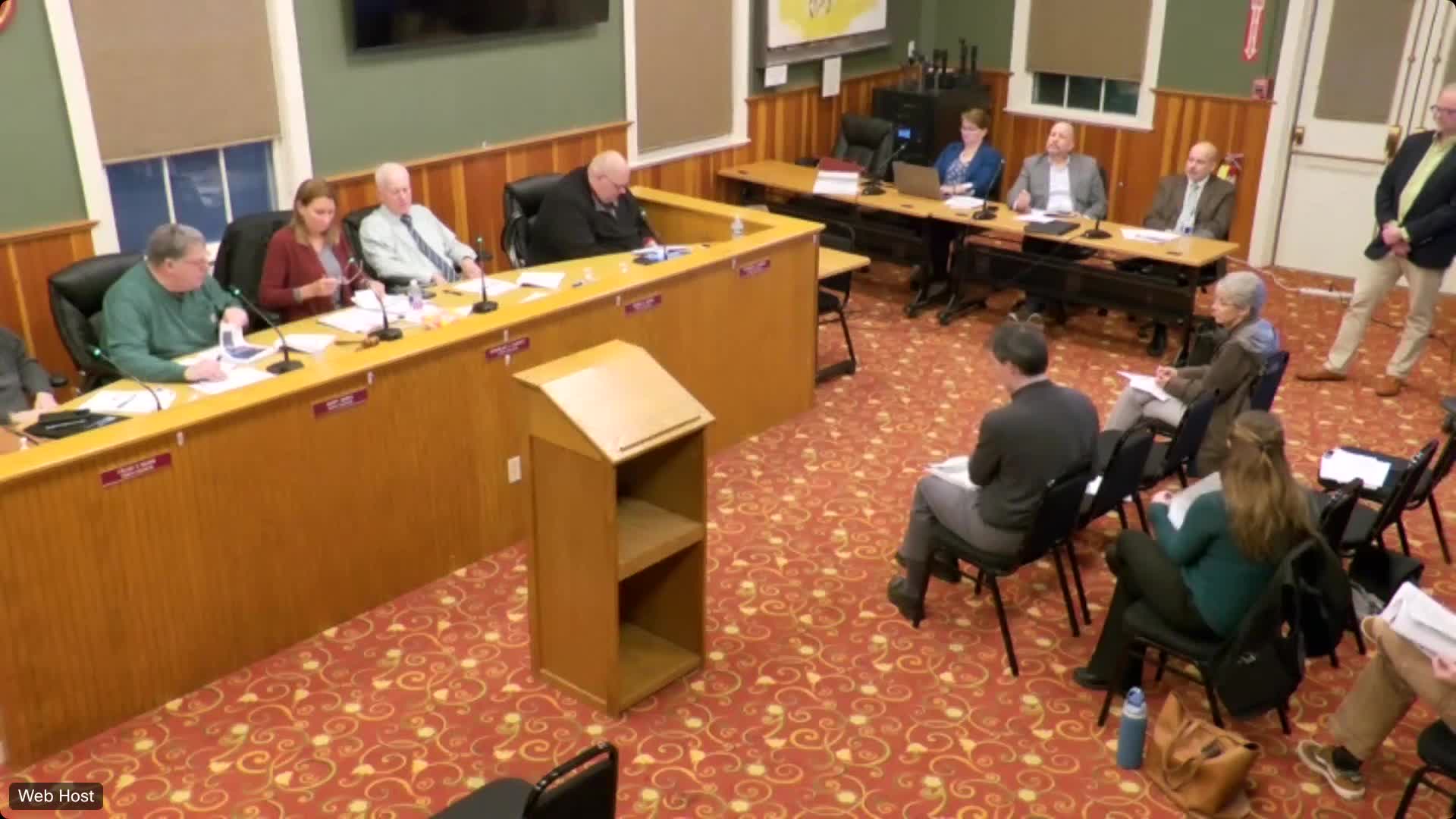
Consultant Jim Reardon of Weston & Sampson presented the Town of Charlestown’s Municipal Technical Assistance Program (MTAP) needs analysis — titled “Confronting Housing Needs and Nitrate Management” — at a March 17 special meeting of the Charlestown Town Council.
The study maps areas beyond development carrying capacity in the Salt Ponds watershed, highlights rising nitrate concentrations in groundwater, and recommends a mix of regulatory and infrastructure tools — including a nitrogen-management overlay district, transfer of development rights (TDR), upgraded on-site nitrogen-reducing wastewater systems and low-impact stormwater controls — to limit future nitrate loading while targeting development to less-sensitive areas.
Why it matters: Charlestown relies entirely on groundwater for drinking water and contains large portions of the Salt Ponds watershed, where dense development and septic discharge have produced nitrate concentrations the consultant said are commonly 5 parts per million and higher in several places. The report frames the challenge as balancing statewide development pressure (including recent state zoning changes expanding accessory-dwelling-unit opportunities) with local water-quality protection.
Reardon summarized key technical findings and approaches. He said the town’s population and housing stock have increased substantially over the last 50 years and that many dwellings (he cited about 63% in town) sit inside the Salt Ponds watershed. He described treatment options — “upgrading on-site wastewater treatment systems to nitrogen reducing systems” — and noted that some advanced systems can discharge as low as 5–10 parts per million, compared with typical systems that discharge at higher concentrations.
The consultant recommended a multi-part program: adopt a nitrogen-management overlay in sensitive areas; require enhanced wastewater and targeted stormwater infiltration practices for new development and redevelopment in those areas; employ TDR to shift growth to less sensitive receiving zones; and couple regulation with public education, social marketing and an adaptive-management monitoring program with a regular review committee.
Councilors and local stakeholders praised the report’s environmental analysis but raised repeated concerns that the study did not provide the level of actionable guidance they expected on affordable-housing production. Councilor Carney said the report “fails to appropriately address the development of the affordable housing,” and several commissioners and members of the Affordable Housing Commission echoed that the deliverable emphasized nitrate management more than steps to increase low- and moderate-income housing.
Council members also questioned data and mapping methods. Councilor Carney challenged the presentation’s headline population figure, saying the 79% increase cited covers a 50-year span and does not reflect more recent 20-year trends shown in the town’s comprehensive plan. Reardon said the 79% figure refers to the 50-year change and argued the town should prepare for intensifying development pressure tied to recent state zoning changes.
Councilors and public speakers asked for more granular data: one councilor noted the town’s comprehensive plan and a recent hazard-mitigation review show much smaller increases in recent years, and another cited building-permit counts (39 single-family permits from 2018–2024) and a roughly 3% housing increase over seven years. Reardon and staff said some specific counts requested (for example, exact percentage of land above nitrate carrying capacity) were not part of the consultant’s scope or the field review completed under this contract.
Local planner Sean Henry said the report is a useful tool for identifying where development is most appropriate and for spelling out environmental constraints, and he urged combining these environmental tools with additional zoning or regulatory work to increase housing supply where suitable. Sandra Pachelski of the Affordable Housing Commission said the report “doesn’t really give us much useful information to actually create units.”
No formal council vote was taken to accept or adopt zoning changes; at the meeting’s end councilors thanked the consultant and asked for the underlying GIS/data layers used to make the map so staff and councilors could review mapping assumptions.
Ending: Councilors directed staff to continue review, including obtaining the data layers and continuing interdepartmental discussion; no ordinance or zoning change was introduced or adopted at the March 17 meeting.