Get Full Government Meeting Transcripts, Videos, & Alerts Forever!
Get email alerts on the State Relations And Legislative Priorities topic
No spam. Unsubscribe anytime.
Charlestown leaders press state lawmakers on zoning, beachfront funding, procurement and short‑term rental revenues
Summary
Town councilors met Feb. 10 with Rep. Tina Spears and Sen. Victoria Gu to review Charlestown’s legislative priorities, including local control over density bonuses and septic/well limits, funding for Bri(e)chway/beachway reconstruction, procurement thresholds and whether short‑term rental taxes should be returned to towns.
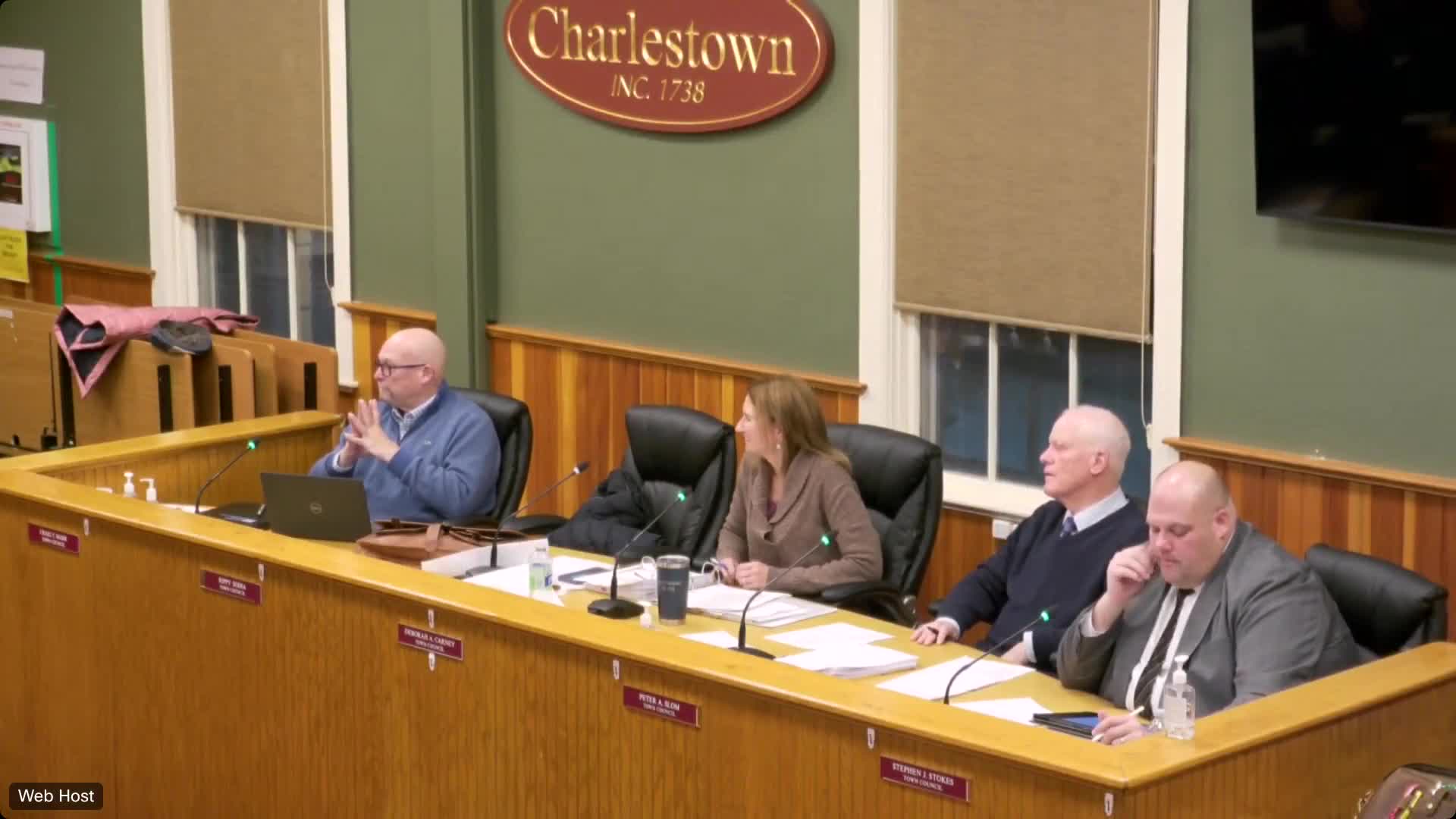
Charlestown Town Councilors met Feb. 10 with Representative Tina Spears and Senator Victoria Gu to review the town’s legislative priorities for the 2025 session, raising concerns about density bonuses tied to affordable housing rules, funding for the Charlestown beach/breachway reconstruction, municipal procurement rules and proposals to redirect short‑term rental and hotel tax revenue to the towns where it is collected.
On density and zoning, councilors told lawmakers that Charlestown’s lack of public water and sewer makes state-wide density bonuses difficult to apply locally. Councilor Stokes and others said developers can use an affordable-housing percentage to qualify for a density bonus that increases the size of entire developments even though only a fraction of units are designated as affordable. Senator Gu and Representative Spears said state regulation (including DEM permitting for wells and septic) and statute include tiers that account for water/sewer availability, but they invited specific local language if the town wants state modifications. “If the town proposes something to give back that local control…then that’s when I think you’ll see a lot more autonomy,” Senator Gu said.
On the Charlestown beach/breachway project, lawmakers said dredging funds were moved up from fiscal 2027 to 2026 and that the state Department of Environmental Management (DEM) has project-level capital funds that could be candidates for support. Federal funding remained uncertain, and lawmakers warned a $220 million state shortfall could affect final appropriations. Representatives said green bond funding and state capital funds remain potential avenues and encouraged the town to be prepared to testify at hearings.
Councilors also raised procurement concerns, including the effective threshold for bid rules (noted as $10,000 for some construction work) and the impact of prevailing‑wage requirements on small municipal projects. Council members asked whether thresholds could be adjusted or whether towns could have more flexibility for low-dollar purchases; lawmakers said they would take those concerns back for review.
Finally, councilors discussed proposed changes to the hotel/homestay tax: the governor’s budget would subject some whole-home short‑term rentals to a 5% tax that is currently applied to hotels, with state-level distribution for homelessness. Representative Spears and Sen. Gu said bills under development would instead target revenues back to the towns where the tax is collected, enabling local spending on resilience, affordable or workforce housing. Officials advised the council to prepare a resolution supporting a preferred formula once bill numbers are posted.
No binding state action resulted from the meeting; lawmakers invited follow‑up language and encouraged the town to coordinate with nonprofit housing developers, the League of Cities and Towns and regional tourism groups.