Get Full Government Meeting Transcripts, Videos, & Alerts Forever!
Get email alerts on the Water Utility Ami topic
No spam. Unsubscribe anytime.
Council hears staff presentation on AMI metering; project cost estimates $1.2–$1.9 million
Summary
Batesburg-Leesville — Town staff presented an overview of advanced metering infrastructure (AMI) during the council work session on March 31, outlining technical features, expected benefits, and a preliminary cost range of $1.2 million to $1.9 million for townwide deployment.
Batesburg-Leesville — Town staff presented an overview of advanced metering infrastructure (AMI) during the council work session on March 31, outlining technical features, expected benefits, and a preliminary cost range of $1.2 million to $1.9 million for townwide deployment.
Utilities staff Jay Hendricks led the presentation alongside newly hired Utility Director Andrew Body. Staff described AMI as a system of solid-state "smart" meters that transmit encrypted meter readings to collectors (likely mounted on water tanks) on regular intervals (hourly or daily) to support customer portals, leak alerts and more accurate billing. Staff said the town has about 3,200 meters and that current manual reads by two meter readers take roughly three weeks to complete each billing cycle.
Staff outlined goals: reduce unaccounted water, replace degraded meters that under-register, provide customers with usage portals and alerts, and improve leak detection to reduce large bills and customer complaints. Staff estimated a 5% average under-registration across the system based on past testing and said recovering that consumption could yield roughly $158,882 annually (water plus sewer) at the assumed 5% level; staff emphasized estimates are preliminary.
Technical points discussed included use of solid-state meters with internal batteries warrantied for 15 years and a projected 20-year battery life; the need for a vendor propagation study to verify radio coverage for System 2 (lake/Harbor Watch area); and alternative collection options, such as cellular backhaul or partnership placements on neighboring tanks or lift stations.
Council members raised multiple questions about cost, financing, equity and implementation. Councilmember Hall and others asked whether savings from more-accurate metering should be earmarked for replacing aging distribution pipes; one councilmember said she would support AMI only if savings were directed toward pipe replacement. Staff noted potential financing sources including cooperative purchasing, bank financing and grant programs through rural water authorities but said no grant award or procurement decision had been made.
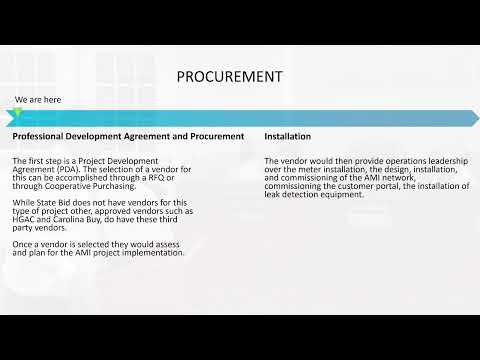
Staff presented estimated project and financing scenarios provided by vendors and local banks, and said a typical third-party vendor would perform a propagation study, manage procurement and coordinate meter replacement and data onboarding. Staff recommended the town consider using cooperative purchasing or RFQ procurement and described possible contract terms, warranties and options to check meter pits for lead connections during installation.
No formal council action was taken; staff said the presentation was intended to inform future decisions and to solicit council feedback on priorities and funding preferences.