Get Full Government Meeting Transcripts, Videos, & Alerts Forever!
Get email alerts on the Transportation Safety Grant topic
No spam. Unsubscribe anytime.
Batesburg‑Leesville reviews $8 million Safe Streets implementation plan for sidewalks, intersections and traffic calming
Summary
Council members and staff discussed how to spend an $8 million federal Safe Streets and Roads for All implementation grant, focusing on sidewalks, intersection framing for planned parks, traffic calming near schools and the towns 20% match requirement and timeline.
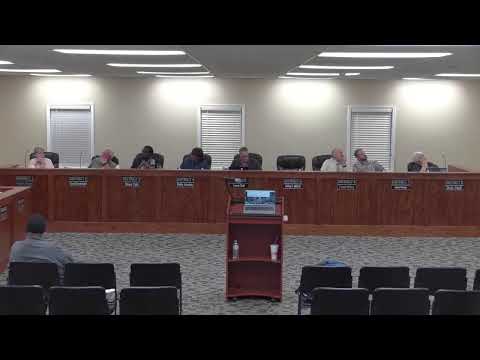
Batesburg‑Leesville council members and staff spent a Feb. 26 work session reviewing how to implement an $8 million Safe Streets and Roads for All grant from the Federal Highway Administration, focusing on sidewalks, intersection improvements, neighborhood traffic calming and how to meet a 20% local match.
The grant is an implementation (phase 2) award following an earlier study, Jay (the town manager) told the council. Jamie Kendrick, a consultant with Wood Valley Strategies who helped write the application and advise on the project, described potential uses and timelines: sidewalks along key corridors, intersection work to frame future park projects and quick-build traffic-calming measures in neighborhoods.
Kendrick said the grant is intended to fund a range of safety and infrastructure work and that the town must sign a grant agreement with the Federal Highway Administration before spending significant funds. "There is a 20% matching requirement, which we know is a big slug for a small town," Kendrick said, adding that the town could spread project delivery over several years and pursue partnerships to meet the match.
Why it matters: the award would be one of the largest single infrastructure investments the town could direct at pedestrian connectivity and roadway safety, tying improvements to economic-development projects such as Woodard Park and to planned sidewalks along Church Street and Lee Street.
Key details and timeline
- Grant size and scope: Kendrick said the implementation grant totals roughly $8,000,000 for infrastructure work the town outlined in the application, including sidewalks, intersection framing and neighborhood traffic calming.
- Matching requirement and reimbursement: Kendrick and town staff told the council the grant requires a 20% local match (about $2,000,000 on an $8 million award). Kendrick said reimbursements will be submitted monthly once projects are underway but the town should expect to front some costs. "There's a 20% matching requirement," Kendrick said. Jay added that the town expects most nonfederal match to come from state funds and local sources (hotel/restaurant tax, county funds or C‑funds) and noted other partners could contribute.
- Timeline and obligations: Kendrick said the town will have five years from the date the grant agreement is signed to obligate funds (to get them under contract). He estimated it could take several months to complete the federal agreement and suggested the second or third quarter of the year as a target to begin obligating funds.
Proposed project priorities discussed
- Sidewalk network: council members repeatedly prioritized filling gaps on main corridors over piecemeal blocks. Identified corridors included Church Street from Raven to Walmart, Lee Street (from the college to Highway 1 and extending toward Bridal/Cedar), Line Street and Howard Street toward Twin City Park. One council member said completing a continuous pedestrian loop through town (Walmart light through the Batesburg and Leesville districts) should be a priority to gain better pricing and construction efficiency.
- Intersection and park-related framing: Kendrick illustrated concepts for framing intersections near proposed parks, including a discussion of Saluda and Westchurch and improvements at Lee and Columbia. He said some options (for example, a roundabout at Saluda and Westchurch) may be impractical because of truck traffic but that framing intersections to advance park construction could be a strategic use of funds.
- Neighborhood traffic calming and quick wins: council members pressed for quick-build, low-cost measures (curb tightening, flex posts, mini islands, tightened geometry) near the middle school, Twin City Park and streets where residents report speeding (Maple, Rawls Drive, Ross Drive). Kendrick said there are "7 or 8 areas" that could be quick candidates for first-year work to show early results while larger designs proceed.
Partnerships and potential match sources
Council members and staff discussed several ways to reduce the local cash burden: using state funds already programmed by SCDOT for nearby projects; counting donated property or right-of-way toward match; coordinating C‑fund or county funds; and arranging funding swaps with state- or COG‑programmed projects. Kendrick and town staff said they were already talking with the Central Midlands Council of Governments (COG), Lexington County and SCDOT about aligning schedules and funding.
Design, procurement and compliance
Kendrick told the council some federal procurement hurdles can be eased by piggybacking on existing contracts and that the town could use the engineering work already done by Mead & Hunt as a base. He said the town will need to adopt certain compliance documents and possibly a resolution or two to satisfy DOT requirements as the agreement moves forward.
Concerns raised by council and staff
Council members cautioned that traffic-calming devices should not inadvertently create bottlenecks near new residential development the planning commission is reviewing. School‑related queuing and dismissal traffic at South Lee and adjacent side streets drew specific concern; Kendrick said safety improvements that support queuing or that use donated property for expanded circulation could be eligible and might count toward match.
Maintenance and zoning implications
Council members discussed whether town code should require frontage improvements (sidewalks) as a condition of new development. Staff warned that if the town requires sidewalks where SCDOT does not, the town will likely assume maintenance responsibility; the council noted existing town code already places some sidewalk upkeep obligations on property owners for certain streets and directed staff to coordinate with planning and the town attorney on code changes and developer site plan review.
Next steps
No formal spending decisions were made. Staff and consultants will continue negotiations with the Federal Highway Administration, pursue partnerships with SCDOT and the COG to reduce the local match, and return with more detailed project priorities and cost estimates. Kendrick said his goal would be to complete the grant agreement by the end of the second quarter and to stage work in batches over the five-year obligation window. "We wanna save your money for final design construction," Kendrick said.
Ending: Council members asked staff to coordinate discussions with the planning commission, school district and SCDOT so that sidewalk, intersection and traffic-calming plans align with new development and school needs; staff and Kendrick said they will follow up with more detailed prioritization and coordination meetings over the coming months.