Get Full Government Meeting Transcripts, Videos, & Alerts Forever!
Get email alerts on the Energy Solar topic
No spam. Unsubscribe anytime.
Central Midlands COG outlines EPA-funded solar plan for Batesburg-Leesville wastewater plant
Summary
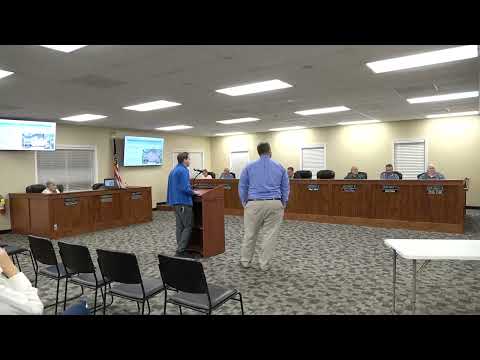
Jory, a planner with the Central Midlands Council of Governments (COG), briefed the Batesburg-Leesville Town Council on a Climate Pollution Reduction Grant the COG applied for that would fund a solar array adjacent to the town's wastewater treatment plant.
Jory, a planner with the Central Midlands Council of Governments (COG), briefed the Batesburg-Leesville Town Council on a Climate Pollution Reduction Grant the COG applied for that would fund a solar array adjacent to the town's wastewater treatment plant.
The grant presentation said the COG's program would support multiple Midlands communities and the COG identified a potential solar site next to the town's plant. Jory said the COG's model shows the array would reduce the plant's electricity costs substantially: "The way I like to think about solar is, of course, it has environmental benefits, but it's also a money printing machine that decreases the electric bill," Jory said.
Jory told council members the COG estimated a roughly 13-year payback if the town paid for the system entirely itself, and that the payback would fall to about "a 3 and a half year payback" with the grant and available federal tax-credit reimbursements. He also described a matching-funds structure in the grant plan in which the COG would cover about 60% of project costs and the town would provide the remainder; the town would carry some upfront costs while awaiting an IRS reimbursement that arrives after project completion and paperwork filing.
During questions, a town staff member said the dataset used in the application listed about 12.9 acres of adjacent town-owned land; Jory said the final array would likely use only a portion of that acreage, "potentially a few acres, but not all 12." Jory cautioned that final size will depend on additional scoping, design-bid responses and the local electric utility's interconnection limits.
Council members asked about timeline, cost-carrying and durability. Jory said the COG expects to complete the project within roughly two years if procurement and contracting proceed as planned, and that municipalities typically need to carry the unreimbursed share for months while IRS paperwork is processed. On durability he said commercial panels generally carry 20- to 25-year warranties and that maintenance needs are limited absent physical damage; he added that maintenance provisions can be included in procurement contracts if the town prefers.
Council members and staff discussed Dominion Energy's role in interconnection and any size limits set by the existing transformer at the plant. Jory said the array size chosen for the grant was based on preliminary coordination with Dominion and that the likely project would remain well under the 1-megawatt threshold that triggers a more intensive interconnection process.
The presentation was informational; Jory told the council there was no action required that night and that more detailed scoping would be done if the town elects to proceed during the next fiscal year.
Ending: The council placed the project on its horizon for future consideration. COG staff said they will return with more detailed figures and procurement-level information as the project advances.