Get Full Government Meeting Transcripts, Videos, & Alerts Forever!
Get email alerts on the Natural Resource Exemption topic
No spam. Unsubscribe anytime.
Committee Hears Targeted Fixes to 2023 Natural-Resource Estate Exemption
Summary
House Bill 3,630 would clarify and broaden the natural-resource exemption enacted in 2023 (SB 498) by allowing trusts and family businesses to qualify, adjusting look-back/look-forward rules, allowing replacement property in exchanges, and excluding qualified property from certain tax-ratio calculations.
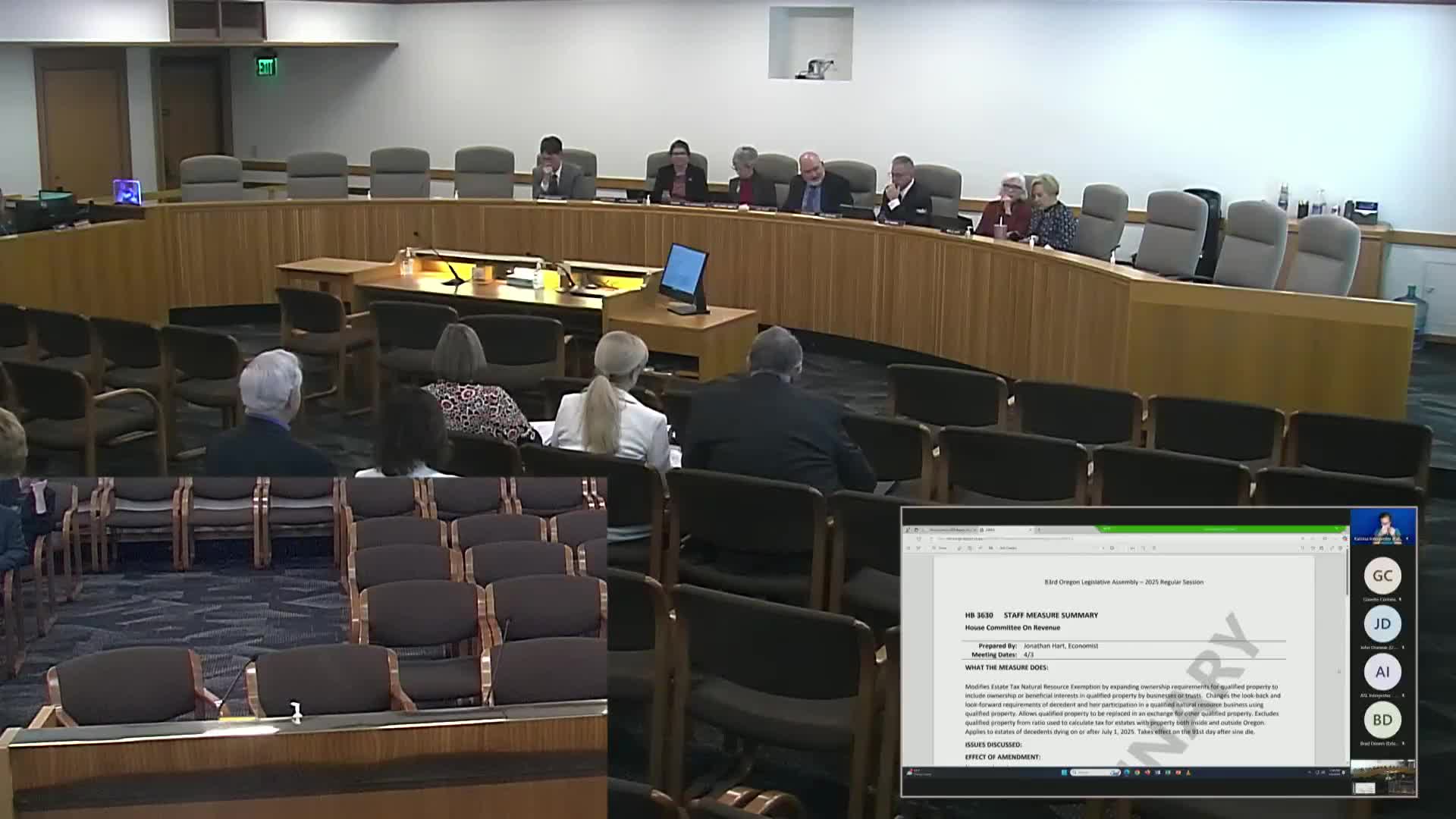
The House Committee on Revenue opened testimony April 3 on House Bill 3,630, which proposes technical and substantive clarifications to Oregon’s natural-resource estate exemption created by Senate Bill 498 in 2023. Sponsors and witnesses described the measure as a "shakedown cruise" fix to address implementation gaps and uncertainty that emerged after SB 498 took effect.
Representative Kevin Mannix and a group of estate-planning attorneys and accountants told the committee the bill aims to preserve the legislative intent while making the statute workable for family-owned farms, timberlands and fishing operations. Key changes described in testimony include allowing ownership by trusts and family-owned business entities (LLCs, S corporations), clarifying the five-year look-back and look-forward ownership/management tests for family members, permitting replacement property acquired in an exchange to qualify, and excluding qualifying property from the ratio used to calculate tax when a decedent owns property inside and outside Oregon.
Attorney Heather Gilmore, who chairs and organized a work group of attorneys and accountants on the subject, said farmland values have increased dramatically and that many family operations use LLCs and trusts for asset protection and succession planning. She told the committee that the group asked the Department of Revenue to adopt administrative rules to interpret active management as "days in the industry" and suggested statutory language to ensure common farming practices (entity use, trust ownership, equipment replacement) would not unintentionally disqualify property from the exemption.
John Hawkins (CPA) and other practitioners described common family business ownership structures — for example, placing land in an LLC while operating the farm through an S corporation — and urged that intra-family transfers among family-owned entities not trigger disqualification. Attorneys and witnesses also raised practical concerns about replacement of assets (tractors and equipment degrade over time) and the need for statutory clarity on exchanges.
Opponents and other commenters noted the law’s complexity: Tax Fairness Oregon urged a broader work group and the consolidation of multiple natural-resource provisions into a single, clearer exemption; advocates warned of loopholes that could allow large natural-resource property owners to avoid tax entirely. Several witnesses recommended a broader, multi-stakeholder review to harmonize the existing provisions and consider gift-tax interactions.
Ending: The public hearing concluded with committee members asking Legislative Revenue Office and Department of Revenue staff to provide technical guidance and with proponents urging statutory fixes to ensure family farms and similar businesses can rely on the exemption without costly trust structures or unintended disqualification.