Get Full Government Meeting Transcripts, Videos, & Alerts Forever!
Get email alerts on the Energy Hydropower topic
No spam. Unsubscribe anytime.
Maine committee weighs limiting data centers’ use of on‑site hydro power at Millinocket redevelopment
Summary
A public hearing on LD 912 focused on a proposed amendment that would cap how much behind‑the‑meter power a generator at the former Great Northern Paper Mill site could sell to data centers to preserve power for other industrial redevelopment.
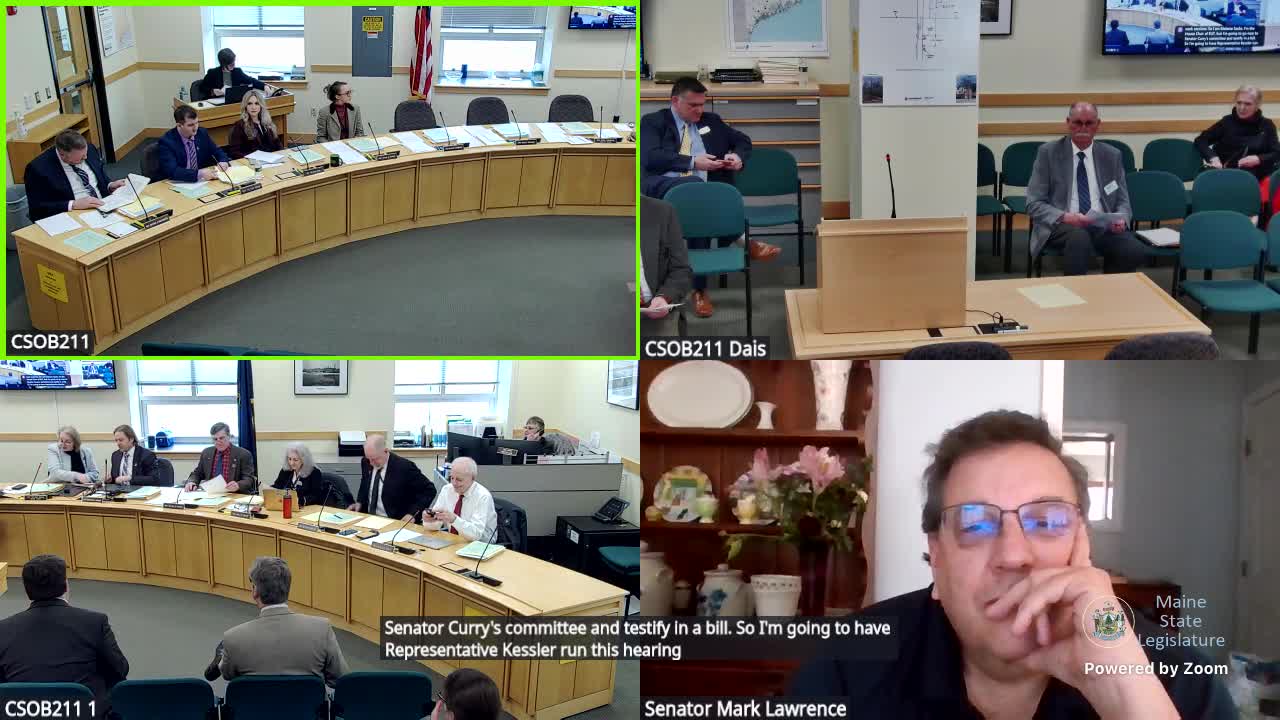
A bill to limit the amount of on‑site electricity that can be sold to data centers at a former paper mill site in Millinocket drew a full public hearing before the Joint Standing Committee on Energy, Utilities and Technology on April 3.
Senator Chip Curry (sponsor) told the committee LD 912 as amended is aimed at preserving the redevelopment value of the former Great Northern Paper Mill site by limiting the amount of behind‑the‑meter power that could be promised to data centers. “The amended version of LD 912 seeks to limit the amount of power that can be promised to data centers, ensuring that the resources available to promote the broader economic development goals on the site and in the region,” Curry said.
Supporters from 1 North (also referred to as Our Katahdin), which markets the Millinocket site, argued data centers could buy all available hydropower and crowd out other industrial users that promise more local jobs and broader economic impacts. Shane Flynn of 1 North said prospective industrial users include a salmon farm the group estimates would require about 50 acres, employ about 85 full‑time people and represent roughly a $300 million investment and a liquid biofuels company the group described as requiring about 30 acres, roughly 45 full‑time jobs in phase one and a roughly $200 million phase‑1 investment. Flynn told the committee “we welcome any companies wishing to bring economic development to the state and region, but data center companies are attracted to the area for one asset, inexpensive hydropower.”
Bill Ferdinand, counsel to 1 North, explained the proposed amendment’s mechanics: if the generator at the Millinocket site sells more than 25% of capacity to a data center the generator could lose the utility status exemption that allows on‑site sales without becoming a transmission and distribution (T&D) utility. Ferdinand said the underlying statutory exemption the site currently relies on was designed specifically for the Millinocket situation.
Opponents and cautionary witnesses raised policy and grid impacts. The Governor’s Energy Office (Caroline Cohn) and the Public Advocate (Heather Sanborn) both testified neither for nor against, recommending caution. Cohn said the GEO is “hesitant in establishing a statewide precedent,” noting national studies that project large growth in data center electricity demand and flag questions about wholesale market prices, emissions, and cost allocation for transmission upgrades. Sanborn said the state should consider tariff design, guidelines for special contracts and mechanisms to ensure data centers bring incremental clean power or participate in export‑oriented energy parks.
Sponsors and proponents emphasized the proposal’s limited scope. Multiple witnesses and counsel said the draft amendment was intended to apply only to the Millinocket site and not to broader statewide policy. Bill Ferdinand told the committee he believes “there’s no other site in the state of Maine that would qualify under section d or of the amendment” as currently drafted.
Questions from legislators focused on details: the size and reliability of the hydro resource, how much power target projects would consume, whether battery storage should be treated similarly to data centers, and how the amendment might interact with federal or regional pricing. Flynn said the local hydro nameplate is 26 megawatts, and that some prospective industrial users described would require multiple megawatts (he mentioned roughly 13.5 megawatts for the salmon operation and 3–4 megawatts for a first phase of a biofuels plant). Flynn and others warned that very large data‑center projects can seek hundreds of megawatts and that those buyers are often deep‑pocketed and able to offer generators long offtake commitments.
The committee did not take formal action on LD 912 at the hearing. Several committee members asked the sponsor and stakeholders to bring additional information to the work session, and multiple witnesses urged the committee to consider statewide regulatory issues — such as tariff structures, special contract review, and transmission cost allocation — in a broader process.
The hearing record includes written materials and several attendees who asked to be contacted for the work session. The GEO, the Public Advocate and industrial consumer groups told the committee they are available to help develop a more detailed policy and regulatory approach that protects ratepayers and accounts for grid impacts while preserving the Millinocket redevelopment opportunity.