Get Full Government Meeting Transcripts, Videos, & Alerts Forever!
Get email alerts on the Data Centers Behind The Meter topic
No spam. Unsubscribe anytime.
Maine committee hears concern that data centers could claim behind‑the‑meter hydropower at Millinocket site
Summary
Sponsor and proponents told the Energy, Utilities and Technology Committee they support redevelopment of the former Great Northern Paper mill in Millinocket but asked the Legislature to limit how much on‑site power can be committed to a single data‑center buyer to preserve energy for other local industrial uses and jobs.
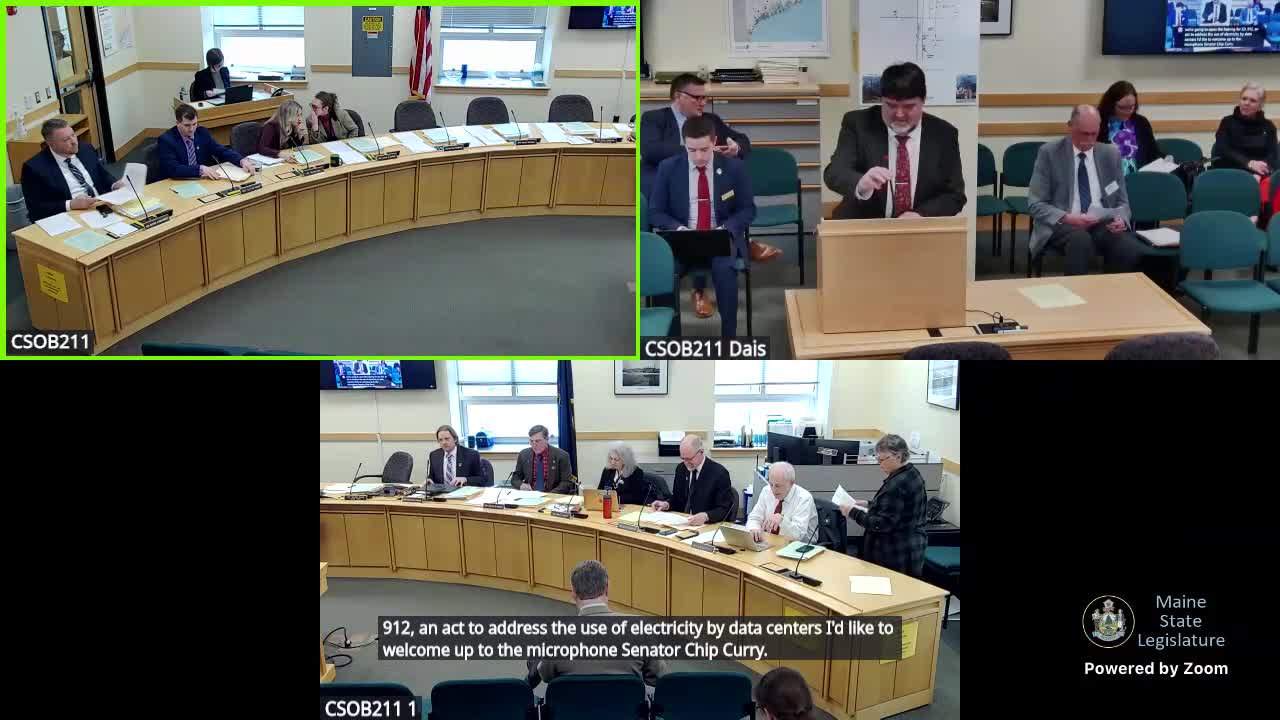
Sen. Chip Curry (R) told the Legislature’s Energy, Utilities and Technology Committee that amended LD 912 would constrain how much on‑site hydropower can be promised to data centers at the former Great Northern Paper Mill site in Millinocket while leaving room for other industrial reuse.
“This provision allows for commercial level behind the meter electricity power grama between generators and their tenants,” Curry said during opening testimony, describing the statute that currently lets on‑site generators sell directly to co‑located users without becoming a transmission and distribution utility.
Proponents from 1 North, the nonprofit marketing the Millinocket site, said the town’s redevelopment depends on access to affordable renewable energy for multiple industrial users. Shane Flynn of 1 North told the committee two target companies — a salmon farm and a liquid biofuels developer — would each use multiple megawatts and create dozens of full‑time jobs, while recent interest from large data‑center brokers could threaten that mix.
“Data center companies are attracted to the area for one asset, inexpensive hydropower,” Flynn said. “We welcome any companies wishing to bring economic development, but not to the exclusion of opportunities that employ and engage fully with local resources.”
Bill Ferdinand, counsel for 1 North, explained the bill’s technical fix is intended to apply narrowly to the Millinocket site and to preserve the existing statutory exemption that lets a generator serve on‑site loads without being regulated as a T&D utility. He said the amendment would cause a generator to lose that exemption if it sold more than 25% of its capacity to a data center, a limit the sponsor and proponents view as a practical way to avoid a single buyer “gobbling up” a site’s available power.
The Governor’s Energy Office, the Public Advocate and municipal and regional development officials testified neither for nor against; they urged caution and broader study of how data centers affect wholesale markets, transmission and ratepayers. Caroline Cohn of the GEO highlighted national analyses showing potential effects on locational prices and capacity factors if major new loads use behind‑the‑meter energy without new incremental clean generation.
“Our concern is to proceed cautiously to ensure that the data center demand doesn’t adversely impact the reliability and cost of the grid for other users,” Cohn said.
Public testimony included local development leaders and legal counsel for the Millinocket project, who asked the committee to preserve the site’s appeal to a range of employers. Committee members pressed proponents about how much generating capacity exists on the site, how batteries interact with hydropower, and whether the sponsor’s proposed 25% limit was evidence‑based. Flynn told the committee the site’s nameplate hydroelectric capacity is about 26 megawatts and with minimum‑flow constraints the realistic annual average is higher, but noted prospective industrial users would consume tens of megawatts over phased builds.
The committee did not take a final vote on LD 912 during the hearing. Members signaled they would take further questions and consider amendments in work session.
Ending: The hearing established a central tension for Millinocket’s redevelopment: whether to preserve on‑site renewable power for multiple local industrial users or allow large data centers to secure large blocks of low‑cost, behind‑the‑meter electricity. Proponents urged a narrowly tailored fix tied to the Millinocket site; state energy staff urged careful study of systemwide impacts before broader policy changes.