Get Full Government Meeting Transcripts, Videos, & Alerts Forever!
Get email alerts on the Tenant Laws Evanston topic
No spam. Unsubscribe anytime.
Evanston staff, tenants group outline new tenant-rights ordinance and key obligations for landlords and renters
Summary
City of Evanston staff and representatives of the Metropolitan Tenants Organization summarized reforms to the Renters’ Rights and Landlord Responsibilities Ordinance (RLTO), which the presenters said were approved in November and took effect Jan. 1.
City of Evanston staff and representatives of the Metropolitan Tenants Organization on Thursday presented an overview of recent reforms to the city’s Renters’ Rights and Landlord Responsibilities Ordinance (RLTO), which the presenters said were approved in November and took effect Jan. 1.
The reforms update who the law covers, cap certain fees, set rules for security deposits, require written leases and landlord disclosures, specify landlord entry notices and times, allow limited tenant-directed repairs and rent-reduction processes after city inspections, and add protections against landlord retaliation and illegal lockouts.
The presentation was led by Ana Elizárraga, Housing and Economic Development Analyst for the City of Evanston, with Javier Ruiz and Philip Devan representing the Metropolitan Tenants Organization (MTO). Javier Ruiz summarized the timeline and scope: "The reforms were approved in November and went into effect Jan. 1 of this year," he said.
Who is covered and who is excluded: The presenters said the RLTO does not apply to every building or occupant. Exemptions cited included medical, geriatric, educational and religious institutions; student housing that is regulated separately; owner-occupied cooperatives; hotels and motels; units occupied by a purchaser under a contract of sale; and authorized transitional or shelter facilities. The presenters said that if a unit is excluded, the landlord must state that exclusion in the lease.
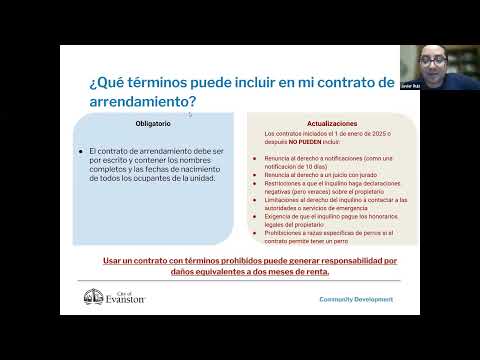
Lease and tenant responsibilities: The presenters said all covered leases must be written, list the full names of tenants and landlords and include the birthdates of all occupants. Tenants remain responsible for complying with local laws and building codes and for using appliances, plumbing and building systems in a reasonable manner. Presenters warned that leases cannot include clauses that waive tenants’ statutory notice rights, require jury-trial waivers, restrict truthful negative comments about a landlord, or prohibit tenants from contacting emergency services or city inspectors.
Fees and security deposits: The presenters described new limits on fees. According to the presentation, late fees are capped at $25 for monthly rents of $1,600 or less; for rents above $1,600 the presenters described the cap as "$25 plus 5 percent" (the presentation did not further clarify the calculation). They said landlords must itemize and justify application and move-in fees when charged. Security deposits, the presenters said, may not exceed 1.5 times the monthly rent; the landlord must place deposit funds in a bank located in Illinois and must return or account for the deposit within 21 days after a tenant moves out.
Required disclosures and landlord contact information: Presenters said landlords must disclose their name and contact information (or a designated agent) and must notify tenants of changes in ownership or management. Landlords must disclose certain building conditions, including city code violations, pending foreclosure on the property, known lead hazards, utility shutoffs and active bedbug infestations.
Repairs, tenant self-help and withholding rent: Presenters explained options when landlords fail to make repairs. Tenants are generally required to give written notice to the landlord and allow up to 10 days for the landlord to respond before arranging repairs themselves. The presenters said tenants may hire a professional and submit the bill to the landlord to deduct from rent, with a stated maximum threshold for tenant-paid repairs described in the presentation as $500. For larger or multiple serious defects, presenters said tenants may follow a process that begins with notifying the city so building inspectors can document violations; after that inspection tenants may deliver a written 10-day cure notice and then reduce a portion of rent in the following month if repairs are not made. The presenters framed the rent-reduction path as a tool to pressure landlords to act, and they emphasized the need to document communications in writing.
Entry, notice and timing: Presenters said landlords may enter a rental unit with tenant consent or for legitimate reasons such as inspection or repairs, generally after giving at least two days’ notice. Entry is permitted during stated hours, described in the presentation as 8 a.m. to 8 p.m., and immediate entry is allowed in emergencies.
Eviction and cure notices: Presenters said a landlord pursuing nonpayment must first give a 10-day notice; if tenants fail to pay within that period the landlord may file an eviction complaint in court on day 11. For alleged lease violations such as unauthorized pets or smoking, presenters said landlords must provide a 30-day notice, during which tenants may cure the violation. During the Q&A portion the presenter misstated renewal-notice timing (initially saying "ninety days," then "nine days") and did not provide a clear, final figure; the required written notice period for lease-renewal or nonrenewal therefore was not specified in the presentation.
Protections against retaliation and illegal lockouts: The presenters said the ordinance prohibits landlord retaliation for tenants who complain to the city, organize with neighbors, serve as witnesses in court, or otherwise exercise rights under the local law. They also said actions such as shutting off utilities, changing locks, or otherwise trying to force tenants out without a court process are illegal "lockouts." The presenters said Internet access and air conditioning are treated as essential services for the purpose of the ordinance when included in lease arrangements.
Practical advice and resources: Presenters repeatedly emphasized keeping written records of requests, notices and payments, and they advised tenants to avoid paying only in cash when possible. They said the city will post the presentation on the City of Evanston website and YouTube channel and directed tenants to call Evanston 311 for referrals; the presenters also offered MTO assistance for tenants seeking help with disputes.
Because portions of the presentation included minor conflicting statements about renewal-notice timing, tenants and landlords seeking precise procedural deadlines or calculations (for example, the formula described for late fees on rents above $1,600) should consult the enacted ordinance text or the City of Evanston for the definitive legal language and numeric thresholds.
The presenters concluded by asking attendees to submit follow-up questions via the event Q&A and the city’s 311 line; the presentation will be available on the city’s website and YouTube channel, they said.