Get Full Government Meeting Transcripts, Videos, & Alerts Forever!
Get email alerts on the Cash Payments topic
No spam. Unsubscribe anytime.
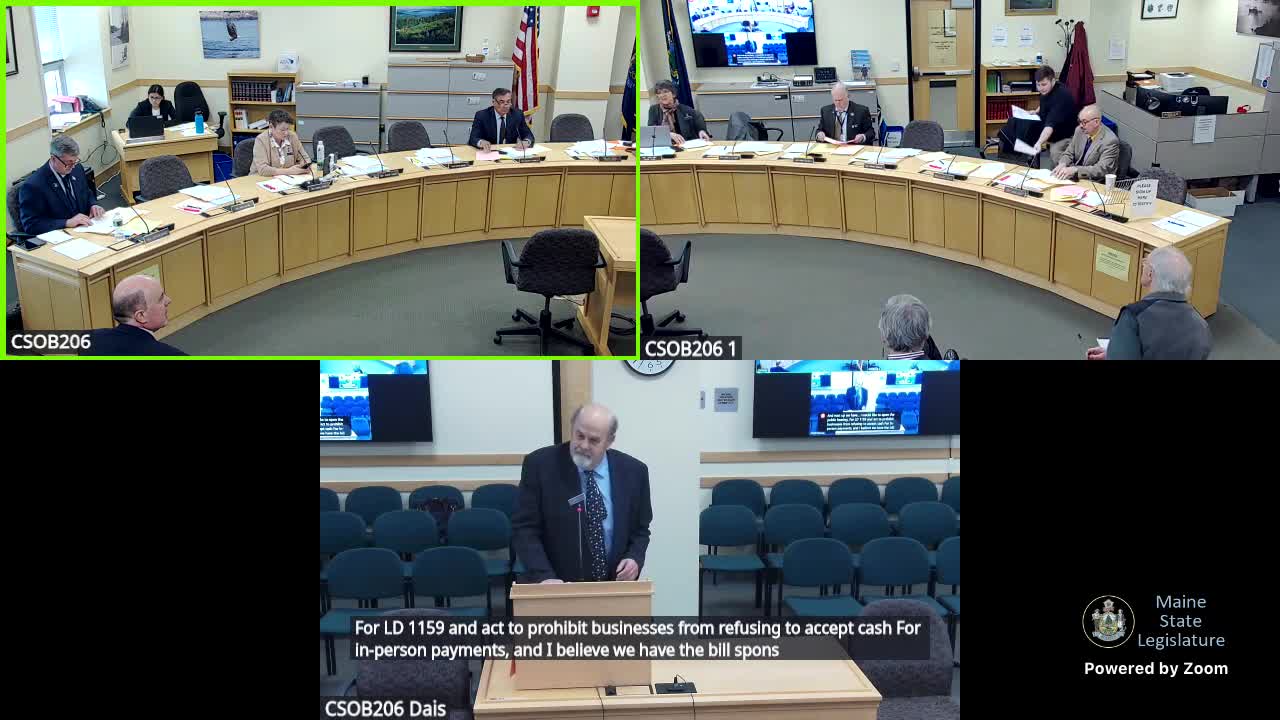
Maine lawmakers hear arguments for and against bill requiring businesses to accept cash
Summary
Supporters of LD 1159 said refusing cash excludes unbanked, underbanked and privacy-conscious customers; retailers and event organizers told the committee cash handling raises costs and safety risks. The committee requested research on other states and legal challenges.
Representative David Rollins introduced LD 11 59, a bill that would require in-person retail businesses to accept cash for transactions under $2,000 and forbid charging higher prices to cash-paying customers. "I believe businesses should accept cash payments," Rollins said, noting concerns about unbanked and underbanked households, older residents and visitors excluded from cashless businesses.
Public testimony divided along predictable lines. Douglas Rooks, speaking as a private citizen, emphasized privacy and access for households without bank accounts and invoked the wording on U.S. currency: "This note is legal tender for all debts, public and private," Rooks said to the committee. He cited a Pew study estimate (provided on request) that an estimated number of Maine households lack bank accounts and argued that cashless policies effectively deny access to commerce for some residents.
Representatives of the business community opposed mandating cash acceptance. Curtis Picard, president and CEO of the Retail Association of Maine, said requiring businesses to accept cash would impose costs and security risks, and that business owners should be allowed to choose their payment methods. "Accepting cash does involve costs such as cash handling, security measures, bank deposits, and potential employee theft," Picard told lawmakers. The Maine State Chamber of Commerce and other business witnesses urged flexibility and pointed to kiosks, single-person retail booths and online competition as contexts where mandatory cash acceptance could be impractical.
The Maine Principals Association (professional and interscholastic divisions) and other event organizers said handling cash at ticket tables or athletic events has in the past led to theft and safety concerns; Dr. Holly Blair testified that her organization moved to cashless ticketing after a $57,000 embezzlement loss tied to venue cash ticket sales. "That experience made clear to us the vulnerabilities and lack of security inherent in managing large sums of cash," Blair said.
Committee members asked witnesses for evidence of how widespread cashless retailing is and whether state or municipal services that have gone cashless (parking meters, some rest areas) should be covered. Senator Rick Bennett asked whether government-run services should be required to accept cash; Representative Rollins said the bill could be amended to include government entities. Committee members asked staff for research into other states' laws and any legal challenges to state-level cash-acceptance requirements.
The committee closed public testimony and requested follow-up information from analysts about other states' laws, legal challenges and estimates of how many Maine businesses do not accept cash. No committee vote on LD 11 59 was recorded during the hearing.