Get Full Government Meeting Transcripts, Videos, & Alerts Forever!
Get email alerts on the Child Safety Family Wellbeing topic
No spam. Unsubscribe anytime.
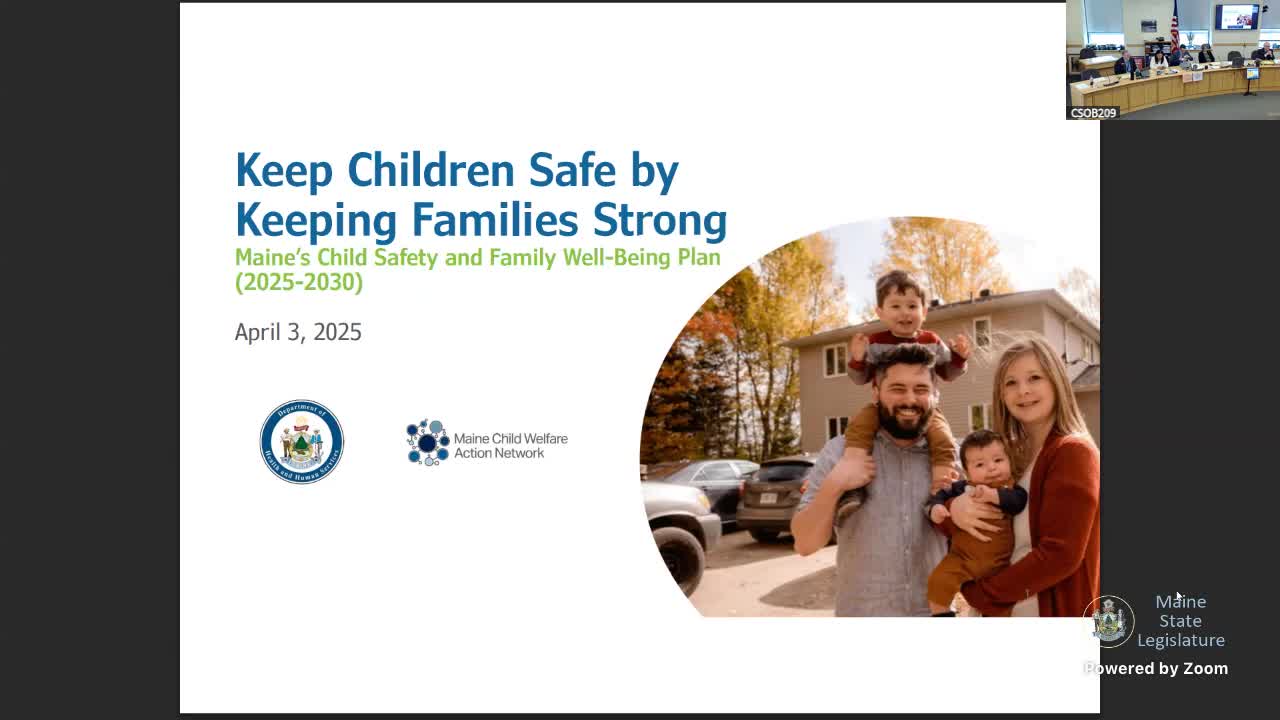
DHHS and partners outline five-year Child Safety and Family Well‑Being Plan
Summary
Child Safety and Family Well‑Being Plan presented to committee leaders Thursday puts prevention and family partnership at the center of efforts to reduce child welfare intervention.
Child Safety and Family Well‑Being Plan presented to committee leaders Thursday puts prevention and family partnership at the center of efforts to reduce child welfare intervention.
The plan, presented by Mariette Aylborn of the Department of Health and Human Services and partners from the Maine Child Welfare Action Network, maps five strategies across two goals intended to ‘‘keep children safe by keeping families strong,’’ Aylborn said. The five strategies include providing economic and concrete supports, expanding access to low‑barrier services, building family partnerships, promoting supportive communities and improving coordination among state and community partners.
The plan matters because participants told presenters that missing basic needs and fear or stigma about asking for help are recurring barriers that push families into crisis. "We can keep children safe by keeping families strong is a theory of change and it's also a call to action," Aylborn said, summarizing the plan's rationale and its emphasis on prevention rather than downstream intervention.
Implementation highlights and examples - "Be There for Me" public awareness campaign: The campaign, seeded by a one‑time $750,000 state appropriation and a $100,000 preschool development grant, created a multi‑language website, ads and print materials to reduce stigma around asking for help and to direct families to local resources. Presenters reported about 19,000 website visits and digital promotions reaching millions of impressions through March 2025. - Community‑based spaces initiative: With one‑time funding of $335,000, Maine Children's Trust and county Prevention Councils surveyed local assets, engaged nearly 25,000 community members and cataloged hundreds of spaces — schools, community centers, food pantries and outdoor areas — that can serve as family supports. Barriers identified included transportation, hours and costs at available sites. - Mandated‑reporting review: DHHS and the Maine Child Welfare Action Network launched a review of mandated reporting, combining data analysis, focus groups and almost 946 survey responses collected in one week. Presenters told the committee that roughly 30,000 calls came into the child protection intake in calendar 2023; 33% were assigned for further action and about 25% of assigned calls later resulted in findings of abuse or neglect. For reports screened out, less than 1% later had findings, the presenters said.
Next steps and metrics Presenters said the plan will be implemented over five years and that the department and partners have developed collective indicators to measure progress. The first annual implementation report is targeted for early 2026. Presenters emphasized ongoing community input, data tracking and the need for sustained cross‑sector coordination.
What committee members asked and raised Committee members asked about whether more reporting is necessarily better and about how the department distinguishes resource needs from neglect in practice. Presenters said the review of mandated reporting aims to improve decision tools and training so mandated reporters can identify appropriate community supports when reports to child protective services are not necessary.
Ending Presenters asked lawmakers and community partners to join the "movement" toward prevention and family support. They offered to return with additional data and invited the committee to review the plan's metrics and early evaluation findings in upcoming reports.