Get Full Government Meeting Transcripts, Videos, & Alerts Forever!
Get email alerts on the Emergency Services topic
No spam. Unsubscribe anytime.
Emergency services seeks added staff, grants and equipment to expand EMS coverage
Summary
The county’s emergency services coordinator requested one additional ALS position, an administrative position and a bundle of grant-funded equipment and generator replacements to improve coverage and reliability for volunteer agencies.
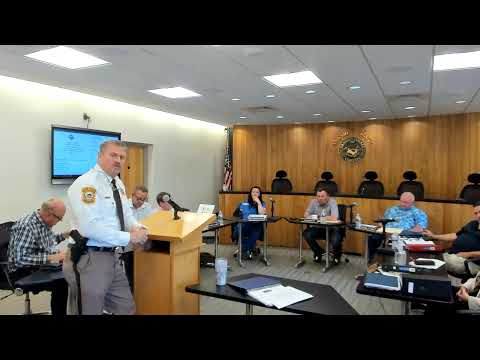
Grayson County’s emergency services coordinator presented the department’s FY26 budget request and asked the Board of Supervisors to support additional staff and several grant-funded equipment projects to shore up countywide EMS coverage.
"We'd like to add an additional EMS position," said Mr. Folwell, the county’s emergency services coordinator. He told the board that adding one ALS position would cost about $64,000 per year including fringes and would move staffing closer to seven-day coverage; Folwell said his office currently lacks personnel to answer roughly a quarter of EMS dispatches when no provider is scheduled.
Folwell described three other key staffing and equipment requests: an administrative/office position estimated at about $45,000 (salary plus benefits) to handle invoicing and paperwork and free coordinator time for emergency management tasks; a multi-year, phased SCBA (self-contained breathing apparatus) replacement program—Folwell proposed purchasing five units per year at roughly $10,000 each under a federal Assistance to Firefighters grant (he noted a local match would be required); and a targeted generator replacement effort for volunteer stations, noting several generator failures in recent years.
On technology and reimbursement, Folwell asked the county to consider a countywide contract for EMS reporting software used for state reporting and agency billing; he estimated the software contract in the ballpark of $24,000 and said the department would pursue grant funding to cover most or part of that cost.
Folwell said the emergency services budget request totals approximately $2,100,000 and that about $2,112,000 of that represents direct pass-through funding to volunteer agencies. He also flagged about $460,000 in contract costs and roughly $279,000 of grant project spending in the request; Folwell said a portion of that grant funding—he estimated roughly $88,000—would be non-recoverable local match.
The coordinator discussed contract increases requested by some volunteer agencies and noted that call volumes have risen in recent years; for example, he reported ALS support call volume has increased to roughly 800 dispatches per year and said that some partner agencies requested higher contract amounts than the county currently pays.
Supervisors asked for a handout of Folwell’s materials and pressed on schedule and coverage options; Folwell said schedule changes alone could not reliably close the coverage gap and that the additional position would provide resilience for training, leave and simultaneous calls. He also discussed interim options such as leasing bunk space with a volunteer fire department and the longer-term possibility of leased bunkrooms or station upgrades.
The board did not take action at the session; Folwell said he would provide handouts and supporting documents for follow-up budget discussions.