
Capitola town hall weighs Park Avenue alignment for Coastal Rail Trail as $67.6M grant deadline looms
Get AI-powered insights, summaries, and transcripts
Sign Up Free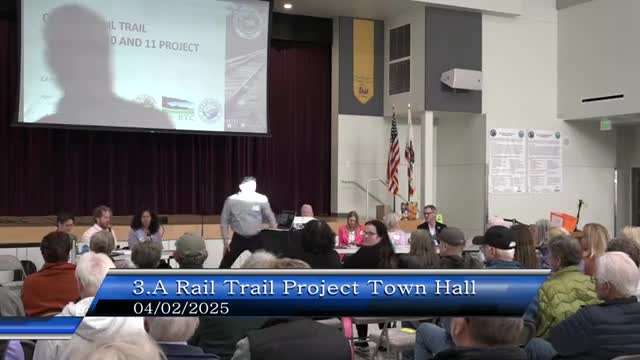
Summary
County and regional transportation officials urged Capitola leaders at a town‑hall meeting to approve a Park Avenue alignment for Segments 10–11 of the Coastal Rail Trail so the region can meet a state grant deadline and preserve $67.6 million in ATP funding.
Capitola — County and regional transportation officials told a packed town‑hall meeting that the City of Capitola must decide soon whether to move the Coastal Rail Trail off the rail corridor and onto Park Avenue if the region is to keep state construction funding for Segments 10 and 11.
Rob Tidmore, project manager for the County of Santa Cruz, told residents the Segments 10–11 project — a 4.2‑mile portion of the 32‑mile Coastal Rail Trail — has secured $93.4 million in funding but still faces an approximately $18.3 million shortfall based on 2023 cost estimates. “It is critical to identify [an] alignment this month to stay on schedule and meet the grant deadline,” Tidmore said, noting the Active Transportation Program grant requires construction funding to be requested by April 2027.
The question matters because the ATP award of $67,600,000 is the main funding source for the county’s work on the trail, and the Regional Transportation Commission (RTC) and county say project delivery depends on meeting the grant schedule. The Park Avenue alignment — which shifts about 0.7 mile of the proposed trail inland and adjacent to Park Avenue rather than along the coastal rail corridor — was recommended during a 2024 value‑engineering review as a way to reduce cost, improve neighborhood connectivity and avoid expensive coastal retaining walls and a viaduct.
Why Park Avenue: staff case
The county, RTC and Capitola staff described technical and cost reasons for preferring Park Avenue in several stretches. Tidmore said the Park Avenue route requires less new infrastructure, reduces conflict with private encroachments on the rail right of way, keeps the trail farther from bluff erosion, and improves access to Cliffwood Heights and schools. Jessica Khan, Capitola public works director, said Park Avenue’s connection to neighborhood streets would improve safe routes to school and that the Park Avenue work was coordinated with earlier city traffic‑calming planning.
Grace Blakesley, a transportation planner at the Santa Cruz County Regional Transportation Commission, added that the Capitola Trestle is a complex set of timber, wrought iron and concrete spans and that “a bicycle and pedestrian bridge cannot be attached to the existing Capitola Trestle due to the structures types,” explaining that a new combined rail‑and‑trail bridge would be required for a long‑term solution and is not funded by the current ATP grant. Blakesley said the RTC’s 2021 analysis estimated trestle repairs at roughly $7,000,000 but that replacement and combined‑use options are far costlier and outside the present project budget.
What the county and RTC will do next
County staff said they will ask the Santa Cruz County Board of Supervisors on April 29 to approve a contract amendment with the consultant team needed to move the project into final design. If Capitola’s council supports Park Avenue, the county said it would request a second amendment to add environmental review for the Park Avenue alignment; RTC staff would request funding for that additional environmental work at the May 1 RTC meeting. If Capitola rejects Park Avenue, the county and RTC said they would seek RTC support to proceed with the coastal alignment despite added cost and feasibility constraints, and would explore alternate permitting paths or scope changes with state agencies — options that staff warned could increase project risk and might jeopardize the ATP grant.
Legal and policy constraints
Samantha Zutler, Capitola city attorney, told the audience that Measure L — enacted by voters in November 2018 and codified in Chapter 8.72 of the Capitola Municipal Code — directs the city to “preserve and utilize the quarter and the trestle for active transportation and recreation,” and also contains language restricting expenditure of city funds on certain trail work on city streets or sidewalks. Zutler said interpretation of Measure L is a city council policy decision: “I give legal advice to the city council and the city council makes the policy decision.”
RTC staff and county officials said those local requirements and state and federal processes are distinct from the regulatory process controlled by the Surface Transportation Board (STB) if the region were to pursue rail abandonment or rail banking. Blakesley said rail‑banking and STB processes are not local decisions and warned that rail‑banking applications can attract opposition and could take longer than the time available to secure construction funding under the ATP schedule.
Mobile homes and right‑of‑way encroachments
RTC staff told the meeting their property survey found private fences, sheds and some mobile homes now sit on RTC‑owned right of way in the Castle Mobile Home Estates. The RTC said it notified property owners in January 2024 of unauthorized encroachments and that options under consideration include seeking variances, shifting homes, replacing or relocating units, or coordinating voluntary solutions with property owners. RTC said a June 2025 date had been presented to property owners as an internal target for resolving encroachments before trail construction, but staff said they had not yet identified steps taken to remove encroachments.
Public comment and community concerns
About two dozen speakers addressed the town hall during the city’s public comment period. Several residents urged the city to approve Park Avenue to preserve the larger project and funding; others urged the city to pursue rail‑banking, preserve the Capitola trestle and avoid routing trail users through Capitola Village. Diane Dreier, who identified herself as a longtime resident, said the community should “think big picture” about future passenger rail needs. A mobile‑home resident said privately owned homes on RTC land are “all we could afford.” Bicyclists raised safety questions about crossings and on‑street bike lanes in the village; one commuter said, “I’ve fallen twice … it's really hard crossing railroad tracks,” and urged clear, safe crossings where the route intersects rails.
Timing and stakes
Project staff repeatedly emphasized schedule constraints tied to the ATP grant and to permit, right‑of‑way and final‑design timelines. Tidmore and RTC staff said final design and right‑of‑way typically require about two years before a construction funding request can be made; that timetable is why the county and RTC are pressing for a near‑term decision on alignment. Staff warned that removing the Park Avenue segment from the ATP scope could jeopardize state grant approval; conversely, proceeding with Park Avenue will require additional environmental review and city permits before construction.
What officials will ask the council to decide
City staff and RTC requested that Capitola’s council state whether it supports studying the Park Avenue alignment so county staff may pursue required environmental review. The city attorney reiterated that the city council — not staff — must interpret Measure L and decide whether city approvals or local funds would be used. County and RTC staff said they will return to Capitola council later this year with environmental findings and permit requests if Park Avenue is advanced.
Why it matters
Officials framed the decision as a choice between preserving the region’s ability to deliver a continuous, funded Coastal Rail Trail now, or seeking alternatives that could delay or add uncertainty to the project and might jeopardize $67.6 million in state ATP funds. Residents on both sides argued the choice affects village character, trail safety and the future possibility of passenger rail. The staff presentations documented the technical tradeoffs — cost, right‑of‑way impacts, bluff stability, monarch habitat and constructability — that underpin the recommendation to pursue the Park Avenue alignment as a lower‑cost, more buildable option in the near term.
Next steps: the county and RTC will pursue board actions in late April and early May and return to the City of Capitola with environmental analyses and permit requests as required. The City of Capitola has scheduled a special council meeting on April 17 to continue this item.