Get Full Government Meeting Transcripts, Videos, & Alerts Forever!
Get email alerts on the Ethics Complaint Mayor Denny topic
No spam. Unsubscribe anytime.
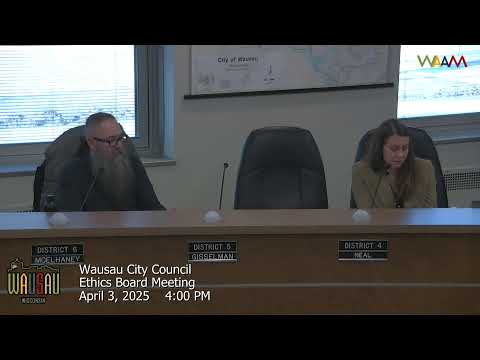
Wausau ethics board finds probable cause in complaint against Mayor Doug Denny; hearing set for April 30
Summary
The Wausau Ethics Board voted to find probable cause that Mayor Doug Denny exceeded his authority by removing a locked absentee ballot drop box, and scheduled a hearing for April 30 at 4 p.m.; the board subpoenaed the city clerk and city attorney to appear.
At a meeting of the Wausau Ethics Board, members voted to adopt preliminary findings that there is probable cause to believe Mayor Doug Denny violated the Wausau ethics code by interfering with the municipal clerk’s plan to deploy an absentee ballot drop box.
The board’s outside counsel, Attorney Eric Larson, defined the standard the body used: “A reasonable ground for belief, supported by facts and circumstances, strong enough in themselves to warrant a prudent person to believe that a violation of the chapter probably has been committed.” The board voted 4–0 with one abstention to conclude its investigation and to adopt the draft finding that probable cause exists.
Why it matters: The board’s finding moves the matter from investigation to an adjudicative hearing, where the board will consider testimony and evidence and may issue final determinations and sanctions under chapter 2.03 of the Wausau Municipal Ordinances (the city’s ethics code).
What the board said it reviewed: The board’s review relied on three core items the chair cited in explaining the decision: the respondent’s sworn statement acknowledging he was told on Sept. 19, 2024, of the city clerk’s plan to deploy a locked absentee-drop box; the clerk’s submission confirming a locked, empty box was placed at City Hall on Sept. 19; and the respondent’s sworn statement and email showing the mayor confiscated the locked box on Sept. 22 and returned it on Sept. 29. The city attorney’s written legal opinion dated Sept. 26, 2024, concluded that state law (cited in the opinion as Wisconsin Statute § 7.15(1)) vests authority to use secure drop boxes with the municipal clerk rather than the mayor; that opinion was part of the record the board considered.
Votes and next steps: After voting to conclude the investigation (vote: 4 in favor, 1 abstention), the board voted to adopt the draft findings that there is probable cause (vote: 4 in favor, 1 abstention). The board then voted unanimously to set a hearing for 4 p.m. on April 30 in the council chambers, and to subpoena the city clerk and the city attorney to attend and be prepared to answer questions. The deputy clerk will finalize and serve the written findings and subpoenas.
Respondent’s position and requests: Respondent’s counsel stated on the record that the mayor would petition for more time before a hearing, asking that any hearing be scheduled at least 30 days after the city attorney and city clerk have each provided what respondent counsel called “complete responses” to the board’s investigative demand. The board declined to delay indefinitely for the state’s criminal inquiry; members emphasized the ethics process serves a different purpose than a criminal prosecution and that awaiting the Department of Justice could materially delay an ethics resolution.
Interim meeting and logistics: The board scheduled a limited follow-up meeting for April 10 at 4 p.m. (to be completed by 5:15 p.m.) to allow members to review submitted materials and consider additional witness subpoenas if needed. The chair and outside counsel indicated drafts of the findings and subpoenas would be finalized and distributed to members and then served by the deputy clerk.
What was not resolved here: The board’s vote at this meeting was a preliminary probable-cause determination, not a final ruling on whether the ethics code was violated. Board members noted that a hearing would permit further factfinding, witness testimony, and cross-examination; the board also recognized the Department of Justice has its own, separate criminal inquiry and that outcome does not determine the ethics board’s findings.
Ending note: The board instructed its deputy clerk and outside counsel to finalize the documents and arrange service; the scheduled hearing remains subject to motions or petitions by parties but, as announced, is set for April 30 at 4 p.m.