Get Full Government Meeting Transcripts, Videos, & Alerts Forever!
Get email alerts on the Ems Municipalization topic
No spam. Unsubscribe anytime.
South Berwick officials propose town-run, fire-based ambulance service starting July 1, 2026
Summary
Town officials presented a plan to move ambulance service from a private contractor to a fire-department–run, municipal EMS model, proposing two ambulances, eight full-time firefighters with medical certification, and an estimated budget increase that would be presented to voters in the next budget cycle.
South Berwick Town Manager Tim proposed on Tuesday that the town move its ambulance service from a private contractor to a municipal, fire-department–based emergency medical service beginning July 1, 2026. The plan calls for buying one new and one used ambulance, hiring four paramedic firefighters and four firefighter-EMTs, and running a staffed ambulance program out of the fire station.
The proposal grew from what Tim described as repeated contract and staffing problems with the current private ambulance provider. “As you know, we have a contractor service ambulance company. Several years ago, they went up significantly on our contract … and we determined later that they did not pass that increase onto Rawlingsford or to the town of York, only us,” Tim said, arguing the town must consider “the long term solvency of how we deliver our EMS service to our citizens.”
Fire Chief (name not specified) walked the council through operational and timeline details and said the department would order a new ambulance immediately and expects delivery about 18 months later. “Here we’re proposing to start providing emergency ambulance service here in town under the fire department starting July first of 2026,” the chief said. Under the plan, the department would cross-train personnel so firefighters could staff ambulances and respond as a single unified team.
Why it matters: town leaders said private ambulance providers statewide are under financial pressure and that many municipalities have moved to fire-based EMS to ensure consistent readiness. The chief cited a 2022 Maine EMS study estimating the cost to run an ambulance call at roughly $1,300 with average reimbursement near $500, producing a large per-call shortfall that private providers struggle to cover. Councilors were told about 12 Maine communities in various stages of transitioning from private to municipal EMS.
Budget and staffing details: the presentation estimated a full-year operating budget for the municipal EMS program of about $1.26 million and a startup request drawn from undesignated funds of roughly $407,000 to buy a used vehicle, equipment and initial supplies. The town manager presented multiple budget scenarios showing a range of taxpayer impacts; one scenario cited a 6.53% increase to the town’s operating budget tied specifically to standing up the service (with alternative scenarios lowering the impact by using undesignated funds). Managers said these figures include salaries, benefits, equipment and a contingency.
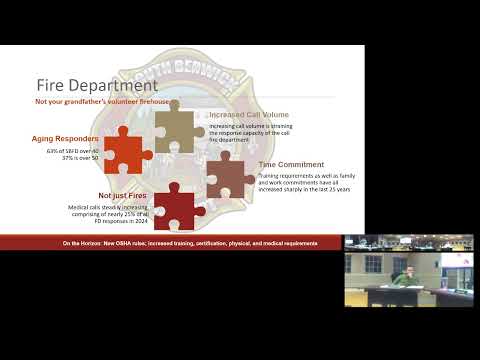
The staffing model described was two-person ambulance shifts with at least one paramedic and one EMT on duty (minimum staffing per ambulance). The town would hire four paramedic firefighters and four firefighter-EMTs to provide 24/7 coverage using a four-shift rotation. The plan also described cross-training existing on-call firefighters (the department reported 36 members, several of whom are currently EMT-certified or in training) and short-term training arrangements with larger nearby services to give new hires ride-time before the town goes live.
Operational points discussed included licensing with Maine EMS at the municipal paramedic level (which requires providing a paramedic 24 hours a day), billing (the town would outsource billing to a revenue-collection vendor and bill patients for transport, keeping patient-billing revenue net of vendor fees), and facility changes to integrate rescue and fire operations at the station. The presenters said two ambulances are desirable so a spare is available if one vehicle is out of service.
Council reaction and next steps: council members pressed for more granular financial comparisons between the status quo and the municipal model, and asked for written estimates of the net fiscal impact — including how often the current private contractor leaves gaps that the town’s firefighters currently fill at overtime pay. Several councilors said they supported further study; others said the timing was a concern given tax pressure on residents. The manager said he would meet with the private contractor, provide the contractor the town’s concerns, return with refined salary numbers and additional scenario modeling, and continue public outreach before any formal vote.
No formal vote was taken. The council asked the manager and chief to continue developing the plan, confirm licensing requirements, refine the budget details for the coming budget cycle and report back at follow-up meetings. The manager said the Thursday meeting with the contractor would be informational and asked councilors whether the proposal should remain “on the table” — councilors indicated it should be considered further.
Context and caveats: presenters and council members repeatedly distinguished between discussion, administrative direction and formal action. The council did not adopt the plan, approve spending, or terminate the existing contract at Tuesday’s meeting; those would require formal votes at a future meeting. The presentation included a short regional news clip about a state-level proposal to assess non-municipal ambulance providers — a proposed 6% assessment in the governor’s budget that, if enacted, could shift costs to private providers and change local fiscal calculations. The council and staff noted that state-level policy changes remain uncertain and that some budget figures (for example, reimbursements and billing lag times) are estimates or conservative projections.
Ending: Town officials said they will return with more detailed fiscal scenarios and staffing proposals and will continue to engage with the current contractor before council action. For now, the plan remains a council-level proposal that the manager described as intended to ensure reliable, local emergency medical service delivery if private providers continue to be unable to guarantee coverage.