Get Full Government Meeting Transcripts, Videos, & Alerts Forever!
Get email alerts on the Housing Eviction Squatters topic
No spam. Unsubscribe anytime.
House advances expedited process for removing unlawful occupants from homes
Summary
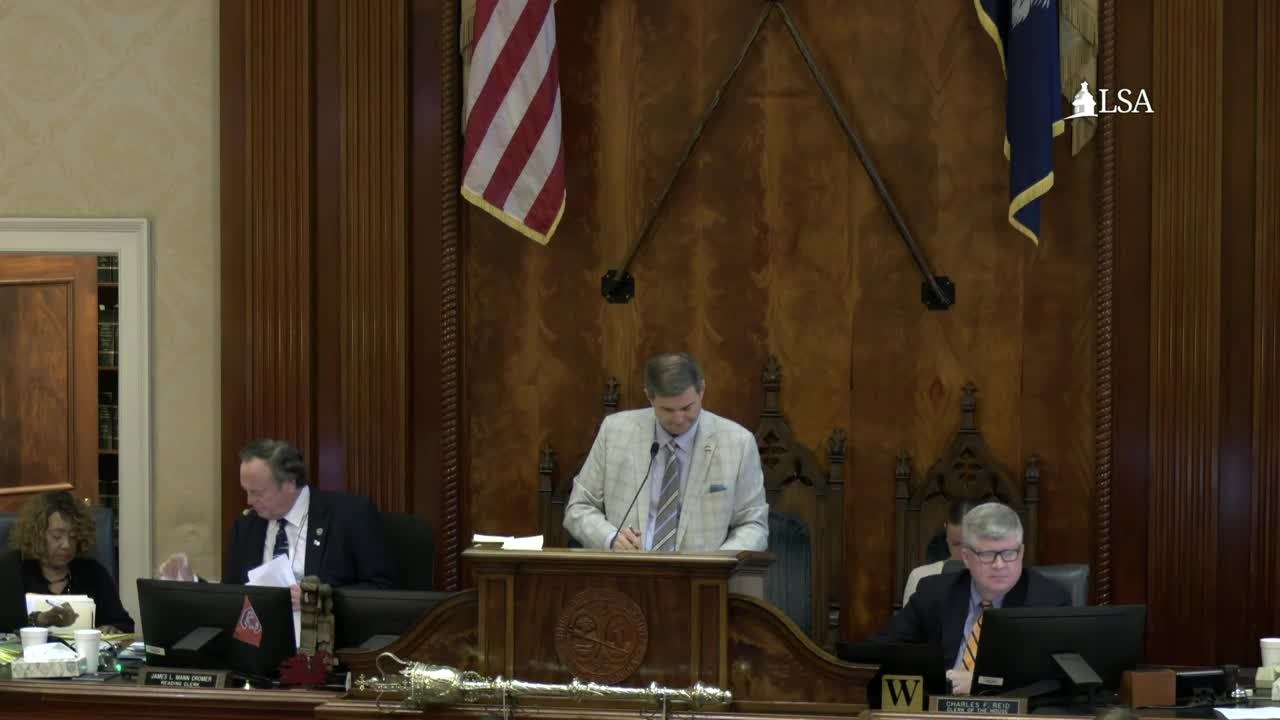
The South Carolina House of Representatives voted 109-0 to give second reading to House Bill 3387, which creates an expedited process allowing property owners to seek ex parte orders to remove unlawful occupants from residential dwellings.
The South Carolina House of Representatives voted 109-0 to give second reading to House Bill 3387, a measure that creates an expedited court process for property owners to remove unlawful occupants from residential dwellings.
Representative Travis Moore, who explained the bill and the committee amendment on the House floor, said the proposal "establishes a process to remove unlawful occupants from residential dwellings by filing a removal petition with the clerk of the or chief magistrate of the county where the dwelling is located." He told colleagues the bill defines an unlawful occupant as "someone who occupies a property without permission of the property owner and without any legal tenant protections under state law. Such persons are commonly referred to as squatters."
Moore said a petition to a chief magistrate must set out specific facts, and if the magistrate finds good cause an ex parte removal order may issue immediately and remain in place until a hearing. The order can include restrictions such as barring the individual from the property. If permanent relief is later granted, the bill allows further measures "including the squatter's permanent exclusion, removal of their belongings and financial liability for damages and court costs," Moore said. The bill also creates criminal penalties for unlawful occupancy and related conduct.
Why it matters: Sponsors and supporters said the bill is aimed at vacant-residence situations where people occupy homes without any landlord-tenant relationship and where current remedies are slow or uncertain. Backers argued the proposal balances property-owner rights with procedural protections, including a post‑removal opportunity for wrongly removed occupants to seek damages or regain possession.
Key provisions and debate: - Criteria for an ex parte petition: Moore read a nine-part checklist the petitioner must allege, including proof of ownership or agency, that the property is a residential dwelling not open to the public, that the occupants are not authorized or immediate family, that no lease or tenant status exists for three months, that occupants have refused to leave, and that no litigation over the property is pending. - Enforcement: The committee amendment clarifies that county sheriffs and constables have authority to enforce removal orders; the petition itself must be filed with the chief magistrate or clerk of court (law enforcement enforces the order after issuance). Representative Moore explained, "County sheriffs must enforce the removal orders and have the authority to arrest individuals found at the property for trespass, outstanding warrants, or any other illegal cause. Law enforcement must arrest individuals who violate an ex parte order with officers having immunity from civil liability, if acting in good faith." - Criminal penalties: The bill creates a criminal offense for unlawful occupation and for criminal mischief tied to occupation; Moore stated violators can face penalties of up to three years in prison or a $3,000 fine. - Magistrate stays and landlord-tenant interaction: The amendment also revises S.C. Code section 27‑4800 (the magistrate stay/eviction appeal process) to require tenants who seek a stay on an eviction to file proof of their appeal and an affidavit promising to continue paying rent. The amendment gives courts discretion whether disputed rent during a modification should be placed in escrow or paid to the landlord.
Questions and clarifications on the floor focused on the petition standard, enforcement mechanics, the role of estate representatives, and how the process compares with eviction law. Representative Herb Kirschman asked whether authorization could be oral; Moore said the occupant could allege verbal authorization, but the petition must allege that no authorization—oral or written—exists for removal to proceed. Representative Kirby sought clarification on whether property owners file the petition with the magistrate or the sheriff; Moore and others clarified the petition is filed with the chief magistrate or clerk and the sheriff or constable executes enforcement.
Representative Van Wilder, a former magistrate, described how the measure operates in practice: "By virtue of this, it is allowing for an ex parte order," and she emphasized that remedies are available later if removal proves wrongful. Representative Cholmondeley noted the bill also targets situations in RV parks and similar settings where occupants maintain mobile dwellings on another's property and asserted the measure fills gaps in current practice.
Votes and next steps: The House adopted two committee amendments by voice vote and then approved second reading, 109-0. Representative Moore asked unanimous consent for the bill to receive third reading the next day; the House granted the request with no objection.
Ending: Supporters say the bill is intended to provide a clearer, faster route for property owners seeking to remove persons who occupy residential property without legal tenancy; supporters and colleagues noted safeguards for mistaken removals and provisions to align magistrate practice with the landlord-tenant framework.