Get Full Government Meeting Transcripts, Videos, & Alerts Forever!
Get email alerts on the Stormwater Infrastructure topic
No spam. Unsubscribe anytime.
Subcommittee hears ARPA stormwater program update; agency urges $30 million recurring support
Summary
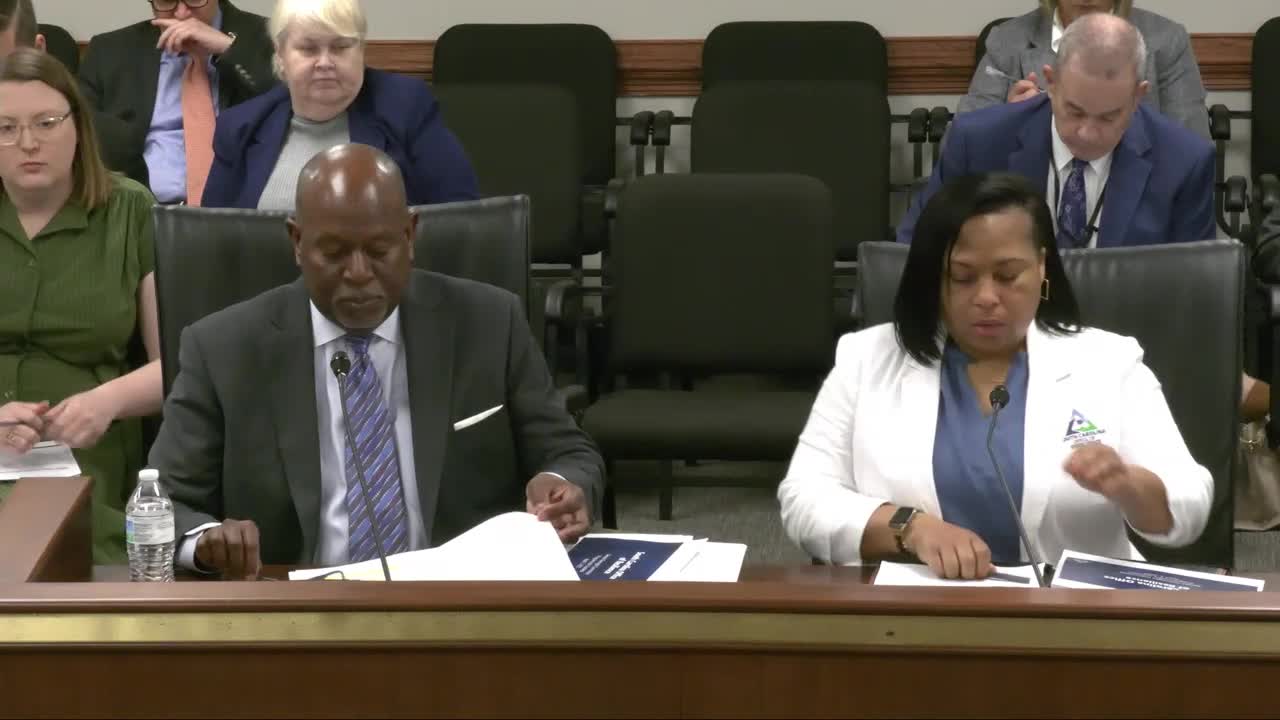
Felicia Lewis, mitigation director at the Office of Resilience, told the Legislative Oversight Subcommittee that the state's ARPA stormwater infrastructure program is fully federal-funded and managing 17 projects across South Carolina.
Felicia Lewis, mitigation director at the Office of Resilience, told the Legislative Oversight Subcommittee that the state's ARPA stormwater infrastructure program is fully federal-funded and managing 17 projects across South Carolina.
"So the ARPA funding, again, it is all federal, funding, and we are using it for stormwater infrastructure projects. We have a total number, of 17 projects that we're managing in that fund. 7 of the projects are currently in construction. We have 2 that are out for bid and 3 projects are also in a procurement process," Lewis said under oath.
The agency said its ARPA allocation has supported predominantly green-infrastructure projects awarded through a statewide competitive application process. Lewis said awards were scored on feasibility, stage of work, benefit-cost analysis, community impact and flood-risk reduction. "We're looking at things like, benefit cost analysis to make sure that we are putting money into the work that we can get the most benefit out of. We're looking at the impact on the community, the amount of flood risk reduction," she said.
Nut graf: The update matters because the Office of Resilience says all ARPA obligations are in place and must be spent and completed by the end of 2026, and the agency is seeking new recurring state funding to continue mitigation work after one-time federal pots are exhausted.
Lewis told the subcommittee the ARPA funds are obligated and that the agency does not expect another round of ARPA funding: "We've already obligated all of the funding. There was a deadline by the treasury for us to go ahead and obligate funding. So we don't currently have any funding available to obligate. And to my knowledge, there is not going to be another round of the ARPA funding." She added that project completion deadlines will be met by or before the end of 2026.
Committee members pressed on other funding sources. Lewis said the agency has used HUD Community Development Block Grant-Mitigation (CDBG-MIT) funds and state dollars for some projects but that those, too, were allocated and not recurring. A subcommittee member noted an estimated post-storm allocation of about $20,000,000 tied to Hurricane Helene that will be directed toward mitigation in affected areas; the official who mentioned that number characterized it as still being finalized.
On the scale of need, Lewis said applications and requests far outstripped available ARPA funds: the agency initially had roughly $55,000,000 allocated for ARPA mitigation work (later increased to ‘‘over 60’’ million, per the discussion), but received about $200,000,000 in project requests; HUD phase 1 mitigation awards and requests were also discussed as substantially larger than available funds. Lewis said the agency is asking the General Assembly for $30,000,000 to replace reserve funds and support ongoing infrastructure needs and that a broader package totaling roughly $117,000,000 is under consideration for different resilience activities.
Members asked how the state prioritizes awards. Lewis said the scoring looks at severity and frequency of flooding, number of structures affected and other factors that maximize public benefit. She also pointed the committee to a state transparency dashboard showing allocations, obligations and spending.
Senator Fadfield asked whether ARPA and other federal funding streams are recurring; Lewis said they were not. Committee members and staff discussed the importance of recurring state funding so local governments can plan multi-stage mitigation efforts rather than wait for one-time grants.
Ending: The Office of Resilience left the subcommittee with a formal request for recurring state mitigation funding and said it will provide additional information on project leverage and the transparency dashboard to committee staff.