Get Full Government Meeting Transcripts, Videos, & Alerts Forever!
Get email alerts on the Transportation Funding topic
No spam. Unsubscribe anytime.
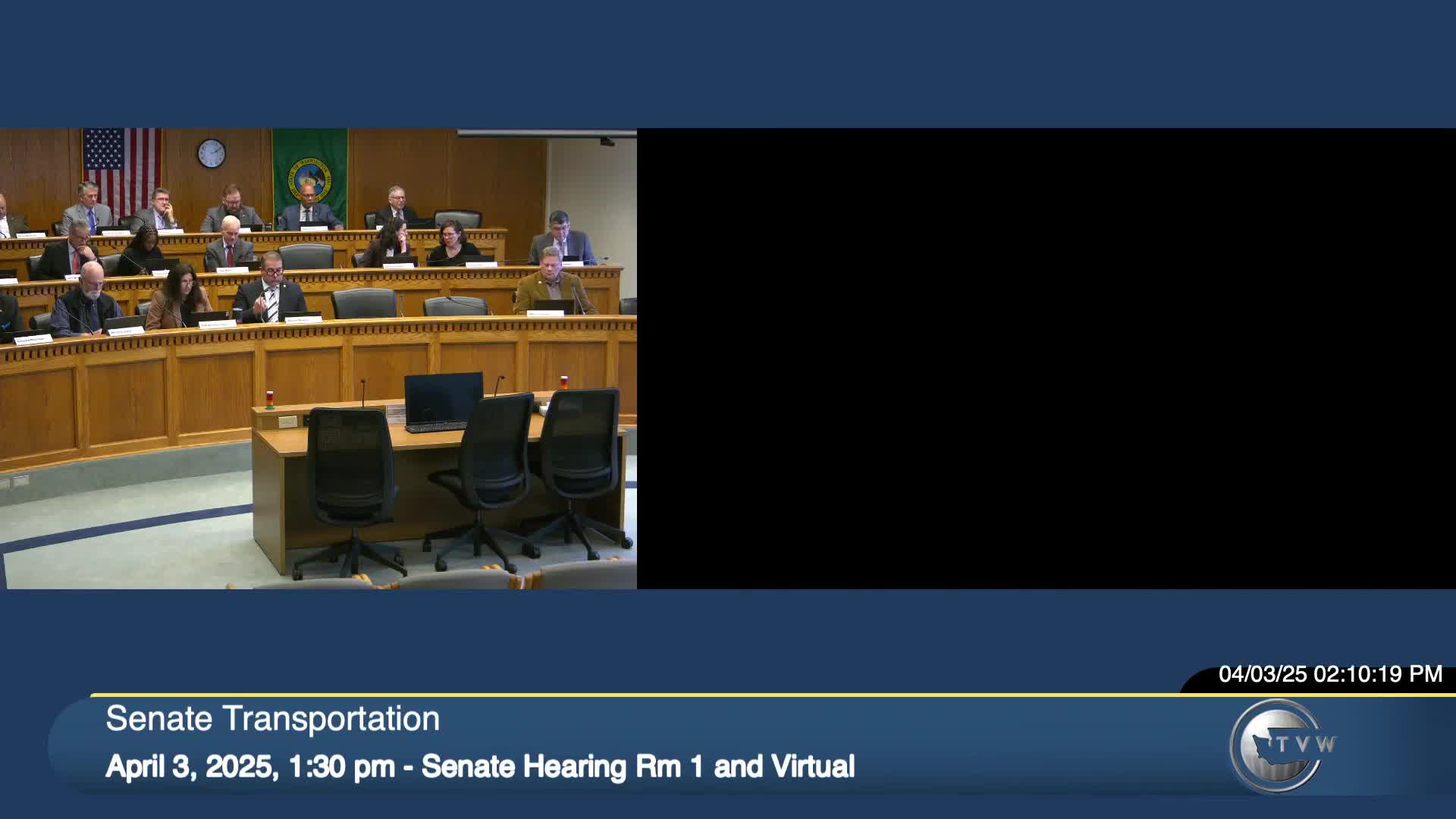
Senate hears substitute on rebalancing fund transfers, accelerating tax repayments for transportation
Summary
Proposed substitute Senate Bill 5,802 would cancel several scheduled transfers into transportation accounts, accelerate repayment of sales-and-use-tax deferrals and dedicate 0.3 percentage points of the state sales tax to the multimodal account beginning July 1, 2027.
Proposed substitute Senate Bill 5,802 would cancel several statutorily scheduled transfers into transportation accounts, accelerate repayment of sales-and-use-tax deferrals for major construction projects, and dedicate 0.3 percentage points of the state sales tax (of the state’s 6.5 percent) to the multimodal account beginning July 1, 2027.
Brian Moore, committee staff, gave a detailed table of cancellations and offsets. He said the bill would cancel Connecting Washington transfers that were part of the larger 16-year funding plan (a total assumption of roughly $518 million) and would cancel Move Ahead Washington assumptions (roughly $855 million in assumed transfers). Moore told the committee the cancellation of transfers for the current biennium represents about $112 million. He said the bill would also accelerate repayment of sales-and-use-tax deferrals—repayments that under current law were scheduled to begin in future biennia—so repayment begins immediately and is to be completed in fiscal year 2026. Moore noted roughly two-thirds of sales-and-use-tax deferral repayments flow to the state general fund, with the remainder affecting local governments.
To offset near-term effects on transportation funding, the substitute dedicates 0.3 percent of the state sales tax to the multimodal account starting July 1, 2027; Moore estimated that dedication would generate about $840 million per year initially (staff caveated that out-year projections rely on forecast assumptions).
The bill sponsor told the committee the substitute is part of a comprehensive operating, capital and transportation package that aims to provide short-term general-fund reserve support and longer-term transportation sustainability; the sponsor said advancing repayment of deferred sales tax and reversing scheduled transfers provides roughly $500 million in operating support in the near term.
Senators asked technical questions. Senator Fortunato confirmed with staff that the existing rental-car tax rate that already supports multimodal accounts was unchanged. Senator McEwen asked whether the Department of Licensing or another agency has previously discontinued low-performing special license plates; staff said current law allows the Department of Licensing to recommend discontinuance but, as far as staff understands, that authority has not been exercised.
Andrew Villeneuve of the Northwest Progressive Institute testified in respectful opposition, urging fiscal restraint and objecting to reallocating future sales-tax dollars that currently flow to the general fund (which funds K–12 and higher education). Villeneuve said the committee should not "siphon sales tax dollars" away from education and core services and urged alternate plans to fund transportation.
Brian Moore said staff would be glad to answer further technical questions; the committee held the public hearing and did not record a committee vote during the session.
Why it matters: the substitute would materially alter the timing and source of funds available for transportation and the state general fund, accelerate repayment obligations for deferred taxes tied to major projects, and dedicate a recurring slice of sales tax to multimodal transportation beginning in fiscal year 2028.