Get Full Government Meeting Transcripts, Videos, & Alerts Forever!
Get email alerts on the Special License Plates topic
No spam. Unsubscribe anytime.
Committee hears proposed substitute for up to 12 special license plates and oversight work group
Summary
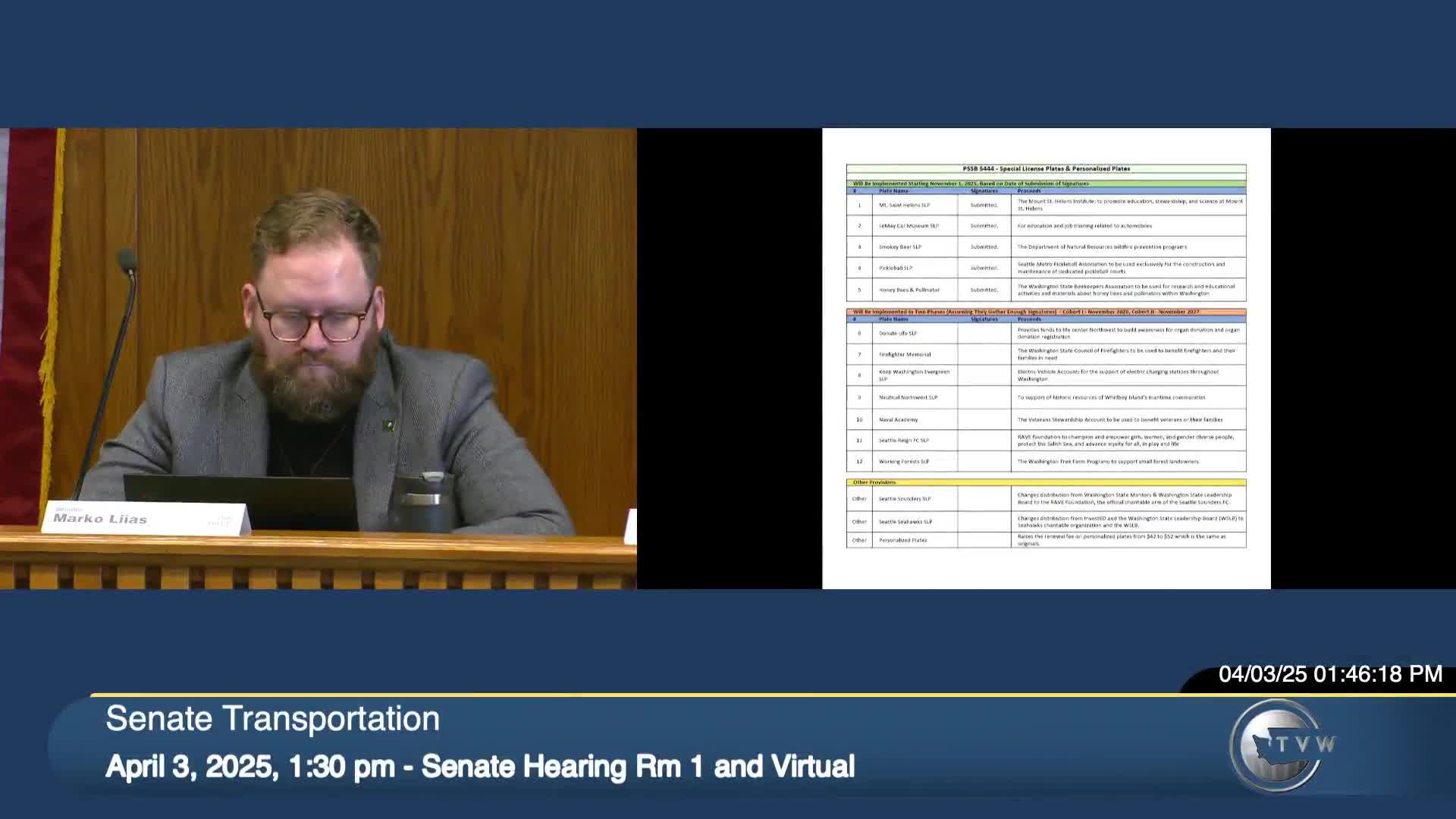
A proposed substitute to Senate Bill 5,444 would authorize up to 12 new special license plates, require sponsoring organizations to submit 3,500 signatures before a plate is implemented, phase launches across 2025–27, and create a Department of Licensing work group to study oversight and discontinuation metrics.
A proposed substitute to Senate Bill 5,444 would authorize up to 12 new special license plates, require sponsoring organizations to submit 3,500 signatures before a plate is implemented, phase plate launches across 2025–27, change proceeds distributions for some existing plates, raise certain personalized-plate fees and create a multi-year Department of Licensing work group to review oversight and application rules.
Brian Moore, committee staff, told the Senate Transportation Committee the proposed substitute authorizes up to 12 plates and requires sponsoring organizations to collect 3,500 signatures. "Five of those license plates have already done so, and so what the bill contemplates is that those five special license plates would begin implementation, beginning 11/01/2025," Moore said. The next seven plates would have until Oct. 1, 2026, to submit signatures to begin implementation Nov. 1, 2026; plates that miss that deadline could try again by Oct. 1, 2027, with implementation beginning Nov. 1, 2027.
Moore also described changes to proceeds distribution requested by two existing plates, with Seattle Sounders and Seattle Seahawks proceeds proposed to flow to their charitable organizations and the Washington State Leadership Board. The substitute would increase the personalized-plate renewal fee from $42 to $52 (making initial and renewal the same), with an estimated effect of roughly $800,000 per year deposited to Fish and Wildlife-managed accounts.
The bill requires the Department of Licensing to convene a work group by Oct. 1, 2025, staffed with special-plate stakeholders and directed to study issues including increased signature and application requirements, methods to discontinue low-performing plates, and stronger oversight by the Joint Transportation Committee. The work group would provide a preliminary report to the Joint Transportation Committee by Nov. 15, 2027, and a final report and potential draft legislation by Jan. 1, 2028. Moore said implementation costs historically run about $30,000 per new plate and estimated about $250,000 for the work group.
Senator Lynda Cortez, the prime sponsor, said she combined several separate plate proposals into a single vehicle to create a process that would move future plate decisions out of ad hoc legislative action and into a more standardized application and oversight process.
Multiple organizations and sponsors testified in favor. Pat Sullivan, director for governmental and external affairs at the Department of Natural Resources, said the proposed substitute would raise funds for wildfire prevention programs and awareness; "this is important not only because it raises funds for wildfire prevention programs, but it really does raise awareness, for preventing wildfires," he said. David Madera, CEO of LeMay — America’s Car Museum, said proceeds would support STEAM programs and a planned regional robotics center with Tacoma Public Schools. Alisa Hoyt of the Mount Saint Helens Institute said her group has collected over 4,000 signatures supporting a Mount St. Helens plate and that proceeds would support outdoor school, youth education and stewardship work.
Kate Van Gent, vice president of the Seattle Metro Pickleball Association, said her nonprofit collected the required signatures for a pickleball plate and described broad community interest. John Henrickson, a small forest landowner, testified in support of a working-forest plate and described long involvement in voluntary certification programs.
Committee members asked about plates that would send proceeds directly to the state rather than a sponsoring nonprofit. Senator Chapman noted a plate that would dedicate revenue to the state and questioned whether the 3,500-signature requirement was appropriate for a plate that would not have an obvious sponsoring constituency; she suggested she might offer an amendment.
The committee held a public hearing; no committee vote was recorded during this session.
Why it matters: the substitute would expand the set of specialty plates available to Washington drivers while creating a formal, multi-year review process intended to increase oversight, tighten application requirements and create mechanisms to remove low-performing plates.