Get Full Government Meeting Transcripts, Videos, & Alerts Forever!
Get email alerts on the Relocation Payments topic
No spam. Unsubscribe anytime.
Senate hears bill to raise reestablishment payment cap for businesses displaced by public projects
Summary
Substitute House Bill 1733 would raise the statutory cap on reestablishment payments for displaced small businesses, farms and nonprofit organizations from $50,000 to $200,000 and require the Washington State Department of Transportation to adjust that cap annually for inflation.
Substitute House Bill 1733 would raise the statutory cap on reestablishment payments for displaced small businesses, farms and nonprofit organizations from $50,000 to $200,000 and require the Washington State Department of Transportation to adjust that cap annually for inflation.
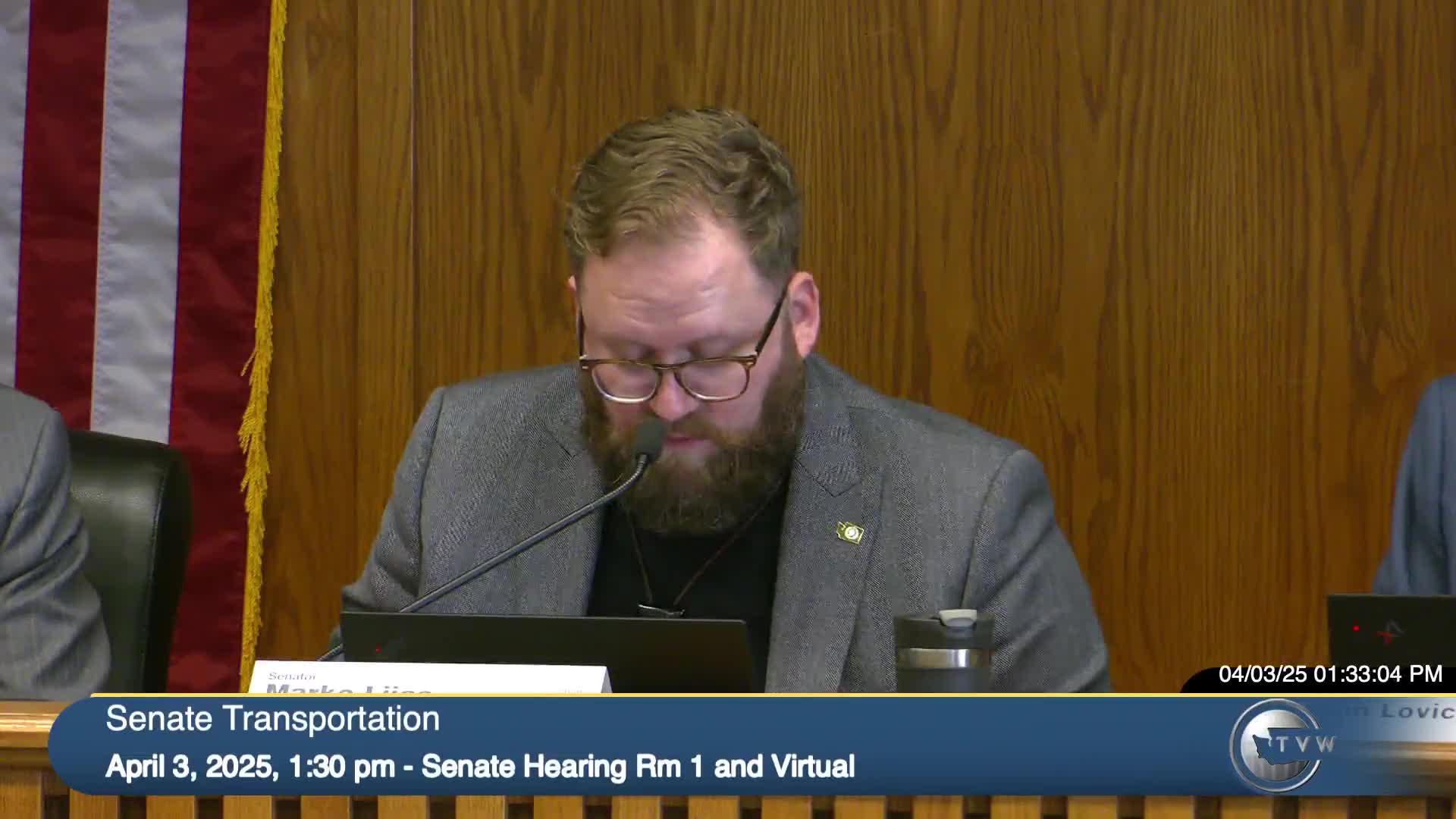
Danny Masterson, committee staff, told the Senate Transportation Committee the state relocation assistance program reimburses displaced persons or entities for moving and related expenses when real property is acquired for a public purpose and that WSDOT is the lead agency that administers the program. "This bill would increase that statutory cap on reestablishment payments from $50,000 to $200,000. It also requires that WSDOT adjust the cap for inflation annually," Masterson said.
The measure drew testimony from several small-business owners and nonprofit leaders who said planned Sound Transit work in West Seattle will displace operations and that current caps leave many organizations unable to relocate. Jordan Crowley, identifying himself as the owner of Alki Beach Academy, said, "Raising the cap on reestablishment, expense compensation gives businesses like my families a fair chance of surviving this placement." Erin Rubin, founder and managing director of Mode Music and Performing Arts, said her nonprofit will be displaced by the Sound Transit West Seattle Link Extension and estimated a build-out cost "close to 400,000 in building costs alone," adding rent increases could push total relocation costs "closer to 600,000 or more." Keith Edwards, owner of The Joint Chiropractic in West Seattle, told the committee: "The relocation estimates for my business is 500,000." Edwards also said his clinic sees about 1,000 patient visits a month.
Representative Brianna Thomas, the bill's prime sponsor, described the change as an update to a cap that "hasn't gone up since 02/2003," and said the House added the annual inflation adjustment in committee to avoid repeating a decades-long gap.
On fiscal impacts, Masterson said the WSDOT fiscal note is indeterminate because future displacements are unknown but offered recent history: "Over the last 5 years, there were an average of 7 entities per year that reached the current reestablishment payment cap of $50,000." He added a rough scenario in which seven entities per year received an average additional payment equal to half the increase would yield about $500,000 of additional payments per year, but he characterized that as a ballpark estimate with "some big assumptions." The fiscal note also anticipates smaller one-time and ongoing workload impacts to WSDOT to implement the change.
Committee members asked staff about eligibility and calculation. Vice Chair Ramos confirmed that the bill does not change the types of expenses that can be reimbursed—only the statutory cap. Senator Gaynor raised a factual question about partial takings affecting farm viability and whether a farm rendered unprofitable by losing acreage could qualify for reestablishment payments; Masterson said he did not know the answer off the top of his head and would consult policy staff.
The committee held the public hearing; no vote on the bill was recorded during the session.
Why it matters: the bill would increase the maximum state-funded reestablishment payment available to small businesses, farms and nonprofits displaced by public projects and would require WSDOT to index the cap for inflation, potentially affecting project budgets where acquisitions occur.
The hearing record includes staff presentations, questions from senators, and three in-person business testimonies from organizations that said they expect displacement from the Sound Transit West Seattle Link Extension.