Get Full Government Meeting Transcripts, Videos, & Alerts Forever!
Get email alerts on the Education Cte Dual Credit topic
No spam. Unsubscribe anytime.
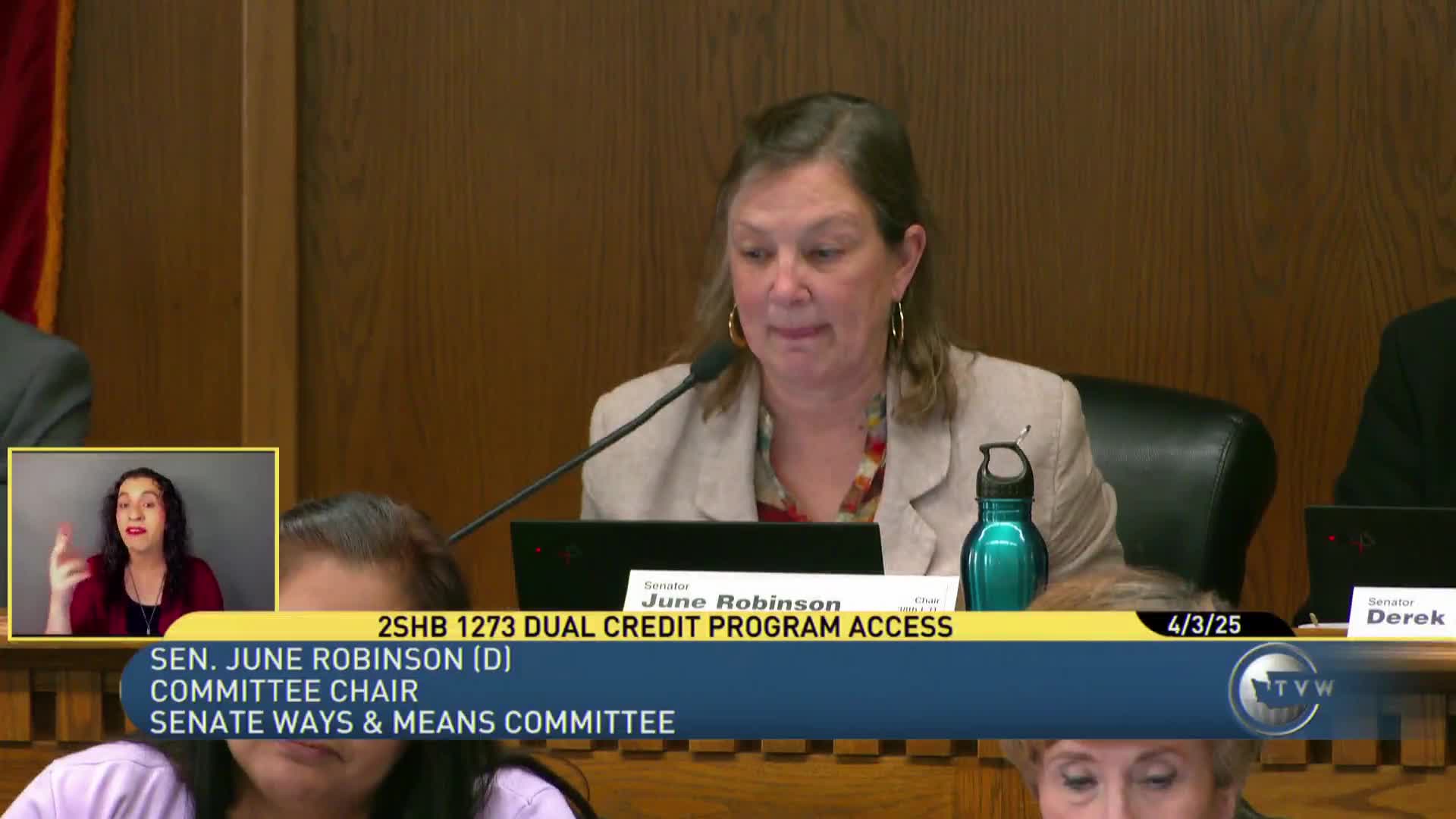
Committee hears students, colleges and advocates in support of extending CTE dual‑credit pilot (Second Substitute House Bill 12-73)
Summary
Second Substitute House Bill 12‑73 would extend a regional pilot to expand career and technical education (CTE) dual‑credit participation and credential attainment and require SBCTC to administer continuation grants and reporting.
Second Substitute House Bill 12‑73 would continue a pilot program to expand career and technical education (CTE) dual credit offerings and credential attainment and require the State Board for Community and Technical Colleges (SBCTC) to administer the continuation.
Committee staff described the pilot and its background: the 2023‑25 operating budget provided $700,000 to SBCTC for a two‑year pilot to increase CTE dual credit participation; the pilot selected community and technical colleges to implement supports such as subsidies for student costs, outreach and professional development, and equipment grants. The substitute would allow SBCTC to continue the regional pilot, award grants for up to two additional years subject to appropriation, and require joint reporting with OSPI (Office of Superintendent of Public Instruction) with recommendations to improve state dual‑credit policies, articulation agreements and transcript uniformity.
The fiscal note staff summarized a one‑time cost of $616,000 for the 2025‑27 biennium (about $600,000 for continuation of the pilot and $16,000 for State Board administrative costs). Local school districts participating in the pilot anticipate $600,000 in one‑time costs passed through the SBCTC. Testimony in the public hearing was strongly supportive: representatives from Washington STEM, the High School Success Coalition, SBCTC staff, 34 community colleges and students from Lake Washington High School described how CTE dual credit expanded access, helped students discover career interests and reduced barriers by offering college credits at low or no cost. Student witnesses described hands‑on learning experiences (agriculture, food science, retail operations, photography) that led them toward postsecondary credentials and careers.
SBCTC staff and student advocates noted the pilot’s interim report (published December 2024) and a final report due December 10, 2025; the substitute requires SBCTC to report recommendations and implementation lessons. The bill contains a null‑and‑void clause and the program is subject to appropriations. Committee staff indicated the program is included in the House budget at the fiscal note amount. Supporters urged the committee to continue the pilot to reduce system barriers, improve credit articulation, and expand access to high‑demand credential pathways.