Get Full Government Meeting Transcripts, Videos, & Alerts Forever!
Get email alerts on the Procurement topic
No spam. Unsubscribe anytime.
Committee considers expanded public-private partnership authority and alternative project delivery methods for WSDOT
Summary
Senate Bill 5,773 would broaden WSDOT—s authority to use public-private partnerships, require WSDOT to develop rules and a best-value process for P3s, and expand allowable alternative project delivery methods such as progressive design-build and GCCM.
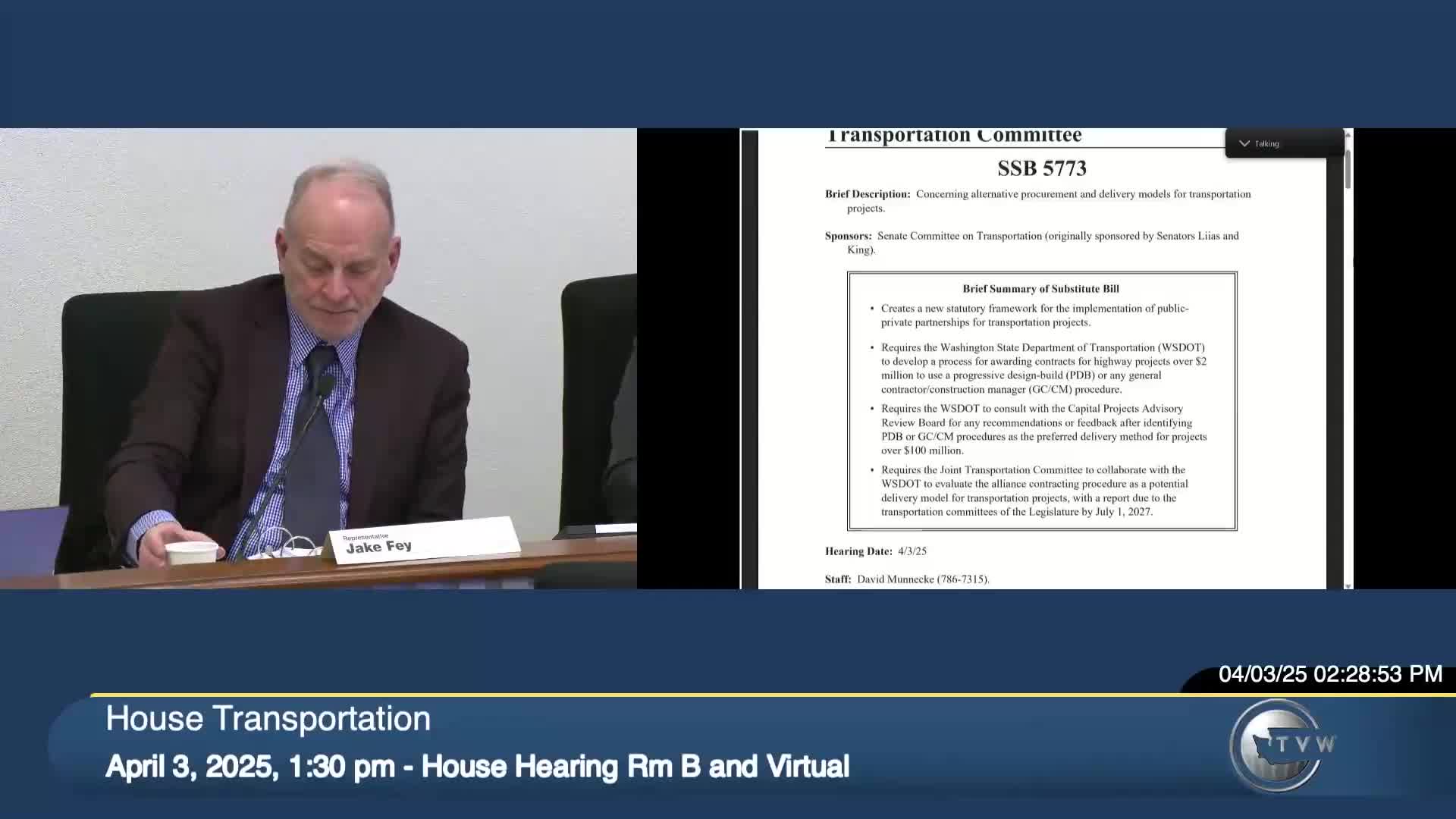
The Senate Transportation Committee heard engrossed substitute Senate Bill 5,773, which would repeal and replace much of the current Transportation Innovative Partnership (TIP) framework and expand alternative procurement and delivery methods that WSDOT may use, including progressive design-build (PDB) and the general contractor/construction manager (GCCM) procedures.
The bill shifts responsibility for review, selection, and execution of P3 projects from the Transportation Commission to WSDOT, while the legislature would retain toll imposition authority and the commission would keep toll-rate setting for toll projects. WSDOT would be required to report proposed policies and guidelines for P3 projects to the transportation committees by Sept. 1, 2026, but those rules could not take effect until Jan. 1, 2027. WSDOT must consult with its Office of Equity and Civil Rights during rulemaking.
The bill also allows WSDOT to evaluate projects under a P3 model if the estimated cost is under $500 million (projects above that threshold would need explicit legislative authorization) and would broaden financing options for eligible projects, including private contributions, bonds, lease proceeds and other revenue streams. The bill requires WSDOT to make a formal finding that a negotiated partnership agreement is expected to provide "best value for the public" and to develop transparent criteria for measuring and reporting best value, including life-cycle delivery and operations and maintenance comparisons.
On alternative delivery, the bill authorizes WSDOT to use PDB and GCCM for projects over $2 million and requires the Joint Legislative Committee and CPARB to evaluate alliance contracting as a potential method; CPARB would have a consultative role for projects over $100 million until 2031. The bill keeps legislative oversight on toll policy, establishes a non-appropriated P3 account for project revenues, and retains many contract protections, including provisions addressing labor and public communication.
WSDOT staff presented a fiscal estimate that anticipated one-time costs and ongoing staffing: an estimated $890,000 in the 2025-27 biennium and ongoing staffing needs beginning in 2027-29 of roughly $1.8 million, including two FTEs and indeterminate consultant costs to support rulemaking, financial reviews and project evaluations. Staff said consultants might cost $1.5 million to $2.5 million to complete the preliminary report and additional consultant support would likely be needed thereafter.
Proponents from engineering, construction and business groups and the state—s building trades testified in favor, saying the bill adds procurement tools to help deliver projects on time and on budget and that other DOTs have successfully used these methods. Contractors and private developers emphasized that P3s typically shift longer-term operations and maintenance responsibilities to private partners and can align incentives differently than short-term design-bid-build contracts.
Several committee members probed how P3 risk allocation and finance mechanisms would affect project costs, competition for proposers and long-term obligations; witnesses noted that P3s can include longer O&M terms and financing risk borne by the private partner, but outcomes depend on contract design. The public hearing closed with no final committee vote at the session.