Get Full Government Meeting Transcripts, Videos, & Alerts Forever!
Get email alerts on the School Construction Assistance Program topic
No spam. Unsubscribe anytime.
Capital Budget Committee begins case‑study phase of SCAP revision, hears funding and process gaps
Summary
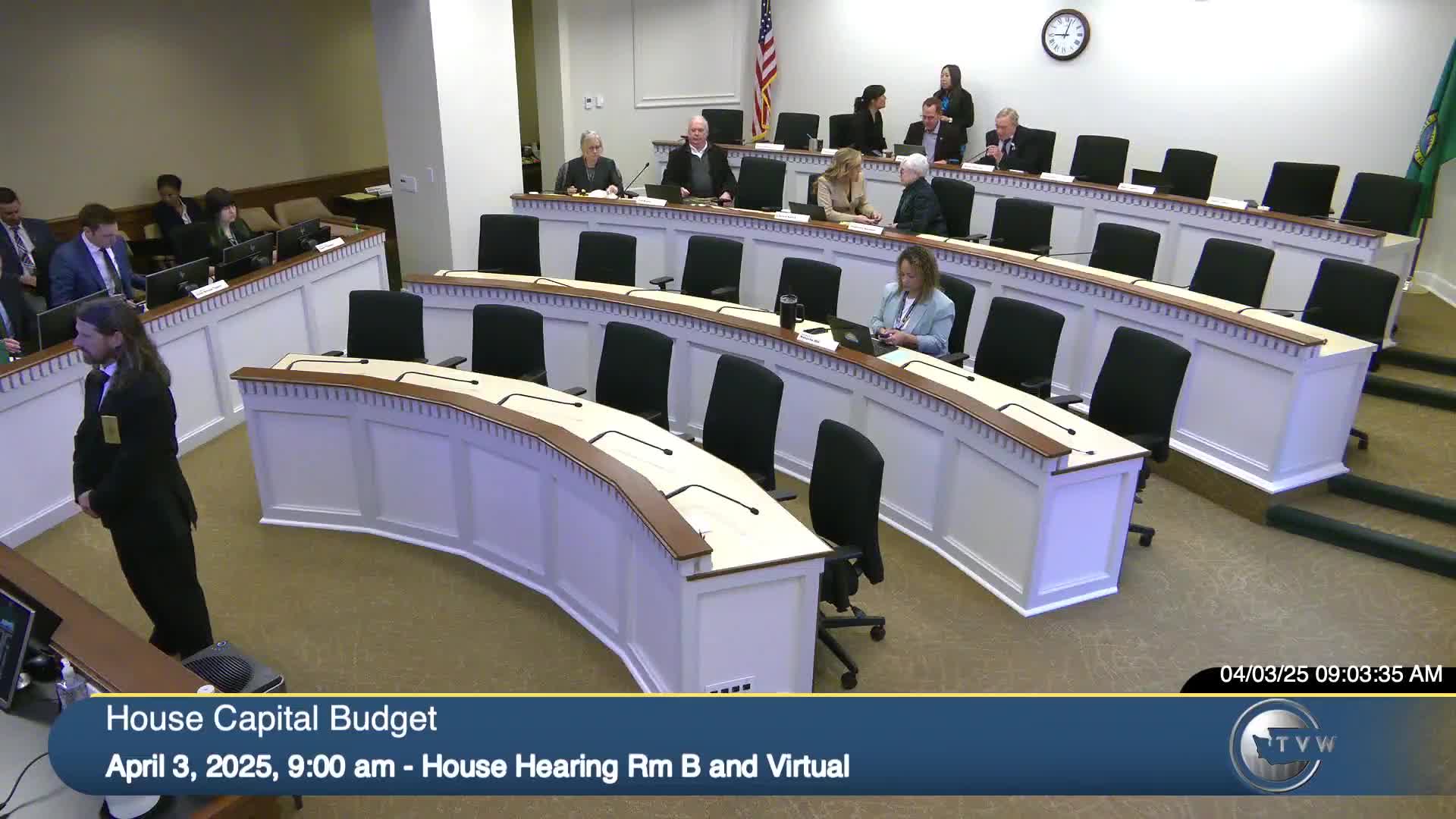
The Capital Budget Committee met April 3 in Olympia to review progress on a multi‑phase project to revise the School Construction Assistance Program, known as SCAP.
The Capital Budget Committee met April 3 in Olympia to review progress on a multi‑phase project to revise the School Construction Assistance Program, known as SCAP. Project consultants David McBride, Gene Simene and Wade Smith told the committee they have completed initial stakeholder outreach and data gathering and will use case studies and focus groups this spring to test candidate formulas and delivery models.
Why it matters: Committee members and consultants said SCAP’s current formula and reimbursement process leave many districts—especially small, rural, property‑poor and rapidly growing districts—without sufficient support to build or modernize schools. The consultants also cited a sharp statewide drop in bond activity and passage rates, which they said reduces districts’ willingness to place measures before voters.
Consultants summarized the work to date and the priorities emerging from their outreach. David McBride said the project has five phases: initial engagement and survey; deep data gathering (now wrapping up); targeted engagement and case studies (just starting); developing and testing proposed solutions; and finalizing recommendations. Wade Smith said the project has “broken this project down into 5 phases” and emphasized continued iterative engagement with districts, OSPI and industry partners.
The team described six recurring themes from a ThoughtExchange survey and dozens of in‑person meetings with superintendents, education service districts (ESDs), OSPI’s Technical Advisory Committee and industry partners: inadequate funding levels and formulas; cumbersome reimbursement and cash‑flow challenges; complexity and lack of transparency; inequitable outcomes by assessed valuation and debt capacity; insufficient support for small rural districts; and regional cost variability.
Gene Simene summarized the survey findings and voter trends: “From 2015 to 2019, there were 198 bonds on the ballot across the state and 53% of those passed. Since 2020 through 2024 there were 102 bonds on the ballot and only 19% of those passed,” he said, adding that “it’s a crisis out there right now.” He also said the ThoughtExchange respondents repeatedly asked that SCAP be simplified and noted concerns that “a confused voter is a no voter.”
Consultants and committee members discussed specific cost and funding examples mentioned in the meeting: the Elmira school rebuild’s overall cost averaged about $700 per square foot, while SCAP reimbursement rates currently cited in the presentation were approximately $375 per student (the team described that as inadequate relative to rising hard and soft costs). The consultants said East Valley High School (Spokane area) would require an estimated $36 million to bring an early‑1980s facility up to current codes and Clean Buildings Act standards without changing instructional space.
Committee members pressed for actionable scenarios and timelines. Representative Walsh said the committee needs concrete recommendations: “All I’m hearing is a constant restating of the problem statement and not … solutions,” he said. Consultants acknowledged that phase 4 (early summer) will be when they develop and test specific formula and delivery‑model proposals and that phase 5 will present draft recommendations for committee and OSPI review.
On delivery methods and other technical fixes, Wade Smith (Walla Walla Public Schools) confirmed the team is explicitly reviewing alternative construction delivery models, including progressive design‑build and GCCM, and noted the current SCAP framework assumes design‑bid‑build and sometimes must be “manipulated” to fit other approaches.
The panel also identified several categories for proposed case studies to ensure regional and program variety: property‑poor districts (low assessed valuation per student), high‑valuation districts with minimal SCAP impact (Seattle, Lake Washington), rapid‑growth districts (Ridgefield, Issaquah, Pasco and others), small rural districts (Elmira, Cape Flattery), tribal districts (Nespelem, Cape Flattery, Wapato), military‑impacted districts (Clover Park, Medical Lake, Yelm) and districts with high online‑learning populations. Consultants said they will run scenarios showing how each case‑study district would fare under alternative formula buckets.
No formal policy changes, votes, or motions were taken during the session. Instead, the committee provided feedback on the proposed case‑study list and the consultants’ approach. Consultants said next steps include additional focus groups with superintendents, school business officials and industry partners, producing scenario models in phase 4, and drafting recommendations for phase 5, with the intent to present actionable options to OSPI, the governor’s office and the committee.
Quotes in this article are taken from committee proceedings and attributed to speakers identified in the record.