Get Full Government Meeting Transcripts, Videos, & Alerts Forever!
Get email alerts on the Finance topic
No spam. Unsubscribe anytime.
Committee debates ‘financial‑intangible’ tax: 0.8% levy on stocks, bonds and funds above $50 million proposed to fund education
Summary
HB 2046 would create a new property‑style tax on certain financial intangible assets (publicly traded stocks, bonds, mutual funds, ETFs) with a $50 million exemption, taxed at $8 per $1,000 (0.8%) on the value as of Dec. 31 each year; revenues are dedicated to the Education Legacy Trust Account and estimated at $2.4 billion in the first biennium.
House Finance received a staff briefing and wide public testimony on HB 2046 on April 3. The bill would impose an annual tax on the true and fair value of specified financial intangible assets — publicly traded stocks, bonds, mutual funds and exchange‑traded funds — with the first $50 million of such assets per taxpayer exempted.
Under the draft text explained by committee staff, the levy rate is $8 per $1,000 (0.8%), with returns and payments due to the Department of Revenue by April 15 each year and revenues deposited to the Education Legacy Trust Account for K–12, early learning and higher education programs. The draft includes a long list of exemptions (retirement accounts, education savings accounts, state and federal debt instruments, nonfinancial intangibles and assets already taxed by another state among them).
Rochelle Harris, committee staff, summarized fiscal projections included in the committee packet: estimated revenues of about $2.4 billion in the first biennium, $4.7 billion in the second biennium and approximately $7.1 billion over a four‑year outlook; an estimated 4,300 taxpayers would be in scope; Department of Revenue implementation costs were estimated at roughly $56.5 million across four years.
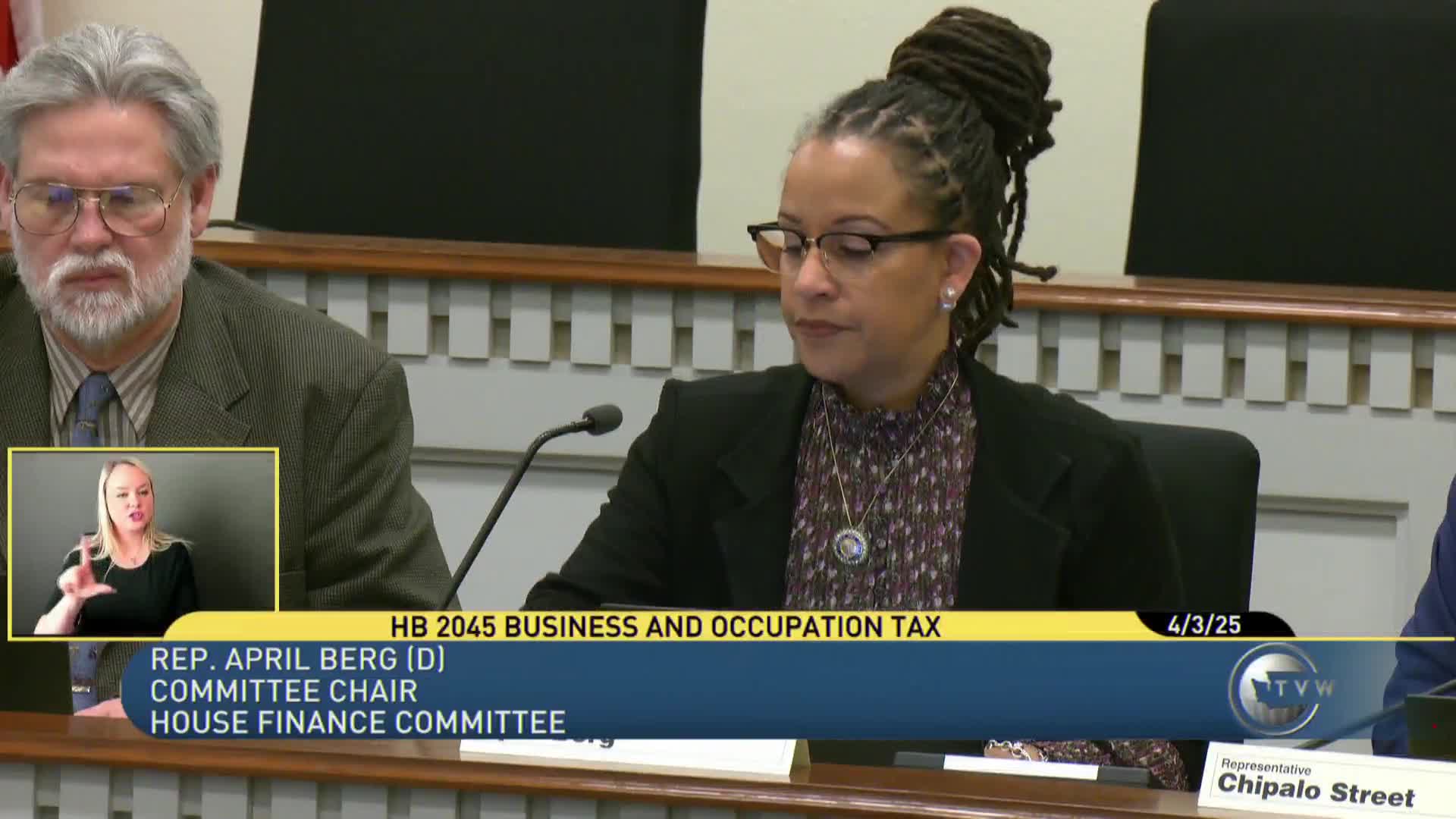
Sponsor Representative April Berg framed the proposal as a modernization of Washington’s tax code. "For many wealthy Washingtonians their wealth is in one of these asset classes," she said. "My home is where I have most of my wealth. For many wealthy Washingtonians their wealth is in one of these asset classes. They are able to borrow against this wealth and when they sell this wealth they will pay an excise tax. But currently, they do not pay a yearly tax on the wealth. This bill changes that."
Legal counsel and expert testimony at the hearing addressed constitutionality and administrative issues. Committee counsel and outside counsel noted that Article VII, Section 1 of the Washington Constitution reserves only a specific classification for real property while leaving the legislature discretion to create or define classes of other property. Counsel cited prior decisions (including the Ridpath line of cases described in the memo) that the legislature may create classes of personal property, so long as any classification is reasonable and applies uniformly within the class.
Experts and advocates supplied differing interpretations of likely taxpayer responses. An academic tax expert with experience on wealth taxes told the committee empirical literature shows mobility responses to wealth levies are small in modern contexts and that several European and Swiss subnational examples produced material revenue with limited taxpayer flight. Business and taxpayer advocates warned the tax could prompt taxpayer relocation or restructuring of assets; others argued that the proposed $50 million exemption narrows scope to a very small group.
The hearing included dozens of written and oral testimonies from teachers, local elected officials, hospital and health representatives, small‑business groups, labor unions and fiscal policy organizations. Testimony for the bill emphasized education and equity objectives; opposing commenters warned of legal risk, administrative complexity and potential effects on investment and housing costs if applied to assets held through local entities.
No committee action or vote was taken; the hearing record includes a staff legal memorandum and a departmental fiscal note summarized in committee testimony.