Get Full Government Meeting Transcripts, Videos, & Alerts Forever!
Get email alerts on the Sled Internal Operations topic
No spam. Unsubscribe anytime.
Subcommittee reviews SLED internal operations, budget, staffing and new facilities
Summary
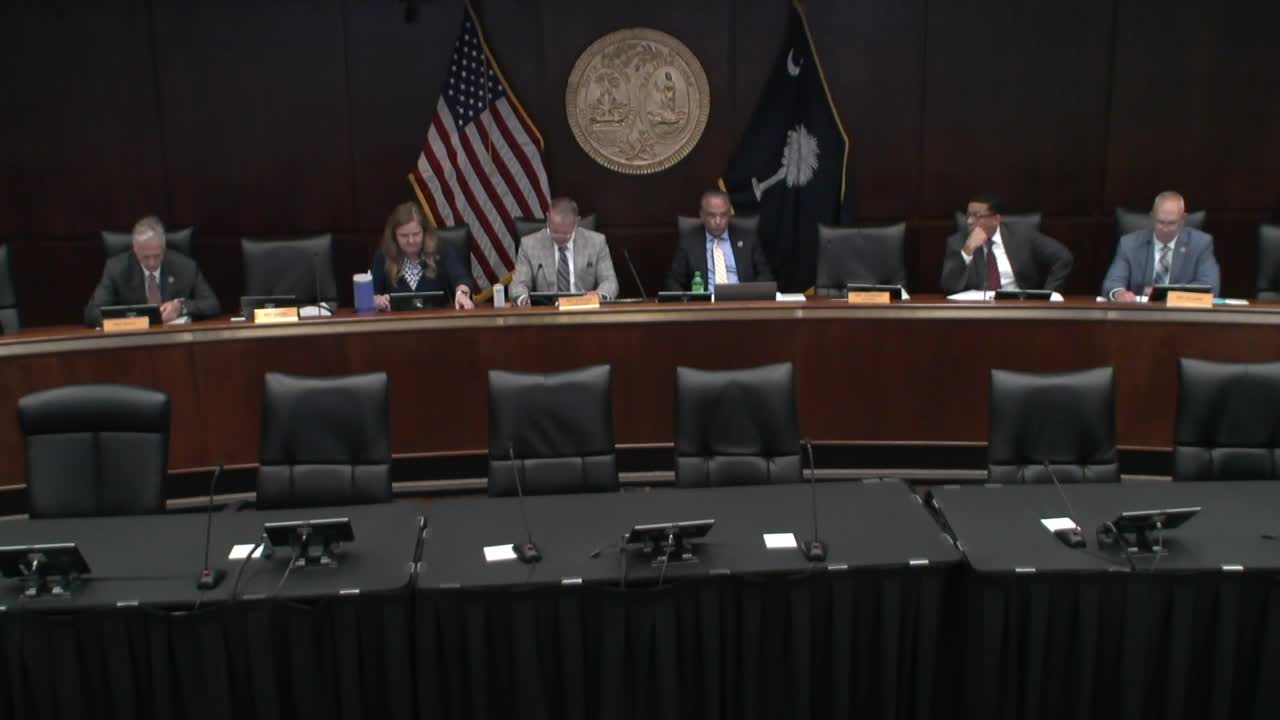
Members of the South Carolina House Subcommittee on Law Enforcement and Criminal Justice heard an overview of the South Carolina Law Enforcement Division’s internal operations — including budget, grants, staffing, procurement, fleet management and facilities — during a subcommittee meeting chaired by Representative Chris Wooten.
Members of the South Carolina House Subcommittee on Law Enforcement and Criminal Justice heard an overview of the South Carolina Law Enforcement Division’s internal operations — including budget, grants, staffing, procurement, fleet management and facilities — during a subcommittee meeting chaired by Representative Chris Wooten.
The SLED presenter said the agency’s recurring FY2025 budget stands at $146,440,183 and that the agency manages roughly $25 million in grant authority, with plans to request an additional $5 million in federal grant authority to meet anticipated program needs. The presentation also covered staffing levels, fleet size and the status of several capital projects, including a $62 million forensic laboratory completed in March 2024 and renovation work on the former lab.
The subcommittee was shown detailed breakdowns of revenues and expenditures and questioned SLED officials about grant stability, vacancy counts, recruitment and the cost of equipping new agents. Mr. Royal, the SLED presenter for internal operations, said the agency had 761 authorized FTEs and 699 filled positions as of early 2025, describing “approximately 62 vacancies” on paper but noting that most openings were in active hiring processes and that the agency had only “four true vacancies” the chief could reassign immediately. Royal said SLED’s FY2025 recurring budget is $146,440,183 and that the agency expects federal grant authority to grow to $30,000,000 to cover additional homeland security activity.
Why this matters: subcommittee members said the agency’s budget and staffing decisions affect forensic case backlogs, regional investigative capacity, and statewide training and school safety programs. Members pressed for details about the cost to hire and equip a new agent, how SLED manages vehicle maintenance across a statewide fleet, and how recent legislation and evolving drug testing requirements have increased forensic lab workloads.
Most important facts and supporting details
- Budget and grants: SLED reported a FY2025 recurring budget of $146,440,183. For FY2024 expenditures, the agency reported $83,585,164 in general funds, $16,148,002 in federal funds and $16,313,520 in earmarked funds. The budget office manages grants oversight and accountability under roughly $25,000,000 in grant authority and expects to request an additional $5,000,000 in federal authority to better match expected grant awards.
- Nonrecurring and capital items: SLED identified several FY2025 nonrecurring allocations, including $7,197,226 for the South Carolina Center for School Safety and Targeted Violence (the repurposed former Gilbert Elementary School), $2,000,000 for the CWP program, $500,000 for personnel equipment and $1,300,500 for specialized vehicles. The agency also noted a $3,000,000 increase in other‑funds authorization to support lab upgrades and a radio system project, and a $600,000 Tri‑County human‑trafficking grant.
- Forensic laboratory and backlogs: SLED completed a new $62,000,000 forensic laboratory in March 2024. Officials reported a 30% increase in completed cases after the new lab opened, a 19% reduction in drug‑ID backlog, and a 95% reduction in gunshot residue cases. However, staff said changes in hemp and synthetic‑drug testing requirements have sharply increased workload and contributed to a current backlog: the transcript cited an example of a 19,000‑case increase in drug submissions after hemp testing rules changed.
- Staffing and recruitment: SLED reported 761 authorized FTEs and 699 filled positions, with many applicants in process for roughly 50 positions and a stated “four true vacancies” available for immediate reassignment. The agency outlined a career path and pay bands (examples: Special Agent 2 starting at $66,700; Special Agent 3 at $73,370; senior special agent $78,602; lieutenant $94,322; captain $107,422; major $123,137). SLED described outreach that included roughly 41 career fairs and campus visits in the prior year and noted internship and community relations efforts. The state Human Affairs Commission’s availability analyses and target goals were cited as the basis for diversity and promotion benchmarks.
- Cost to hire and equip: SLED provided a first‑year cost example for a new position starting at $58,000: total first‑year cost was $191,584 (salary and fringe ~$91,828; recurring costs ~$26,700; nonrecurring upfit ~$73,000, including vehicle purchase/upfit). Officials gave agent equipment cost estimates per role — approximately $26,700 for a general agent and about $30,400 for a crime‑scene agent — and said average vehicle upfit costs are roughly $20,000 (mobile radio ~$14,000; secure lockbox ~$3,000; siren/lighting ~$3,000).
- Fleet and maintenance: SLED reported a fleet of approximately 601 vehicles (up from 556 in 2019). The agency performs many services in house with three full‑time mechanics and uses state contracts or local vendors for outstate maintenance when needed; SLED said in‑house work offers both time and cost benefits for outfitting and readiness.
- Human resources and discipline: Theresa "TK" Kitchens, identified as SLED’s HR director/administrative manager, described grievance and disciplinary processes: grievances are uncommon ("I would say one or two" annually), and alleged misconduct is handled through the Office of Professional Responsibility with review by a disciplinary committee that includes the chief, legal, HR and relevant supervisors.
Committee questions and agency responses
Committee members asked about federal grant stability and unmet budget requests; Mr. Royal said payments on a few grants had been temporarily suspended but expected to be released and described the pending request to increase federal authority by $5 million. Members asked about recruiting and retention; SLED described active outreach and stated that many hires are experienced lateral transfers rather than academy recruits. On pay and IT staffing, the SLED chief said recent pay raises were transformative but flagged difficulty competing with the private sector for IT personnel.
On evidence turnaround and the effects of changing hemp and synthetic‑drug testing requirements, the chief said that the quantitative testing now required for hemp plant material and the complexity of synthetic substances significantly increased the drug‑ID workload.
Votes at a glance
- Motion to approve minutes from the subcommittee’s February 13, 2025 meeting: Motion made by Representative Gilliam; roll call recorded three ayes (Representative Bailey, Representative Gilliam, Representative Whilton), two members not present. Outcome: approved (3 ayes, 2 not present).
Ending
SLED officials offered to provide additional requested budget detail and vacancy lists to committee staff. The subcommittee said staff will follow up with outstanding information requests and adjourned the session when questioning concluded.