Get Full Government Meeting Transcripts, Videos, & Alerts Forever!
Get email alerts on the Dphhs Reorganization topic
No spam. Unsubscribe anytime.
Sponsor says splitting DPHHS will improve performance; providers warn of duplication and cost
Summary
House Bill 851 would split Montana's Department of Public Health and Human Services into two agencies; sponsor says reorganization will improve service delivery while provider groups warned it would create duplication and administrative cost.
Representative John Fitzpatrick introduced House Bill 851, which would split the Department of Public Health and Human Services (DPHHS) into two agencies: a reconstituted Department of Public Health and Human Services and a new Department of Health Services responsible for facilities and community behavioral health and developmental-disability programs.
Fitzpatrick said the bill is structural rather than programmatic: “When you go in and flip the pages inside, what you'll find is that the word department of public health and human services is crossed out and the word department of health services is inserted. There are no programmatic changes in any of the programs that are operated by the department in this bill. This is simply a structural reorganization.” He told the committee he began drafting the measure in January and solicited stakeholder input though he said he did not receive engagement from the department during drafting.
Supporters at the hearing included Amanda Curtis, president of the Montana Federation of Public Employees (MFPE), who said staff and patients would benefit from a more focused agency: MFPE views the fiscal note as a reasonable investment for improved outcomes. “Our members…go into this work because they care about the patients and their health outcomes,” Curtis told the committee.
Opponents included Mary Windeker of the Behavioral Health Alliance of Montana and the Montana Association of Disability Services and Patrick Madison, board president of the Montana Association of Community Disability Services. They said the reorganization would bifurcate Medicaid and non‑Medicaid services, duplicate administrative functions and incur substantial additional state costs. Windeker warned providers that splitting programs would create bottlenecks and complicate billing and coordination across continuity-of-care services: “A new department will bifurcate both Medicaid and non Medicaid services. It will require a substantial amount of state funds to duplicate another department,” she said.
Fitzpatrick said his intent was to move facilities and community-based programs (mental health, developmental disabilities, veterans services and substance‑use disorder programs) into the new agency and to preserve Medicaid administration in the continuing DPHHS so the new agency would submit billing requests to the Medicaid agency for payment. He told members he expected the agencies could begin formation in 2025 and be fully operational in 2026 for the 2027 budget cycle.
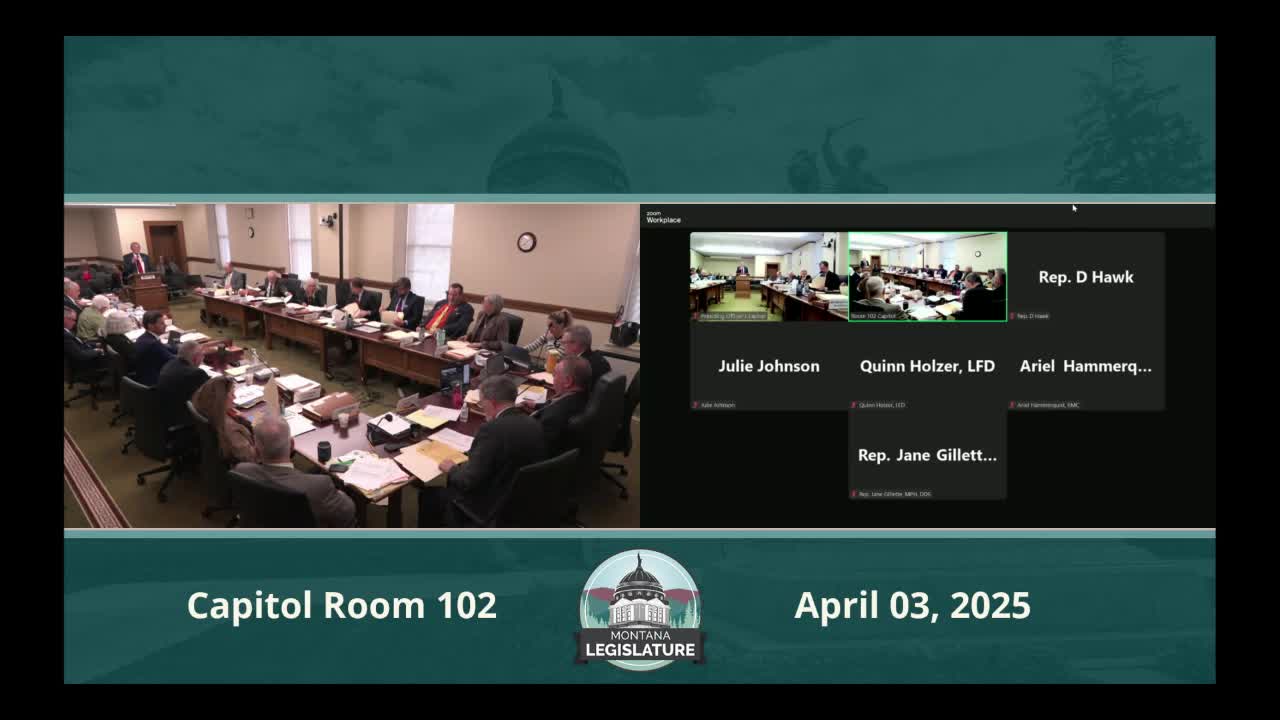
During executive action the committee voted to pass HB 851. The roll call on final passage during EA recorded 20 yes and 3 no votes and the bill passed out of committee. Opponents urged caution and asked for further fiscal and operational analysis during any implementation planning.