Get email alerts on the Appointment Department Of Agriculture topic
No spam. Unsubscribe anytime.
Senate committee recommends Paul Brierley for Arizona Department of Agriculture after contentious questions on bird flu, eggs and outreach
Summary
The Arizona Senate Committee on Director Nominations recommended Paul Brierley to the full Senate by a 3-2 vote. The hearing covered agency reorganization, responses to avian influenza, egg supply and the delayed cage-free rule, plus concerns about outreach to regulated entities and past political statements.
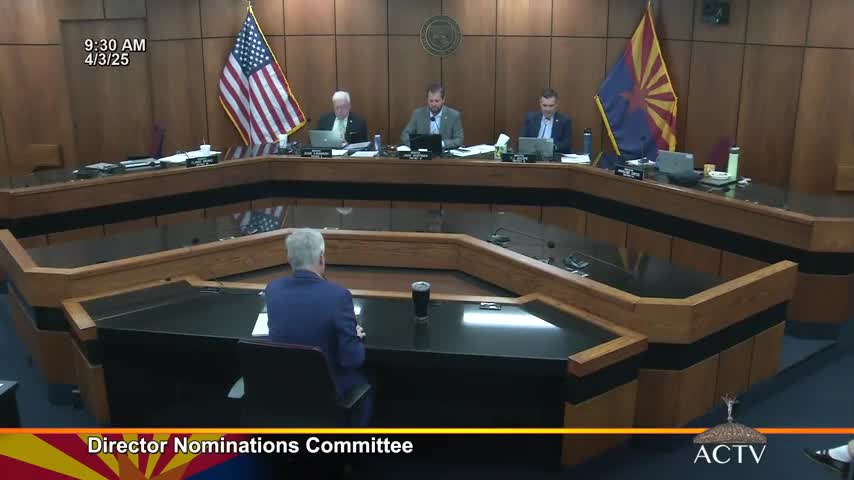
Paul Brierley, the governor’s nominee to lead the Arizona Department of Agriculture, won a narrow recommendation from the Arizona Senate Committee on Director Nominations after a hearing that covered agency modernization, the state response to avian influenza, the egg supply and a contentious line of questioning about solicitations for nomination support and past political commentary.
The committee recommended Brierley to the full Senate by a 3-2 roll call. Senator Jake Hoffman chaired the hearing; Senators raised questions about the department’s organizational restructuring, its approach to biosecurity and disease response, IT and licensing modernization, weights-and-measures enforcement, and an implementation plan for the state veterinarian and livestock inspectors. Aggressive questioning from some members focused on Brierley’s past political statements and whether he had asked regulated parties for letters of support during his confirmation process.
Why it matters: The director of the Department of Agriculture oversees food safety inspections, animal- and plant-health programs, producer licensing and licensing systems, and emergency response to outbreaks. Recent supply shocks — especially widespread avian influenza outbreaks and their impact on egg availability and price — mean department decisions can have near-term effects on retail prices and on producers’ operations.
Opening statement and background Brierley summarized his background in production agriculture, leadership at the Arizona Farm Bureau and as the inaugural executive director of the Yuma Center of Excellence for Desert Agriculture (YCEDA). He told the committee he grew up on a family farm and later applied an engineering and computer-science background to agricultural innovation; he described Yuma as "Arizona's crown jewel" for winter leafy-green production. He asked the committee for a favorable recommendation.
Reorganization and modernization priorities Brierley described a department reorganization that consolidated program work into three regulatory divisions (animal services, plant and produce services, environmental and consumer protection) plus a non-regulatory "Agriculture and Food Systems Support Division" for proactive training and grant-making. He emphasized one priority budget ask: licensing-system modernization. The department issues roughly 200,000 licenses a year and Brierley said legacy systems create security and performance issues; he said licensing modernization is the administration’s leading IT priority.
Avian influenza, eggs and cage-free rule Brierley explained the department’s response to recent avian influenza outbreaks and the steps taken to protect consumers and producers. He said the department worked with USDA and tribal partners to depopulate infected facilities and implement biosecurity measures; he noted pasteurization keeps the milk supply safe in dairy incidents and that a quarantined dairy had been identified. On eggs, he said a single large affected poultry facility removed roughly one million hens from the supply chain, contributing to higher retail egg prices. To ease sourcing pressures, the department delayed implementation of a state cage-free egg rule; Brierley said the delay was intended to allow greater sourcing flexibility during the outbreak and to avoid further disrupting the market.
Questions on weights-and-measures, enforcement and staffing Committee members pressed Brierley about weights-and-measures inspections and the frequency of consumer overcharges reported in a media review. Brierley described risk-based targeting of inspections and efforts to work with retailers and trade associations before enforcement actions. He also said staffing for livestock inspectors had declined from about 74 to 17 positions over time and told the committee that current staffing levels do not meet demand; he asked for additional inspectors and for investments in the state veterinarian’s office after noting the department had been thin during concurrent disease responses.
Contentious exchanges and committee concerns Several senators criticized Brierley for soliciting letters of support from people and groups in his agricultural network; Brierley said he sent one general email to contacts and did not follow up or pressure recipients. Questions also highlighted a 2020 public post in which Brierley criticized national political leadership; Brierley said the statement was years old, that he has since tried to be more apolitical in his public role and that he currently works to build cooperative federal relationships with USDA and federal partners.
Formal action A motion to recommend confirmation passed after roll call: Senator Bravo — Aye; Senator Kavanaugh — No; Senator Ortiz — Pass (not voting); Vice Chair Schoel — Aye; Senator Schoep — Aye; Senator Bowman — No. The committee recorded 3 ayes and 2 nays and recommended the nomination to the full Senate.
What’s next The nomination is forwarded to the full Senate for confirmation. Committee members who voted no cited concerns about judgment, outreach to regulated entities and past public commentary; members who voted yes cited Brierley’s industry experience, leadership network and modernization priorities.