Get AI Briefings, Transcripts & Alerts on Local & National Government Meetings — Forever.
Arizona House committee finds executive decisions expanded DD costs, adopts findings amid $122M shortfall
Loading...
Summary
The Arizona House Ad Hoc Committee on Executive Budget Mismanagement on March 1 adopted findings blaming executive‑branch decisions for unexpectedly large cost increases in the state’s developmental disabilities program and called on the governor’s office to identify federal funds to backfill a shortfall.
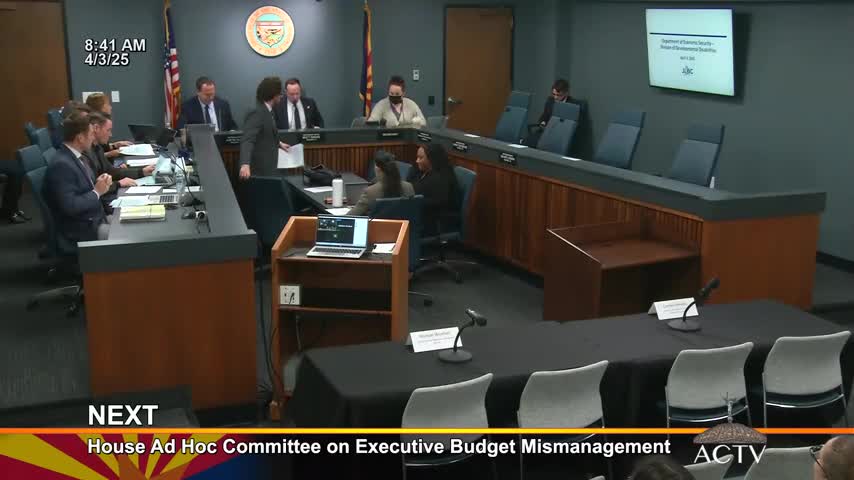
The Arizona House Ad Hoc Committee on Executive Budget Mismanagement on March 1 adopted findings that faulted executive‑branch actions for expanding the state’s developmental disabilities (DD) program and creating a fiscal shortfall, the committee said.
The committee voted to adopt the findings by a roll call tally described at the meeting as six ayes, zero nays and three absent. Vice Chair Olsen moved to adopt the findings and members present read and approved a list that included a call for the executive to identify federal funds and for the legislature to consider transfers to sustain services.
The committee convened to examine a reported FY2025 shortfall in the DD program. Committee presenters from the legislature’s budget staff summarized a timeline and drivers of rapid cost growth, and a non‑voting invited witness from Idaho described statutory reforms his state used to increase legislative oversight of federal waivers.
Why it matters: Committee members said the DD program provides essential services for children and adults with developmental disabilities and that a growing, unfunded liability could threaten the program’s continuity. The findings direct the legislature and call on the governor’s office to identify federal dollars under executive control that could be used to backfill the need while the legislature considers longer‑term measures.
Key facts and findings
- Budget shortfall and supplemental requests: The committee record states the Department of Economic Security (DES) informed legislators that DES needs approximately $109,000,000 for DD program formula costs and an additional $14,000,000 for high‑cost clients through June 30; earlier committee remarks also cited an estimated $122,000,000 shortfall for FY2025. The executive’s January budget included a $109,000,000 supplemental request that JLBC staff said reflects overall DD formula costs that include but are not limited to PPCG (Parents as Paid Caregivers).
- Rapid growth and drivers: JLBC and legislative policy staff told the committee that DD enrollment and utilization have grown faster than historic baselines, citing increases in member counts and in authorized attendant and habilitation hours. Staff reported that the program’s size rose from roughly 17,000 members a few years ago to roughly 59,000 members in recent data the staff presented; JLBC presented an adjusted total‑spending estimate of about $2.9 billion for FY2026 (as cited during the hearing) and staff said program costs could exceed $4 billion under continued growth assumptions.
- Parents as Paid Caregivers (PPCG): The PPCG initiative began as a temporary, federally funded policy during the COVID‑19 public‑health emergency and was later continued via a federal waiver. Staff explained that the federal waiver approval requires the state to begin sharing the cost (the regular Medicaid match) beginning April 2025. JLBC staff described a timeline in which the state initially budgeted $4,000,000 for the state match of PPCG (January 2024 estimate) and later actuarial estimates used in capitation rates showed annualized state costs rising to about $57,000,000. Staff said those rate changes were implemented in October 2024 despite an unfavorable JLBC review.
- Federal waiver and budget neutrality: Committee presenters stated that Centers for Medicare & Medicaid Services (CMS) approved Arizona’s waiver request to continue PPCG (presenters described it as an 1115‑type demonstration waiver) and that the CMS approval letter indicated the demonstration was expected to be budget neutral to the federal government. JLBC staff emphasized that federal budget neutrality to CMS does not guarantee neutrality to the State of Arizona and that the state match obligation can increase state general‑fund exposure.
- Access corrective action plan: The committee heard that Access (the Medicaid managed‑care contractor referenced in hearings) issued a corrective action plan to DES in November 2023 after public comments and other input identified inconsistent implementation practices, including disagreements over how support coordinators assess and authorize extraordinary care under PPCG.
- Absent executive witnesses: Committee members repeatedly noted that officials from Access and DES and representatives of the governor’s office did not attend the hearing despite invitations. Several members described the absence as an obstacle to obtaining agency explanations for rate setting, utilization changes and delays in implementing a proposed weekly cap on parent hours.
Committee action and immediate next steps
- Findings adopted: The committee adopted preprinted committee findings and added a finding that “the state legislature must receive annual reports from the administration identifying all federal funds received and an exit plan should those federal funds be eliminated,” language moved and read by Vice Chair Olsen during the meeting.
- Vote: Committee members recorded six ayes, zero nays and three absent. Committee members who spoke on the record in favor of the motion included Representative Bliss, Representative Carter, Representative Gutierrez, Representative Stahl Hamilton, Vice Chair Olsen and Chairman Gress (recorded on the audio transcript as voting in favor during roll call and closing remarks). The motion text as read to the committee summarized the findings (see committee action in the meeting record).
What the committee asked for: The findings call for the executive branch to identify federal funds under the governor’s control that could be used to backfill program needs in the short term, and for the legislature to explore transfers and further oversight steps. The committee also announced it will continue oversight and consider legislation to place guardrails on waivers or program implementation.
Context and outside testimony
- JLBC presentation: JLBC and legislative policy staff described enrollment and utilization trends, the timeline of PPCG from the pandemic‑era temporary authority through waiver submission and approval, and agency actions that changed capitation rates affecting the state share. Staff reported that DES planned to implement a 40‑hour weekly cap per child for PPCG beginning July 1 and that the waiver requires a cap; staff said earlier phase‑in plans in the waiver were not implemented as originally described.
- Idaho experience: Representative Megan Blanksma, a former Idaho state representative invited as a witness, described Idaho’s legislative reforms to increase oversight of federal funds and waivers, including (1) an annual federal funds report requirement and (2) a statutory requirement that the legislature approve waivers expected to increase state costs. Blanksma said those statutory tools allowed the Idaho legislature to review and limit executive action that would expand state obligations without legislative appropriation.
Remaining questions and limitations
- Data and agency responses: Committee members noted that many detailed questions about utilization drivers, exact enrollment growth month‑by‑month, and technical claims coding changes can be answered only by Access and DES. The agencies’ absence meant JLBC and policy staff used agency‑provided and publicly posted material and vendor‑briefing slides to prepare their presentations.
- Timing and fiscal risk: The committee’s findings say the program’s critical status requires short‑term solutions and legislative consideration of funding transfers and guardrails, but the transcript makes clear the committee did not adopt a specific appropriation; it adopted findings and signaled further legislative action.
Ending
Committee members said they will continue oversight, consider legislative proposals to increase transparency and guardrails for federal waivers that affect state funding, and pursue identification of available federal funds that the governor controls. The committee adjourned after the roll call vote (recorded as 6 ayes, 0 nays, 3 absent).