Get Full Government Meeting Transcripts, Videos, & Alerts Forever!
Get email alerts on the Heat Pumps Electrification topic
No spam. Unsubscribe anytime.
Panel outlines heat‑pump programs, costs and limits as Alaska explores electrifying home heat
Summary
Researchers and nonprofits told the House Energy Committee that air‑source and ground‑source heat pumps can cut home heating bills and reduce fuel imports, but that cold‑climate limits, workforce and distribution upgrades must be addressed for broad deployment.
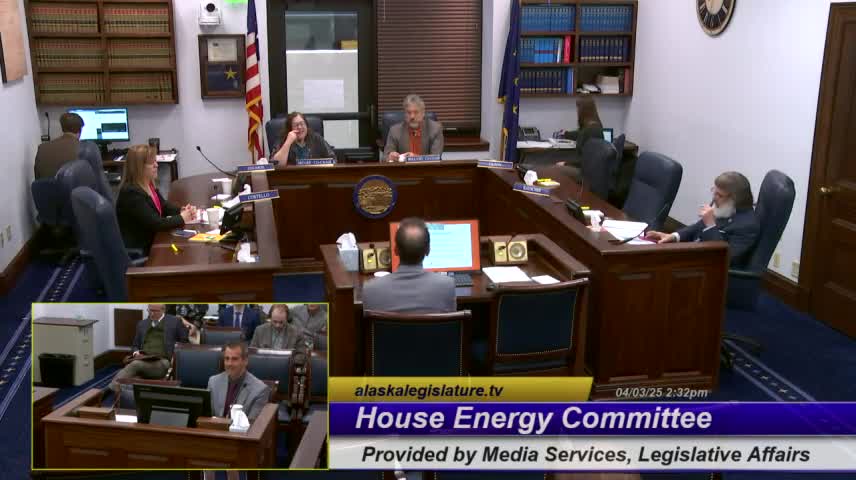
Researchers and nonprofit program managers told the House Energy Committee on April 3 that heat pumps offer substantial household savings and energy‑security benefits in many Alaskan communities, while also identifying workforce, grid and cold‑climate limitations that policymakers must address.
"Alaska HeatSmart...promote[s] energy efficiency in Alaskan homes and buildings," said Andy Romanoff, executive director of Alaska HeatSmart, who outlined that group’s mix of programs: a Home Energy Assessment program, a HUD‑funded whole‑home retrofit program for low‑income households, a Department of Energy Clean Heat Incentive and a larger ACES grant aimed at incentivizing thousands of heat‑pump installs. Romanoff said Alaska HeatSmart has assessed roughly 1,000 homes across Juneau and Sitka and directly served about 180 lower‑income families with conversions and retrofits. He said the organization’s DOE‑funded incentive work has so far provided about $134,000 in incentives and helped leverage roughly $530,000 in private funding.
Technical research: Tom Marcek, a sustainable energy professor at the University of Alaska Fairbanks and researcher with the Alaska Center for Energy and Power, summarized the physics and performance metrics for heat pumps and emphasized the coefficient of performance (COP) as the key measure. "A heat pump...takes the heat from the outside cold environment, steps up its temperature and moves it into the building," Marcek said. Marcek and research engineer Michelle Wilbur presented Alaska data and modeling showing that modern mini‑split units can reach COPs above the threshold (roughly COP = 2) needed in Southcentral Alaska to reduce net gas consumption at the power plants, though they said economics for Southcentral homeowners currently often favor gas under existing rate structures.
Workforce and installation: Wilbur noted that policy incentives can increase installer capacity — she cited regional data (from Homer) showing installer counts rose from one to seven after an incentive program — and flagged that rural communities without electricians or refrigeration/AC technicians face significant availability barriers. The committee heard that EPA, DOE and HUD funding streams are already being used for incentives and building retrofits; Romanoff described an ACES grant (EPA‑funded) that aims to incentivize roughly 6,100 heat‑pump installations across Southeast and coastal regions and to leverage approximately $20 million in private funds.
Grid and cold‑climate limits: Witnesses told the committee that microgrids and small diesel‑dominated systems must evaluate generator capacity before rapid load growth from electric heating. On the Railbelt, researchers said distribution services, transformers and home service capacity would need to be assessed if many buildings add heat pumps or electric vehicles; in some apartment buildings, upgrades could be required. Research from UAF also showed that as outdoor temperatures fall the COP declines, so in Alaska’s coldest regions many homes will need a backup heat source; witnesses recommended keeping existing systems until buildings and controls are optimized for mixed operation.
Costs and savings: Presenters gave cost ranges and savings estimates discussed at the hearing: single‑zone, ductless mini‑split installs commonly range from about $6,500 to $9,000 (two‑head systems $9,500–$11,000); Tom Marcek said smoother installs can be near $5,000 in ideal conditions. Romanoff estimated average annual residential savings of $1,500–$1,800 replacing an oil system in Southeast hydro communities and about $1,300 replacing 100% electric resistance heat. He described one case where a low‑income family saved roughly $2,000 per year after a retrofit.
Committee questions: Representatives asked about extreme‑cold performance, refrigerant handling and maintenance. Marcek and Wilbur said refrigerant handling requires EPA certification, that newer refrigerants have lower global‑warming potential, and that maintenance needs in an Alaska field study were modest (in one tracked sample, two of 38 pumps needed technician repairs during a year). Romanoff emphasized program design: his group recommends homeowners keep existing heating systems until a winter cycle demonstrates heat‑pump reliability for that household.
Ending: Witnesses urged coordinated policy — combining weatherization, incentives, workforce training and utility planning — to maximize savings, avoid distribution bottlenecks and enable heat pumps where they are cost‑effective. The committee requested additional technical details and follow‑up materials from the presenters.