Get Full Government Meeting Transcripts, Videos, & Alerts Forever!
Get email alerts on the Health Insurance Network Adequacy topic
No spam. Unsubscribe anytime.
Senate committee advances bill setting network adequacy thresholds for Alaska insurers
Summary
The Senate Health and Social Services Committee adopted two amendments to Senate Bill 122, which would require insurers to meet provider-network thresholds and direct the Division of Insurance to weigh whether very narrow networks could mislead consumers. The bill was forwarded out of committee as amended by unanimous consent.
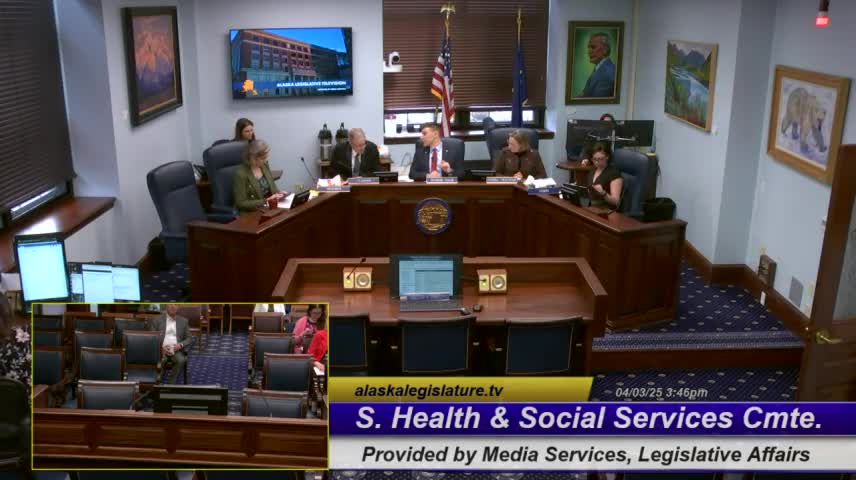
The Alaska Senate Health and Social Services Committee advanced Senate Bill 122 on April 3, adopting two amendments and voting to send the measure from committee as amended for further consideration.
Senator Alyse Giesel, sponsor of SB122, said the bill "would create a requirement for insurance companies to ensure that there are adequate provider networks included in their policies" and described it as "actually [a] consumer protection type of bill." The bill, in its amended form, directs the director of the Division of Insurance to assess whether a network is so narrow that it offers consumers little choice or incentivizes shoppers to buy plans with limited provider access because of a lower premium.
The measure sets minimum provider-network standards across Alaska's regions. Senator Giesel and others framed the bill as protecting consumers who might select the cheapest plan only to learn they lack access to needed specialists.
During committee discussion, Heather Carpenter, deputy director of the Division of Insurance, told the panel she had a copy of the amendment and said, "I do have a copy of the amendment in front of me." Carpenter said she did not believe narrow-network plans were common in Alaska now and that, with the bill's high thresholds, she did not foresee the proposed situation arising immediately, but she would need to review how the amendment fits with the rest of the bill.
Industry and provider witnesses testified in committee. Brenda Snyder, state government affairs director for CVS Health Aetna, testified in opposition, saying the bill "is an unnecessary change in these network adequacy standards" and argued federal law and state oversight already require sufficient networks. She said mandating the specified thresholds "will negate the balance between access, cost, and quality" and could raise premiums and out‑of‑pocket costs.
Doctor Steve Compton, past president of the Alaska State Medical Association, testified in favor of the bill, telling the committee Alaska already faces provider shortages in specialties and that ongoing market dynamics could threaten access. He said the measure is intended to address those risks if insurers pursue narrow-network strategies.
The committee adopted two amendments by unanimous consent. The first clarified that insurers must consider whether a network is so narrow as to limit consumer choice or to incentivize selection of a low‑cost product that provides only a small set of providers. The second amendment reduced each of the bill's regional percentage thresholds by 15 percentage points (for example, changing an 85 percent standard to 70 percent and a 90 percent standard to 75 percent), a change explained to the committee as intended to preserve consumer protections while making the thresholds more practicable for carriers.
After final discussion the committee "move[d] from committee Senate Bill number 122 ... as amended with individual recommendations and attached fiscal note," by unanimous consent. The committee did not record a roll-call vote in the transcript and forwarded the bill as amended for further consideration.
Clarifying details discussed in committee included that the underlying bill applies when the director identifies a narrow‑network plan design (for example, limited or no out‑of‑network benefits) and that the Division of Insurance would weigh whether a product's design could mislead consumers.
Committee members also noted concerns that Alaska's sparse provider supply in some specialties could make rigid numerical thresholds difficult to meet and could affect contracting dynamics and costs. Senator Hughes asked whether references in the bill to Medicare Advantage would cause issues because Medicare Advantage products are not used in Alaska; invited witnesses explained that the bill references a list of specialties used for measurement, not a product-specific mandate, and suggested adding pediatrics to that list.
The committee record shows the bill advanced with the two amendments adopted; the transcript indicates the bill was reported from committee without recorded objection. The committee will continue legislative processing of SB122 in the regular Senate workflow.