Get Full Government Meeting Transcripts, Videos, & Alerts Forever!
Get email alerts on the Renewable Portfolio Standard topic
No spam. Unsubscribe anytime.
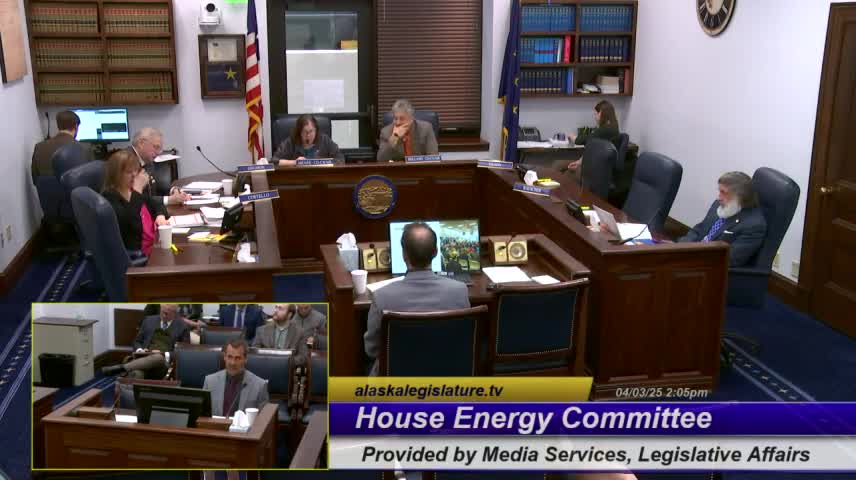
House Energy Committee hears testimony supporting HB153 renewable portfolio standard; bill set aside for further review
Summary
The Alaska House Energy Committee on April 3 heard invited testimony in support of House Bill 153, a proposed Renewable Portfolio Standard, and set the bill aside for further consideration.
The Alaska House Energy Committee on April 3 heard invited testimony in support of House Bill 153, a proposed Renewable Portfolio Standard (RPS), and set the bill aside for further consideration.
Supporters told the committee that an RPS would give the Railbelt planning process clear policy inputs, improve investor certainty for renewable projects and reduce the risk that future gas‑supply investments become stranded. "We do absolutely support an RPS, as a wise policy move," Joel Groves, president of the Alaska Independent Power Producers Association and a civil engineer, told the committee. Groves said three reasons underpinned his support: (1) process clarity for the Railbelt Reliability Council’s integrated resource plan (IRP); (2) better definition of the Cook Inlet gas system’s future role; and (3) correcting market structures that now limit independent power producer participation on the Railbelt.
Why it matters: committee members and witnesses said the legislature’s direction now would shape long‑term contracting and planning on the Railbelt. Natalie Kylie Bergen, energy lead at the Alaska Public Interest Research Group (Alaska PIRG), told lawmakers that an RPS would provide "regulatory and economic certainty" for projects and consumers, citing the risk that long gas contracts negotiated this year could lock in prices for decades and raise rates if global gas prices change.
Groves told members he could not address details of specific private projects when asked about Puppy Dog Lake; instead he said "every project needs to advance on its own economic merits." Groves also disclosed he serves on the Railbelt Reliability Council’s board but said his testimony represented the Alaska Independent Power Producers Association, not the council.
Hawaii experience: Mark Glick, chief energy officer for the Hawaii State Energy Office, appeared virtually to summarize Hawaii’s RPS implementation and results. Glick highlighted Hawaii’s statutory RPS targets and the state’s experience reducing exposure to oil‑price volatility. He said higher renewable penetration on Kauai and other islands helped stabilize retail energy prices there during global fuel shocks.
Committee questions and concerns: Representatives pressed witnesses on practical effects. Representative Holland asked whether an RPS would affect investor interest and project viability; Groves answered that price support from an RPS would improve project economics. Representative Rauscher raised utility concerns about penalty levels reported by some utilities, noting a utility estimate that fines could reach roughly $200,000 per month initially and $300,000 per month under later benchmarks; witnesses said modeling of industrial impacts had not been completed and that utilities are part of the ongoing discussion. Representative Costello asked how in‑state gas infrastructure would interact with RPS economics; witnesses answered that available modeling is limited and that the committee should expect follow‑up analyses.
Formal committee action: Chair Meares told the committee she would set HB153 aside for the day to continue other business; no vote on the bill was taken.
Context and next steps: Witnesses repeatedly said the timing matters because utilities are negotiating long gas contracts this calendar year and because the Railbelt Reliability Council is beginning an IRP process. Supporters argued passing policy clarity beforehand would avoid disrupting the IRP; witnesses and committee members asked for additional written testimony and economic modeling to inform future hearings.
Ending: The committee did not take further action on HB153 at the April 3 meeting; additional testimony and modeling were requested and will appear on future agendas.