Get Full Government Meeting Transcripts, Videos, & Alerts Forever!
Get email alerts on the Tribal Coordination Transportation topic
No spam. Unsubscribe anytime.
DOT outlines expanded tribal coordination: tribal team, STIP outreach, bridge funding and regional planning pilots
Summary
DOT officials told the Senate Transportation Committee they are expanding tribal engagement through a multi-person tribal team, targeted STIP outreach with translation options, pilot tribal coordination calls, TTP bridge funding partnerships, 23 USC 202(a)(9) fund transfers, and RPO pilots.
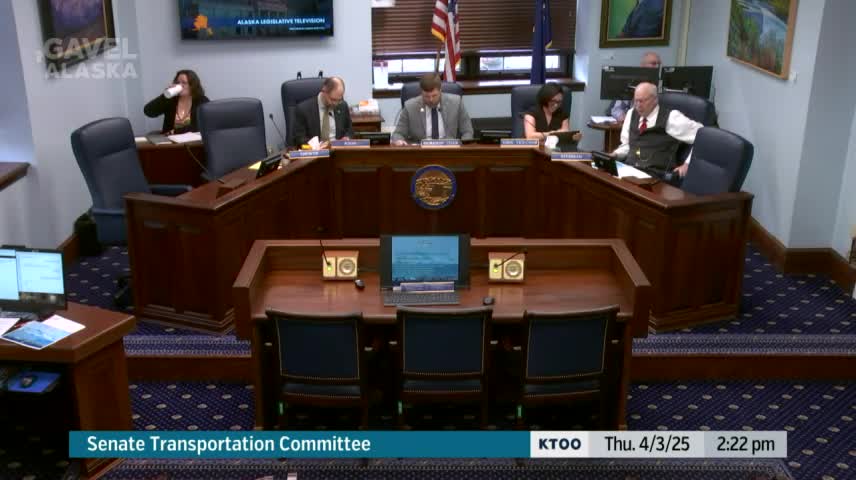
Shannon McCarthy, communications director for the Alaska Department of Transportation and Public Facilities (DOT&PF), and DOT planning leaders presented the department's efforts to expand coordination with Alaska Native tribes at the Senate Transportation Committee on April 3.
DOT officials said they have moved from a single tribal liaison to a multi-person tribal team to provide sustained engagement and to avoid having outreach rely on a single staff member. "We really are trying very hard to individualize our approach with different communities," said Sarah Lucey, Northern Region Planning Manager.
Tools and outreach: DOT identified several ongoing and planned actions to increase engagement: targeted outreach and translation options for the Statewide Transportation Improvement Program (STIP) amendments; multiple consultations as part of the federally required statewide functional classification update; early outreach for the statewide long-range transportation plan kickoff; quarterly tribal coordination calls (pilots in the Interior and Mat-Su regions); community transportation workshops in rural hubs; and a revamped tribal relations website with collaboration tools and contacts.
Funding and partnerships: DOT described grant and funding mechanisms being used to partner with tribes, including discretionary grant applications that involve tribal support (Elliott Highway corridor study covering communities such as Minto and Tanana; Talkeetna Spur culvert upgrades with Knik Tribal support; Glen Highway separated-path scoping with Chikaloon Native Village). DOT highlighted Tribal Transportation Program (TTP) bridge funding used in partnership with tribes (example: Hot Springs Slough bridge on the Elliott Highway, design underway and construction currently scheduled for FY 2028). DOT staff also described a 23 USC 202(a)(9) fund-transfer mechanism that allows federal highway funds to be transferred into tribal program authorities where appropriate, explaining that the transfer relocates funds under a tribal authority with different administrative rules.
Capacity-building and pilots: DOT noted it has designated three pilot regional planning organizations (RPOs) to build local planning capacity in rural areas and is partnering on a $2 million federal regional capacity grant that includes direct allocations for disadvantaged communities. The department said it is expanding outreach to regional Native corporations, and staff reported ongoing weekly coordination with FHWA on outstanding STIP consultation items.
Questions from senators focused on implementation detail: Senators asked about translation services and quality control for indigenous languages (DOT said it coordinates with its civil-rights division and uses qualified translators for languages such as Yup'ik), how the bridge funding eligibility relates to tribal inventory lists, and whether fund transfers provide more administrative flexibility than traditional transfer-of-responsibility agreements. DOT staff answered that 229 federally recognized tribes and the state's vast geography require tailored approaches, and that many of the new procedures are intended to increase continuous engagement rather than transactional notice-only contacts.
Outcome: The presentation was informational; the committee asked follow-up questions and indicated interest in maps and regional detail for members. No formal committee action or vote followed the presentation.
Context: DOT officials present included Shannon McCarthy (communications director), Sarah Lucey (Northern Region Planning Manager), and Judy Chapman (Deputy Director of Planning). Senators and committee members raised regional concerns ranging from Southeast ferry and road connections to priorities for bridge replacements and RPO formation.