Get Full Government Meeting Transcripts, Videos, & Alerts Forever!
Get email alerts on the Public Pensions topic
No spam. Unsubscribe anytime.
Actuary says shared-risk DB in HB78 likely raises near-term state costs but could narrow with member transfers and lower discount rates
Summary
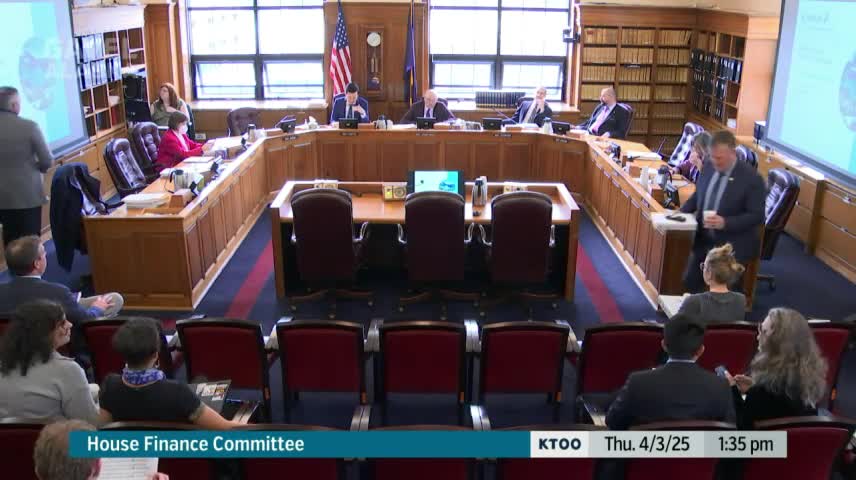
The House Finance Committee heard an actuarial presentation on House Bill 78, the proposal to offer a shared‑risk defined‑benefit retirement plan to Alaska public employees. Gene Kowarski of Chiron presented four scenarios, saying the main present‑value estimates—based on a 7.25% discount rate and Gallagher’s turnover assumptions—put additional state employer costs in the hundreds of millions over 14 years, and that a lower discount rate would raise present‑value costs.
The House Finance Committee heard an actuarial presentation on House Bill 78, the bill that would offer a shared‑risk defined‑benefit retirement plan to current and future public employees. Gene Kowarski, CEO and consulting actuary with Chiron, presented cost scenarios, turnover assumptions and an initial assessment of economic impacts.
Kowarski said the analysis used the actuarial assumptions currently applied for Alaska by the state actuary (Gallagher) and that the firm produced four scenarios showing different mixes of current DC members transferring into a DB option and different turnover assumptions. "We're using a 7 and a quarter percent interest rate" for the main present‑value calculations, Kowarski said during the presentation.
Why it matters: a change in retirement plan design affects employer costs, employee retirement security and broader state finances. The committee’s members pressed for clarity on the assumptions behind turnover, discount rate and whether the analysis normalized per‑dollar investments between plan types. Several members said retention improvements could substantially change the state cost picture.
Details of the actuarial presentation
Kowarski outlined why actuarial assumptions differ between DB and DC plans: DB plans show lower ultimate turnover and earlier retirements in many data series, while DC plans have higher turnover after five years. He said the turnover assumptions used were those Gallagher applies to Alaska and are based on select‑and‑ultimate tables (higher turnover in early years, lower 'ultimate' turnover later).
He laid out four scenarios the committee requested: 1A (current DC members transfer to DB and DB turnover assumptions apply), 1B (no current transfers; future hires enter DB under DB assumptions), 2A (current members transfer but DC turnover assumptions persist) and 2B (no current transfers, future hires enter under DC assumptions). Kowarski said his view made 1A and 2A the plausible bounds and noted experience in other systems—San Diego, for example—where many DC members retroactively moved back into a DB plan.
On projected costs, Kowarski directed the committee to the far‑right column of a 14‑year present‑value table. Using a 7.25% discount rate he identified figures in the hundreds of millions of dollars (the deck showed present‑value increases to the state on the order of several hundred million over 14 years). He said using a lower discount rate (6.5%) would raise the present value (he gave an illustrative top‑line change to roughly $610 million under a 6.5% assumption).
Kowarski also described HB 78’s built‑in risk‑sharing levers: member contribution rates may be adjusted within a band (he cited language allowing member rates to rise to 12% and not fall below 8%), and cost‑of‑living adjustments could be reduced if unfunded liabilities grow.
Committee questions and limits of the presentation
Committee members repeatedly pressed Kowarski on normalization of contributions (whether the analysis compared the same dollar amounts invested under DB vs. DC), the assumed long‑term rate of return, stress testing and whether Alaska‑specific experience (rather than national samples) was used for turnover and retirement assumptions.
Kowarski said the turnover assumptions were the state's (Gallagher) assumptions and that the primary discount/assumed return used in the presentation was 7.25%. He confirmed Chiron had done stress testing for a similar bill last year (Senate Bill 88) and said the firm could run additional stress scenarios on request, but that the committee had asked only for the scenarios presented.
Context and next steps
Representative Chuck Kopp (sponsor's office) and other members asked for modeling showing buy‑in costs for typical employees and for stress testing showing how lower returns or worse experience would affect funded ratios and contribution rates over multi‑decade horizons. Kowarski said his team could do that work but had been engaged recently and the current delivery reflected the scope requested for this hearing.
Ending
The actuarial presentation closed with Kowarski noting the potential for positive economic spillovers if the plan improved recruitment and retention—lower hiring and training costs, greater local spending by longer‑tenured employees—and a recommendation that the legislature consider a formal economic analysis to quantify those effects.