Get Full Government Meeting Transcripts, Videos, & Alerts Forever!
Get email alerts on the Taxation Vehicle Rentals topic
No spam. Unsubscribe anytime.
Senate committee hears bill to require platforms such as Turo to collect state vehicle-rental tax; bill set aside
Summary
Senate Bill 138 would require vehicle-rental platforms to collect and remit Alaska's vehicle-rental tax, lower the platform rate to 8% while leaving traditional rental companies at 10%, and bar retroactive collection; the committee took testimony and set the bill aside for later consideration.
Senator Matt Klayman, sponsor of Senate Bill 138, told the Senate Transportation Committee on April 3 that the use of peer-to-peer vehicle-rental platforms such as Turo and Getaround has risen sharply and that many hosts do not know how to collect or remit the existing state vehicle-rental tax.
Klayman said the bill would require rental platforms to collect the existing tax and remit it to the Department of Revenue, lower the rate for platform transactions from 10% to 8%, and prohibit retroactive collection of unpaid state rental taxes. "Senate Bill 138 requires vehicle rental platforms like Turo to collect the existing state rental tax and remit the tax to the Department of Revenue," Klayman said.
Why it matters: vehicle-rental tax receipts have long been used to support Department of Transportation programs and state parks. Claire Holland LeClaire, a former member of a state parks advisory board, told the committee that vehicle-rental tax receipts supply roughly half of the operating budget for state parks in the current fiscal year and urged the committee not to adopt a lower tax rate for platforms.
Discussion and testimony: municipal officials from the Municipality of Anchorage described a local ordinance that requires hosting platforms to collect the city's rental tax and said platform collection simplified administration. Paula Birmingham, tax enforcement officer for the Municipality of Anchorage, told the committee that the city enforces collection by requiring platforms to register and remit and that the city did not pursue back taxes from hosts because of the administrative burden.
Brandon Spanos, Deputy Director, Tax Division, Alaska Department of Revenue, said the department has no reliable statewide estimate of uncollected tax and that its fiscal note is indeterminate. Spanos described past efforts to obtain platform customer lists through subpoena, and said courts limited enforcement of subpoenas outside Alaska; the bill contains language intended to allow cross-border subpoena enforcement for in-state transactions. Spanos also described how IRS 1099-K reporting changes (a phased-in reduction of the reporting threshold) should eventually provide the department more data about platform payments but that the IRS reporting cadence has lagged.
Committee members questioned enforcement and equity: Senator Kiel and others asked why the bill would set a different tax rate for platform rentals than for traditional rental companies and whether that would pick winners and losers. Senators also pressed whether Department of Revenue could instead use its existing regulatory authority to collect unpaid taxes without new legislation. Senator Stedman and others requested a financial breakdown from the Department of Revenue to show how much revenue might be at stake.
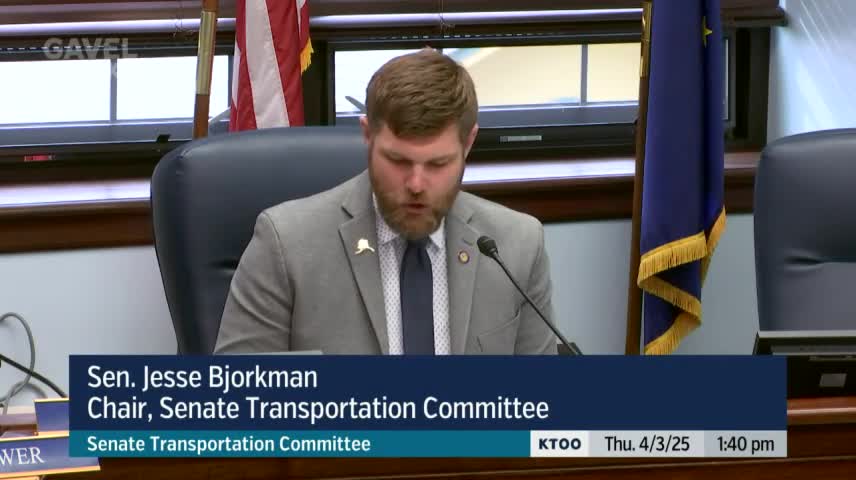
Outcome and next steps: The committee did not vote on the bill. Chairman Bjorkman said, "That's probably good. At this time, we'll set Senate Bill 138 aside for future consideration at a meeting coming up soon." No motion or vote was recorded in the transcript; the item was postponed for further committee consideration.
Credits and context: Committee testimony included the sponsor and his staff, representatives from the Municipality of Anchorage and the Alaska Department of Revenue, and public commenters. No formal fiscal estimate was provided during the hearing; the Department of Revenue has described its fiscal note as indeterminate.