Get Full Government Meeting Transcripts, Videos, & Alerts Forever!
Get email alerts on the Child Psychiatric Care topic
No spam. Unsubscribe anytime.
Committee hears bill to expand parental access, inspections and restraint reporting at child psychiatric hospitals
Summary
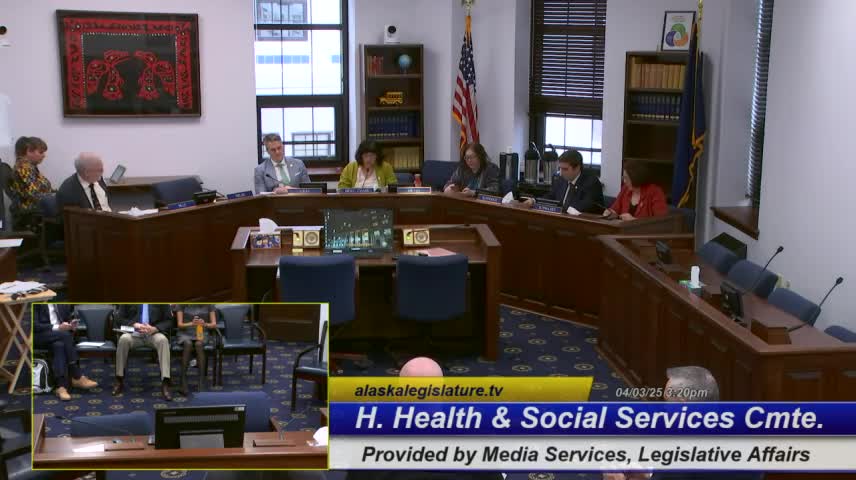
The House Health and Social Services Committee on April 3 heard House Bill 52, which would guarantee confidential telephone and video contact between minors in psychiatric hospitals and their parents, require unannounced twice‑annual inspections of in‑state facilities and mandate reporting when restraints are used.
The House Health and Social Services Committee on April 3 heard House Bill 52, sponsored by Representative Maxine Divert, which would expand parents’ and guardians’ communications with minors in psychiatric hospitals, require more frequent unannounced inspections of in‑state facilities and mandate reporting on the use of chemical and physical restraints.
Divert, a representative from Downtown Fairbanks, said the bill “is designed to further protect children housed in psychiatric hospitals, enshrining parental rights, and creating transparency in their care.” Her office described three main reforms: (1) guaranteed confidential telephone and video communications for at least 60 minutes per week; (2) unannounced inspections by the state twice annually with interviews of residents; and (3) required notifications to the Department of Health when seclusion or restraints, including chemical restraints, are used.
Why it matters: Witnesses and committee members framed the measure as a response to reported abuses and to recommendations in prior federal and independent reviews. Proponents said improved communication helps preserve family and cultural ties when children are placed far from home; they also said regular, surprise inspections would catch problems that scheduled visits can miss.
Committee discussion and clarifications: Committee members pressed sponsors and agency staff on several operational points. Representative Gray asked whether the bill duplicates or conflicts with existing patient‑rights language in Alaska law; sponsors and a Department of Health representative said HB 52 adds video communications and sets a minimum amount of confidential contact time. Committee staff and the Department clarified that the current statute granting psychiatric patients “reasonable access” to telephone calls allows facilities to place limits; supporters said HB 52 sets a floor rather than a ceiling.
Members also sought details on inspections. Sponsor staff said the bill requires surveyors to interview roughly 50% of residents during a visit; staff estimated that would mean about 30 interviews at the Northstar facility and 5 at API, for 35 interviews per visit and 70 interviews annually for the in‑state population. Department witnesses clarified the bill’s inspections would apply only to state‑licensed Alaska facilities, not to out‑of‑state hospitals where some Alaskan children are placed.
The committee discussed how the bill would treat medications used as restraints. Representative Gray and others raised the possibility that a drug prescribed daily could be used in a higher dose as a chemical restraint; agency and sponsor staff referenced Alaska statute language distinguishing psychopharmacologic drugs used for discipline or convenience from treatment, and said they could add clarifying amendments to ensure only uses as restraints are reported.
Testimony: Kim Swisher, deputy director of the Office of Children’s Services, told the committee facilities do not force youth to accept calls if they refuse, but said ensuring access is in children’s best interests. Dr. Seth Green of the Aleutian Pribilof Islands Association supported unannounced inspections and urged limiting restraints to extreme, rare circumstances. Multiple legislators described fiscal and policy context, including a committee reference to a recent $4,000,000 supplemental legal expense tied to litigation over the state’s care system and a fiscal note on HB 52 of roughly $212,000.
Committee action: Chair Mina said the committee would “set aside House Bill 52 for further consideration.” No formal vote on the bill was recorded at the hearing.
Outstanding issues and next steps: Committee members requested clarifying language on who may approve communications plans (the bill uses “professional person in charge” rather than “overseeing physician”), tighter language about interviews to protect interviewee safety, and an explicit statutory definition to avoid reporting loopholes when a medication is both prescribed and later used as a restraint. Sponsors and staff said they would consider amendments and follow up with the committee on inspection timing, data collection for out‑of‑state placements, and whether the publicly posted annual report should include de‑identified medication and restraint statistics.
Ending: The committee paused HB 52 for further work; sponsors and agency staff agreed to return with clarifications and possible drafting changes before additional committee action.