Get Full Government Meeting Transcripts, Videos, & Alerts Forever!
Get email alerts on the Program Evaluation Selection topic
No spam. Unsubscribe anytime.
Legislative Audit subcommittee advances roughly 11 semifinal topics to legislator survey; vote unanimous
Summary
The Legislative Audit Commission evaluation subcommittee voted unanimously April 2 to advance the top-ranked semifinalist topics — roughly 11 items from 18 nominations — to a survey of legislators to gauge final interest; members discussed sequencing and concerns about two voter-registration items and several timing-sensitive topics.
The Legislative Audit Commission evaluation subcommittee voted unanimously April 2 to forward the top-ranked semifinalist topics to a survey of legislators that will determine which program evaluations the Office of the Legislative Auditor pursues in 2025.
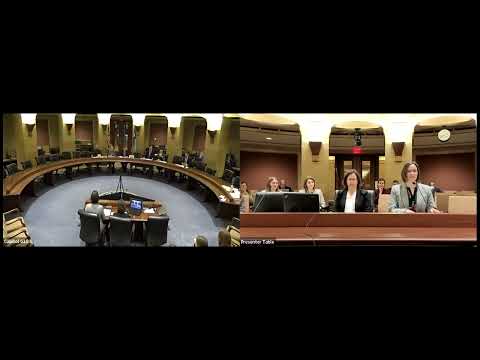
The subcommittee met at 8:30 a.m. in Room G15 of the Minnesota State Capitol to review background papers on 18 proposed evaluation topics and to narrow that list for the broader legislative survey. Representative Anderson moved to advance the items in the two highest-ranked groups (about 11 topics) to the survey; the motion was seconded and carried on a roll-call vote that the clerk recorded as unanimous.
The Office of the Legislative Auditor (OLA) staff emphasized that the preliminary screening is intended to avoid sending topics to the full legislature that look popular but are not feasible or timely. "In the past, we have typically moved along 10 topics to the survey," said Jody Munson Rodriguez, deputy legislative auditor for OLA's program evaluation division, noting her office had done background research to assess feasibility against criteria the commission adopted in October.
Why it matters: the survey results will shape which evaluations OLA begins. Munson Rodriguez said the office plans to recommend five topics this spring, start four of those immediately, and roll additional topics into work that begins in late summer and fall. The subcommittee’s decision therefore sets which proposals legislators will rank publicly and which agencies should expect possible audits.
Discussion highlighted two clusters of concerns. First, members and OLA staff cautioned that two nominees that include the phrase "voter registration" are distinct and could create confusion on the survey: an automatic voter registration (AVR) evaluation focused on the Minnesota Department of Public Safety’s handling of citizenship documentation and implementation of AVR-related software, and a separate voter registration systems evaluation focused on the Office of the Secretary of State and local precinct processes. "Automatic voter registration ... would be focused on the activities of the Department of Public Safety," Munson Rodriguez said. Legislative Auditor Judy Randall added that the AVR review "also would involve the Office of the Secretary of State," and warned that selecting both in the same cycle could overburden the relatively small Secretary of State office.
Several members proposed clarifying language for the survey so legislators can distinguish the two items — for example, by noting one is an examination of DPS implementation of AVR and the other examines statewide voter registration systems and county/precinct processes. Representative Quam suggested adding brief parenthetical descriptors; Munson Rodriguez said OLA typically sends the background papers as PDFs and could add clarifying text.
Second, OLA staff placed seven topics in a lower-priority category because of timing or suitability concerns. Munson Rodriguez said nonemergency medical transportation and medical-assistance provider fraud-prevention topics face pending legislation that could fundamentally change the programs, making findings premature if laws change. She also noted that the childcare assistance program recently moved from the Department of Human Services to the Department of Children, Youth and Families and that the new administration of that program has been in place only a few months, limiting the usefulness of a near-term evaluation. Financial-transparency reporting for nursing facilities had only its first year of new reporting data due in February, reducing the available data for analysis.
Munson Rodriguez also raised independence and scope concerns about fiscal notes because the Legislative Budget Office currently oversees that function and the legislative auditor sits on the board that oversees the LBO; she said those concerns make a fiscal-notes program evaluation problematic. Finally, she said MinnesotaCare eligibility and unemployment insurance raise core questions that OLA’s financial-audit division is better positioned to examine.
Procedure and next steps: the subcommittee’s action advances the top two ranked groups of topics to a survey for all legislators. Historically, OLA has sent about 10 topics for legislators to rank; the subcommittee noted that the office typically uses the survey results to narrow to roughly five evaluations to begin. OLA staff said they expect to begin four of the selected topics immediately and to phase others in later in the year.
The subcommittee adjourned after the unanimous vote. The full Legislative Audit Commission will receive the committee’s recommendation and the survey results before final topic selection and assignment of evaluation work.