Get Full Government Meeting Transcripts, Videos, & Alerts Forever!
Get email alerts on the Guardianship topic
No spam. Unsubscribe anytime.
Audit finds Minnesota guardianship oversight inadequate; auditors urge centralized monitoring and training
Summary
The Legislative Audit Commission heard April 2 that Minnesota lacks adequate oversight of adult guardianship and should adopt a more proactive, centralized system to protect people placed under guardianship, according to a presentation by the Office of the Legislative Auditor (OLA).
The Legislative Audit Commission heard April 2 that Minnesota lacks adequate oversight of adult guardianship and should adopt a more proactive, centralized system to protect people placed under guardianship, according to a presentation by the Office of the Legislative Auditor (OLA).
"First, we found that there is inadequate oversight of adult guardianship in Minnesota," said Caitlin Badger, evaluation manager for the Office of the Legislative Auditor, presenting the OLA's program-evaluation report to the commission.
The OLA told commissioners that guardianship — a court-ordered legal arrangement in which a guardian makes some personal decisions for an adult deemed incapacitated — can protect adults who need support but also removes certain rights and creates potential for harm when oversight is weak. The report identified three broad problems: limited monitoring and enforcement of guardians' duties, inadequate training for guardians and judicial officers, and no statutory complaint process for the judicial branch to handle guardian-performance complaints.
The auditors presented specific findings and data. The judicial branch estimates "over 30,000 people subject to guardianship in Minnesota and over 41,000 guardians," Badger said. In a file review the OLA selected 62 guardianship cases and 260 annual personal-well-being reports; only eight of those 62 cases had all reports submitted on time, and across the 260 reports the OLA found that 30% were submitted on time. The report also found that courts issued an order to show cause in fewer than 20% of instances when guardian reports were more than 60 days late.
The OLA highlighted practical consequences of the reactive approach. In one case the court issued a warrant for a guardian's arrest after repeated missed reports, yet as of February 2025 the guardian remained the only guardian for the person subject to guardianship and had not been arrested; the missing annual report was 17 months late. The OLA said it found limited consequences for repeated noncompliance.
The audit flagged training gaps: "Guardians are not required to participate in any training prior to or after becoming a guardian, including training on their roles and responsibilities," Badger said. OLA survey results also showed that only 35% of judicial officers who recently presided over guardianship hearings said it was mostly or very clear how to respond to a substantiated complaint about a guardian, and only 64% said they always determine whether less-restrictive alternatives exist before appointing a guardian.
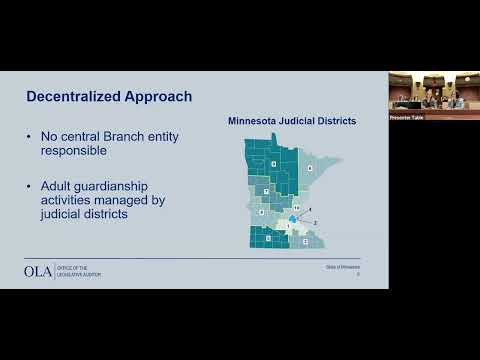
The OLA recommended that the legislature consider establishing a centralized statutory entity to administer and monitor guardianships (options in the report include centralized work within the State Court Administrator's Office, a separate judicial-branch board, or moving oversight to the executive branch). The auditors also recommended that statutes define enforcement and oversight duties, require baseline training for all guardians and for judicial officers who preside over guardianship hearings, and establish a statutory complaint process for guardian performance.
The State Court Administrator's Office (SCAO) and Judicial Branch representatives acknowledged progress while warning that some recommendations would require resources or raise separation-of-powers concerns. "Ensuring that adults subject to guardianship are protected and treated with dignity is a responsibility we take seriously," said Dawn Torgerson, deputy state court administrator. Torgerson listed recent initiatives the branch said have strengthened oversight, including online reporting tools (My Minnesota Conservator and My Minnesota Guardian), a 2021 federal Elder Justice Innovation Grant that funded the Minnesota Vulnerable Adult Care Project, a pilot complaint and investigation process launched in July 2022, and centralized guardianship teams established in every judicial district in June 2023 to track guardian reports and escalate concerns.
SCAO staff described the pilot complaint program and investigation triage. The branch said it has hired staff with grant funds, developed triage criteria and investigative protocols, and that the complaint process has increased reported complaints: OLA reported that SCAO had received 245 complaints since the pilot began and averaged three to four complaints per week in early 2024; SCAO told commissioners it now faces a backlog and is using additional federal funds and a second grant awarded in 2024 to improve data, reporting and complaint processing through 2027.
Legislators asked about compensation incentives, whether guardianship can be ended or "rehabilitated," and which recommendations would require new funding. OLA said it found no direct evidence of fraud in its review but said the available data were insufficient to draw broader conclusions and recommended stronger oversight to enable that analysis. Jurisdictional and process questions — for example whether some administrative, programmatic oversight belongs outside the judiciary — drew discussion; SCAO representatives said moving certain administrative or investigatory functions outside the judiciary is among the options discussed in the audit.
The commission did not take formal action during the hearing. The OLA report contains additional recommendations and technical detail cited by auditors (the report's recommendations begin on page 93). SCAO officials said they would continue work under federal grants and that making complaint investigations or periodic reviews permanent would require legislative funding decisions.
For now, the statutory duties auditors cited remain limited: law requires courts to maintain a guardian registry and to require guardians to submit annual personal-well-being reports, but statutes do not prescribe how courts must monitor guardian performance, how often a guardian must meet with a person subject to guardianship, or a statutory complaint-and-investigation duty for the branch. The auditors asked the legislature to address those gaps to better protect Minnesotans under guardianship.