Get Full Government Meeting Transcripts, Videos, & Alerts Forever!
Get email alerts on the Energy topic
No spam. Unsubscribe anytime.
Lawmakers say recent bills aim to bring IPP power into Utah and shield ratepayers from data-center costs
Summary
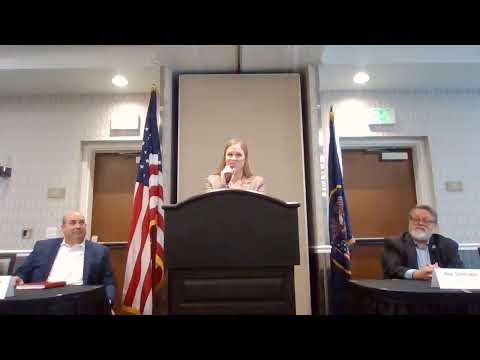
Representatives at a Washington County Republican Women luncheon described passage of SB132 and HB70 as steps to secure generation and require large data-center loads to pay their own power costs, including bringing the IPP plant capacity into Utah.
State lawmakers attending a Washington County Republican Women luncheon said two measures passed this year to address large new power demands from data centers and to secure generation capacity for Utah.
Representative Colin Jack, who chairs the House Public Utilities and Energy Committee, said SB132 passed unanimously in both chambers and sets a framework for utilities to serve large electricity loads — such as data centers — without shifting costs to ordinary ratepayers. "We passed out of the House unanimously, and then we got unanimous concurrence at the Senate," Jack said, describing SB132 as a mechanism to let big users "pay their own way."
Jack also credited HB70 (referred to in discussion as the bill to keep the IPP plant) for preserving nearly 2 gigawatts of capacity at the Intermountain Power Project (IPP) near Delta and returning much of that generation to Utah’s grid supply. "HB70 . . . will allow the state of Utah to keep the IPP power plant up in Delta," he said, adding the measure will enable an operator request-for-proposal process when it takes effect.
Representative Neil Walter, who said he carried the related IPP bill in the House, described the legislative approach as preventing a form of cross-subsidy in which existing ratepayers would otherwise absorb costs tied to new large industrial or data-center customers. "Because of [Jack’s] expertise, that was prevented," Walter said, describing the bills as protecting consumers from a hidden tax to subsidize corporate demand.
Speakers noted strong lobbying pressure from data-center interests during the session. Jack said the combination of SB132 and HB70 is intended to let utilities serve large loads while requiring those users to bear their share of system costs, not the general rate base. Jack and Walter both characterized the measures as improving Utah’s energy security and capacity planning as large artificial-intelligence and data facilities grow.
Details provided in the discussion included an estimate that HB70 will bring roughly 2,000 megawatts of generating capacity back into Utah’s effective supply once the IPP arrangements take effect; Jack said an operator RFP will follow the bill’s effective date in May. The lawmakers did not provide legislative vote tallies in the luncheon remarks beyond describing SB132’s unanimous passage.
Why this matters: Large data centers and new high-demand users have raised questions nationwide about how to add capacity without driving up residential and small-business electric rates. The lawmakers said the pair of bills is intended to direct costs toward the new large users and preserve generation capacity that had been contracted out-of-state.
Looking ahead, Jack said rulemaking and utility-level implementation will determine how charges are allocated, and he said the RFP for an operator for IPP will be a near-term step following HB70’s effective date.