Get Full Government Meeting Transcripts, Videos, & Alerts Forever!
Get email alerts on the Zoning topic
No spam. Unsubscribe anytime.
Planning commission approves new rules for community homes, sets caps and spacing
Summary
The Huntsville Planning Commission approved an amendment to the city zoning code defining three types of community homes for people with disabilities, setting occupancy caps, a 1,000-foot separation rule and a reasonable-accommodation process required by federal law.
The Huntsville Planning Commission on March 25 approved a zoning-ordinance amendment to define and regulate "community homes" for people with disabilities, establishing three categories of living arrangement, occupancy caps and a 1,000-foot spacing requirement.
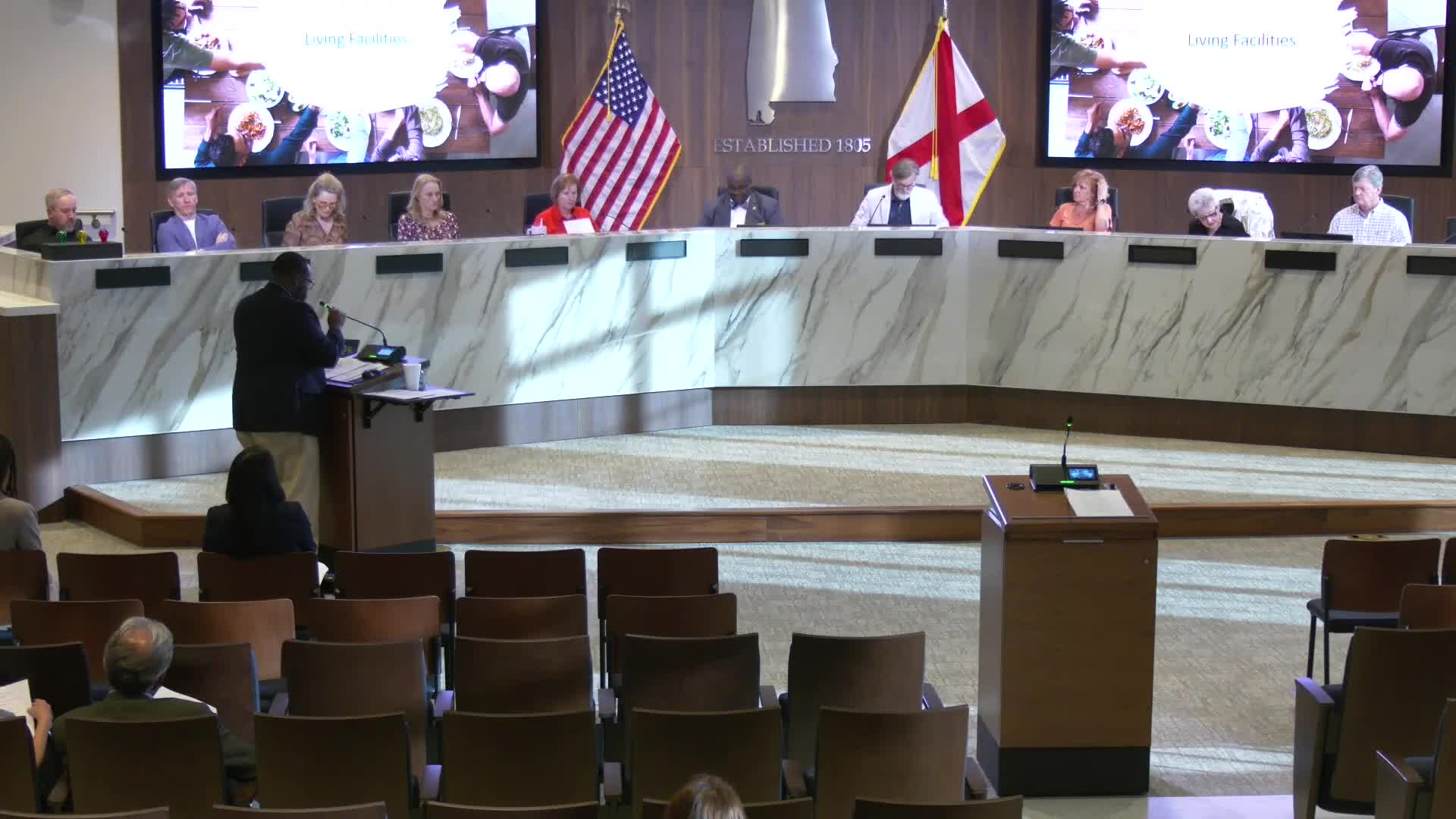
City planning staff said the change fills a gap between local rules and federal requirements. "This presentation is primarily related to individuals with disabilities and is required by federal law for us to have an ordinances as it relates to ADA compliance and [the] Federal Housing Act," Thomas Nunez, manager of the Planning and Zoning Services Division, said during the commission presentation.
The amendment creates three classifications for community homes: "essential community" homes (long-term, up to six unrelated residents on single-family lots), "group community" homes (longer-term group living with higher caps in some districts) and "transitional community" homes (short-term stays under 180 days). The ordinance sets a 1,000-foot radius separation between community homes, applies the rules to single-family structures in districts that allow single-family dwellings, and outlines a reasonable-accommodation process to evaluate requests under federal law.
Nunez told commissioners the ordinance also clarifies accessory-use rules so that shared kitchens, bathrooms and other common, non-habitable spaces that support a community home are not counted toward accessory-use square-footage limits. He said existing lawful community-home operations would be grandfathered as nonconforming uses until they are otherwise altered.
Sally Wharton, chair of the Zoning Committee, presented the committee's recommendation and moved approval. The commission voted in favor on a voice vote; no roll-call tally was provided in the record. "We are amending, we're proposing to amend the zoning ordinance in the following ways... Article 3, definitions... Article 73, supplementary regulations... and to add Article 78, community homes," Wharton said in the committee report.
Commissioners and staff said the amendment is intended to bring local zoning into alignment with federal obligations under the Americans with Disabilities Act and fair-housing requirements while preserving the character of single-family neighborhoods. Nunez said a formal permit application and administrative process for classifying a given home as essential, group or transitional will be developed and that outside legal counsel will assist with implementation and any further refinements.
The commission's approval sends the amendment forward in the local review process; additional steps before final city adoption were discussed but not specified in detail during the meeting.
The ordinance text before the commission included numeric occupancy limits by category (six for essential homes; caps of 10–12 for group homes in some districts; up to 14 in specific industrial zoning for transitional facilities) and defined the 180-day threshold that distinguishes transitional from longer-term arrangements.