Get Full Government Meeting Transcripts, Videos, & Alerts Forever!
Get email alerts on the State Budget topic
No spam. Unsubscribe anytime.
Washington amendment threatens Columbia River Gorge Commission funding; executive director to press governor's office
Summary
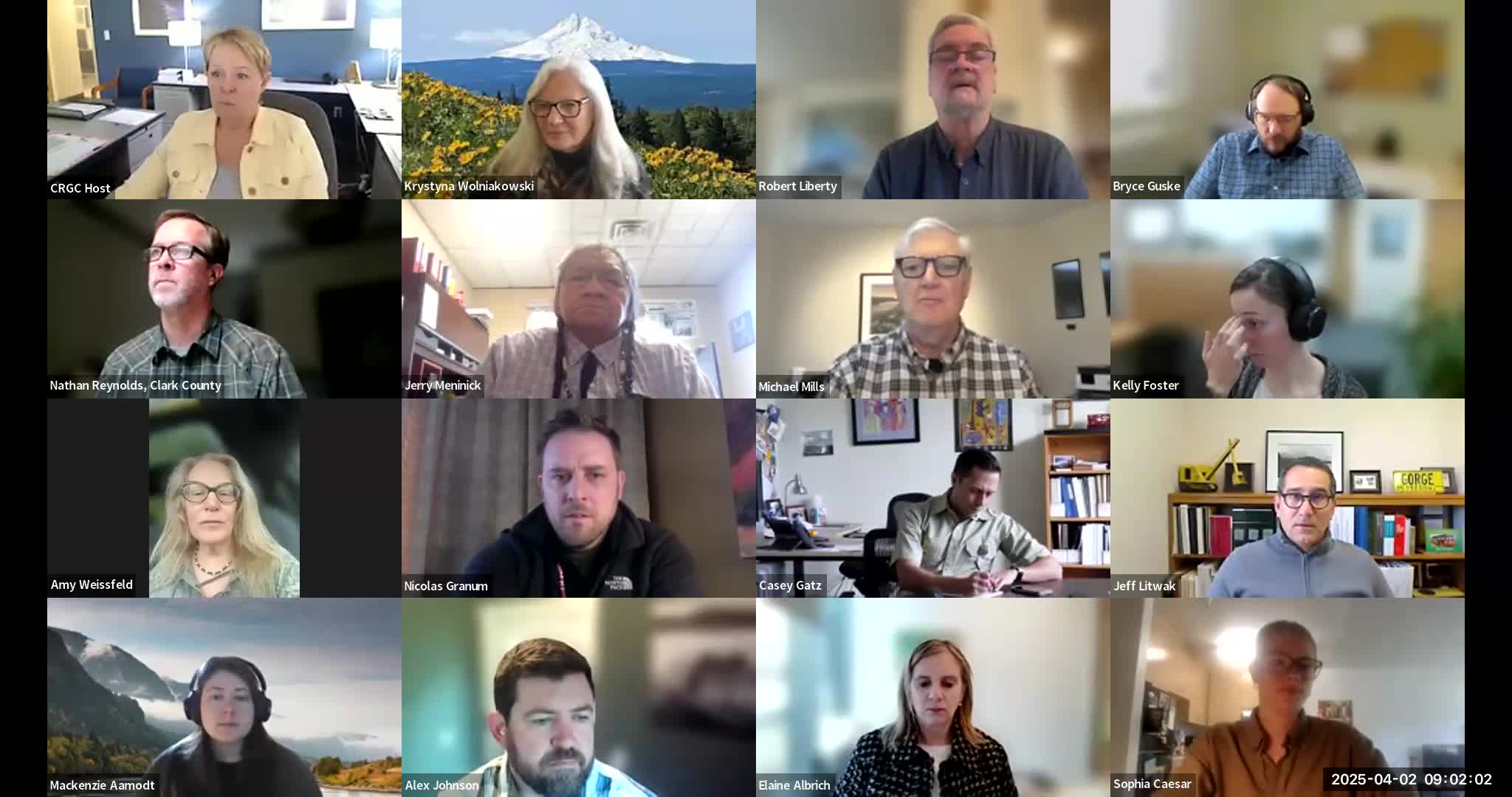
Executive Director Christina Walenkowski told commissioners on an emergency virtual meeting that an amendment adopted in the Washington House would, if sustained, remove Washington—s share of funding for the Columbia River Gorge Commission.
Executive Director Christina Walenkowski told commissioners on an emergency virtual meeting that an amendment adopted in the Washington House would, if sustained through reconciliation, remove Washington—s share of funding for the Columbia River Gorge Commission.
"There was a vote by through an amendment to defund the commission," Walenkowski said, describing the action as "very startling" and saying she and staff immediately began outreach to the Washington governor—s office and members of the House Appropriations Committee.
The commission—s budget depends on matching contributions from both Washington and Oregon; Walenkowski said the Washington portion for the agency is comparatively small but essential, roughly $2,000,000 for the two-year biennium in Washington. She said the Senate and House budget proposals had been "fairly similar" and aligned with Oregon—s draft budget at about $21,000,000 before the amendment.
Why it matters
The Columbia River Gorge Commission administers the National Scenic Area management plan on behalf of both states; commissioners said losing Washington—s share of funding would sharply reduce the commission—s ability to staff planning, coordination and certification work. Walenkowski said she planned to travel to Olympia immediately after the meeting to meet with the governor—s office and other contacts to press for restoration of funding during the conference and reconciliation process.
What commissioners discussed
Several commissioners urged rapid outreach and clearer messaging to counter what they described as public misinformation linking the commission to land-acquisition activities carried out by the U.S. Forest Service. Commissioner Amy Weisfeld said she wanted clarity on whether representatives who sponsored the amendment had been contacted; Walenkowski said she had not heard back from those two members but had been in contact with Representative Kevin Waters and planned broad outreach.
Forest Service representatives on the call said a March 11 letter from Skamania County was directed to the U.S. Forest Service and referenced a 2016 memorandum of understanding; the Forest Service suggested the letter—s wording may have caused confusion by conflating the commission—s role with Forest Service authority to acquire land. A Forest Service representative who identified themselves as Casey said the agency has continued acquisitions but described recent activity as a "trickle" compared with decades past and offered to supply a report of recent acreage and acquisitions by year.
Commissioners and county representatives said the land-acquisition issue is a live concern in Skamania County, where speakers described pressures on the local tax base and the impact on schools and services. Commissioner Brennan Bissell said Skamania County's calculations estimate $4 million to $5 million in lost tax revenue over time and cited specific acreage figures for Cape Horn; she urged clearer responses to county concerns.
Economic and contingency concerns
Several commissioners called for stronger emphasis on the commission—s role in economic stewardship in the National Scenic Area and for rapid development of a contingency plan in case funding is cut. Commissioner Albridge (Aldridge) asked staff to prepare a contingency budget showing options from limited funding to zero Washington support. Chair Tara Mills and other commissioners said they would prioritize that planning at the next regular meeting.
Public comment and partner outreach
Gil Kelly, chair of the Oregon Investment Board, told commissioners the board runs a $10,000,000 revolving loan fund that helps businesses in the Gorge and said the commission—s planning role is "irreplaceable" for coordinated management and long-term economic health. Tyler Stone, a Wasco County representative, urged the commission to improve community engagement and suggested counties may bypass the commission if they cannot get needs addressed.
Next steps
Walenkowski said she would travel to Olympia the day of the emergency meeting to meet with the governor—s office and other legislative contacts and would report back to the commission at the next regular meeting. Commissioners requested staff compile acquisition history, clarify the 2016 MOU referenced by Skamania County, and prepare contingency budget scenarios.
Ending
The commission closed the emergency session with plans to receive an update from the executive director at next week—s regular meeting and with several members urging a broader review of community engagement and messaging regardless of the immediate funding outcome.